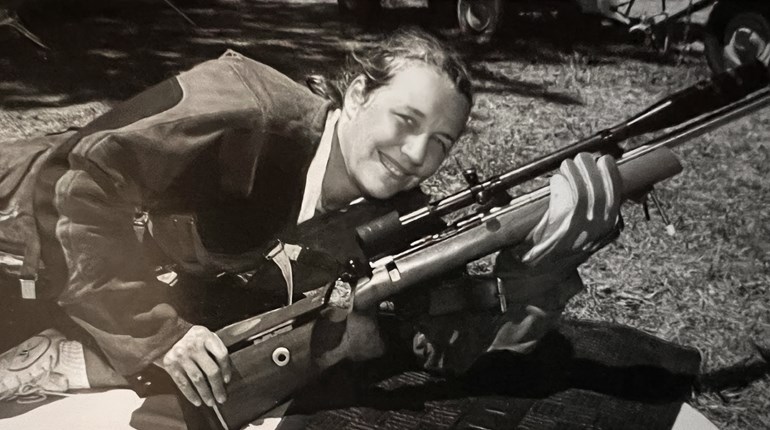
From the archives: a reader letter sent to American Rifleman magazine querying about the relationship between altitude and bullet point of impact. The answer was published in the July 1954 issue by none other than Gen. Julian Hatcher himself.
I am a transplanted Arizonan exploring a copper deposit here in southern Peru. Even though the roads are only poor to fair, it is just a matter of a few hours by car from the beach up to the region of the snow peaks of the Andes.
It occurred to me that here was a place I could collect some data on that old argument among riflemen―the effect of change of altitude on point of bullet impact.
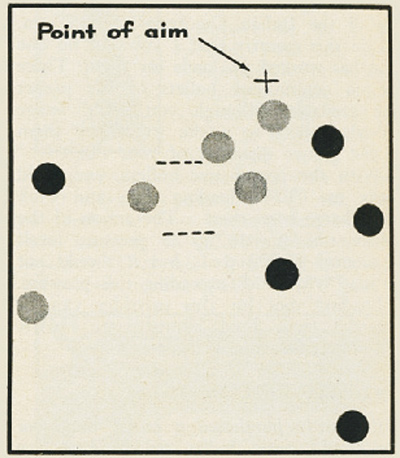
Our camp is at 11,000 feet, and in a half hour I drove the Jeep up onto a pampa at 13,750 feet, where I measured the range with a tape and shot the first group. Leaving the scope on the rifle, I rolled it up in a blanket and tarp, and headed for the beach. There I measured off the 200 yards along the edge of the salt water, and fired the second group. I made it a point to shoot both groups on the same day in order to eliminate the possibility of a stock warpage that might occur over a longer period. The heat waves were noticeable at the beach, and probably account for the wider shot spread in the second group. Both groups were fired from prone with sling and bed roll rest.
Some might contend that the test is not conclusive because of the difference in temperature, but it would seem a strange coincidence if the temperature rise in this case were just exactly enough to compensate for the extreme of altitudes.
―J. McK. Pardee,
Peru, S.A.
Answer by General Hatcher: Even though your two group overlap, the center of impact of the one shot in the mountains is .69 inch higher than that shot at sea level. While this is not much of a difference, it agrees almost exactly with calculations.
The time of flight for your ammunition over a 200-yard range at sea level should be .2214 second, and the drop, calculated by the old formula, 192 multiplied by time of flight squared, is 9.41 inches. If your ammunition could be fired in a perfect vacuum, the time of flight would be .2020 second, giving a drop of 7.84 inches. You see from these figures that the maximum added drop caused by the air at 200 yards is only 1.57 inches.
At your elevation of 13,750 feet, the air has only 59 percent of its sea level pressure, so as a quick approximation, we could say the that 1.57 inches of drop due to air resistance would be reduced to .89 inch. That is mighty close to the actual difference of .69 inch that your target shows.
The ballistic coefficient, C, is a measure of the ability of the bullet to overcome air resistance. When the air is thin, the resistance is less, and C is larger. At 13,750 feet, C is about 1.6 times the sea level figure. Using this value, and calculating the drop at 400 yards, we find that, for your .30-06 bullet at 2970 fps muzzle velocity, the remaining velocity at sea level at 400 yards would be near 2050 fps, and the drop about 45 inches, while at the elevation of 13,750 feet the remaining velocity at 400 yards would be 2350 fps, and the drop would be 40 inches. Your rifle would be shooting five inches high, or about a minute and a quarter of angle.
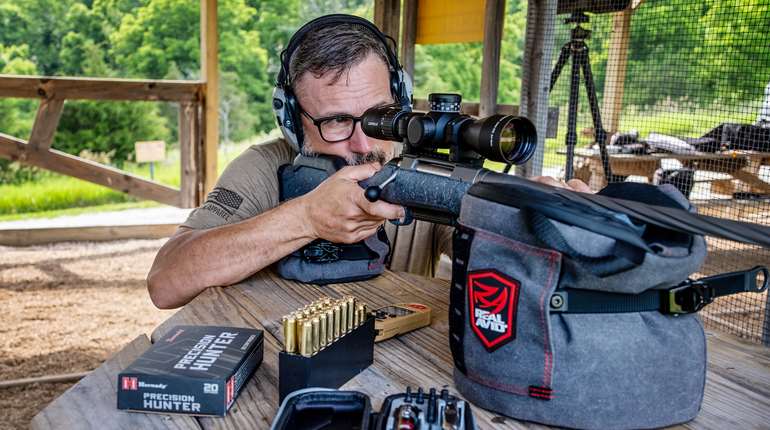
Lead photo: Josh Cluff shooting the H-S Precision HTR Precision bolt-action 6.5 Creedmoor, using the Kahles K525i riflescope. Photo by Ryan Trenka