
No crowd at Camp Perry saw the best long-range shooting of 1932. Maj. John W. “Jack” Hession fired it at Fort Bliss, Texas, during the Eighth Corps Area’s regional matches that fall, running a perfect 100 with 19 Vs in the Wimbledon match to set a record. He was 55 years old, and his first national titles were nearly a quarter-century behind him.
The setting was atypical. Congress had eliminated funding for the 1932 National Matches as Depression-era budget cuts reached the War Department, and NRA answered with a scattered program of regional championships at Army Corps Area sites that shooters nicknamed “Little Camp Perrys.” Hession’s 100 came at the Fort Bliss edition, held Sept. 26 to Oct. 2. American Rifleman that year shared the news about the 1932 Wimbledon Cup, the second time his name went on that trophy after a 1919 win.
Born in 1877 in Clinton, Ontario, Hession shot for the New York Athletic Club and built much of his reputation on a single rifle. Around 1906, he bought a Springfield Model 1903, serial number 264631, chambered in .30-’06 Sprg., and topped it with a J. Stevens Co. scope. It grouped well enough that he took it to England for the London 1908 Olympic Games, where the rifle events were fired at Bisley. He entered two of them, 300-meter free rifle in three positions and 1,000-yard free rifle, finishing outside the medals in both.
Back home, the wins came quickly. Hession took the Grand Aggregate at Camp Perry in 1908 and returned the following year to set a world record at 800 yards, a performance that landed on the front page of the Piqua Leader-Dispatch. Forest and Stream later reported a run of 67 consecutive bullseyes at that distance. He won the Marine Corps Cup in 1913. During U.S. tryouts held in France in 1918 for the Inter-Allied rifle competition, he finished 63 points ahead of the runner-up.
His precision carried over to smallbore. At the Eastern Smallbore Championships at Sea Girt, New Jersey, on July 3, 1925, Hession set four world records in a single day, firing 102 shots without one leaving the bull, sighters included.
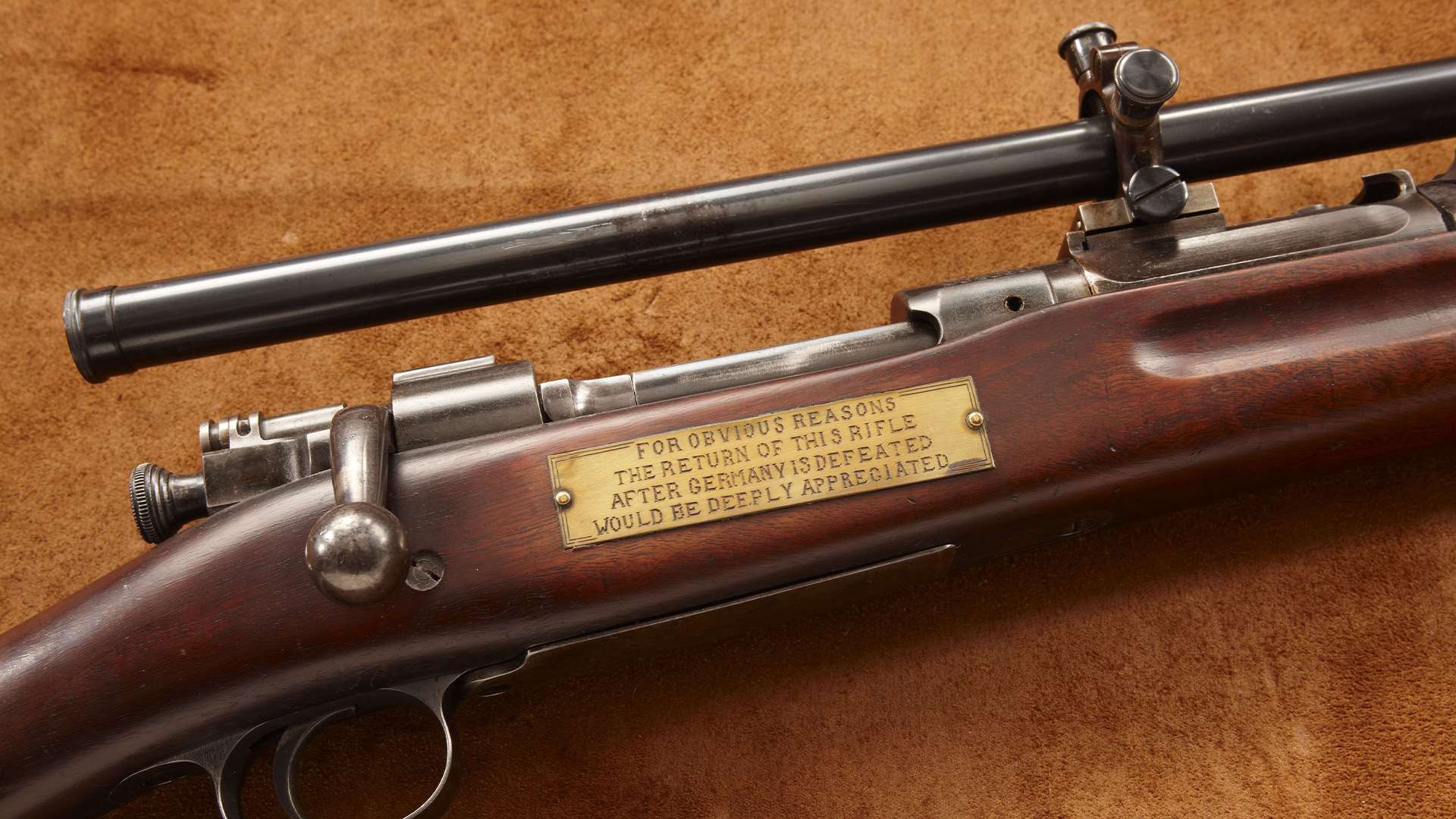
Away from the line, he made a living in the ammunition business, including work as a ballistician with the U.S. Cartridge Company. By 1940 he was with Winchester, and that year his old Springfield went to war without him. After Dunkirk left British civilians short of arms, C. Suydam Cutting organized the American Committee for Defense of British Homes to gather guns from American owners, and Hession shipped his prize rifle across the Atlantic. In all, NRA sent more than 7,000 privately owned firearms to England. Plates added to the stock listed his best-known wins. One on the fore-end told whoever received it that “the return of this rifle after Germany is defeated would be deeply appreciated.”
Britain honored the request. The rifle came home after the war and is now part of the NRA National Firearms Museum collection in Fairfax, Virginia. Hession remained a contender at long range into the 1940s and died in Clearwater, Florida, in 1962. When American Rifleman ran his obituary that April, it followed directly after the one for Col. Townsend Whelen, placing two of the era’s great riflemen side by side one last time.