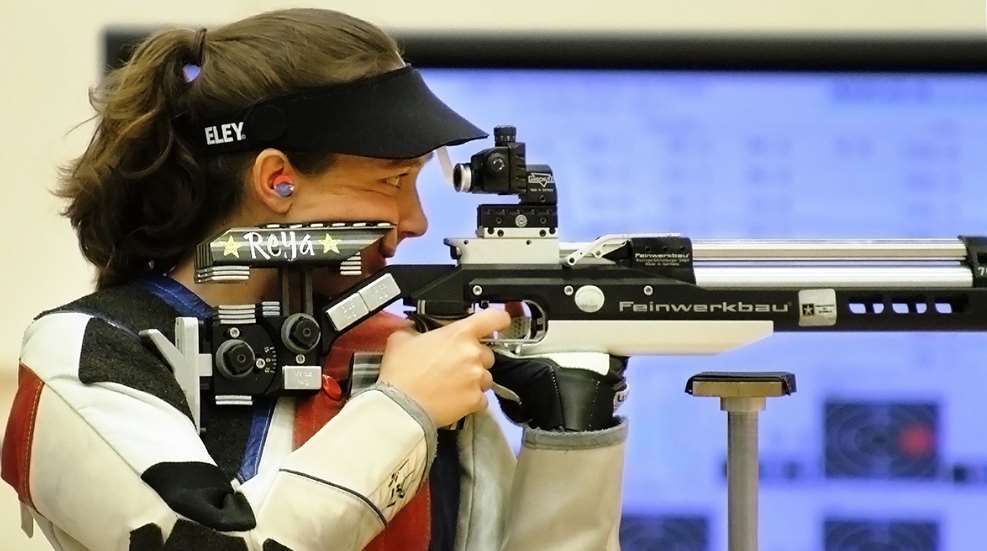
Above: The author shooting in the final of USA Shooting’s 2014 Winter Air Gun Championships. Photo courtesy USA Shooting.
We’ve probably all been there during a competition: staring through the sights and slowly squeezing the trigger—only to realize after the shot that our mind was trying to recall if we had fed the cat before leaving the house that morning (or something similarly unrelated). Usually this happens about the same time we see the shot is not quite as good as we had hoped for. So, we kick ourselves for not paying attention and recall the comedian Bob Nelson’s wise words: “The mind is a terrible thing.”
On the other hand, we’ve also experienced those shots where the mind is completely clear and focused, the shot goes off perfectly before we have a chance to even think about it, and there appears a nice shot right in the middle of the target. It almost feels easy.
What is the difference between these two shots? And most importantly, what can be done to get more of the second type?
The answer is complicated and varies for each person, but I’d like to share one technique that has helped me. I’ve been shooting competitively since I was eight years old, and I will confess that it was only in the past two years during my time at the Olympic Training Center that something finally clicked as I learned about mindfulness. It’s a simple technique, summed up in the title of this article. To perform at your best, you must pay attention to the task at hand—to be aware in the present moment.
The human mind loves to wander. Our mindfulness instructor often referred to it as a “monkey mind, swinging from branch to branch.” I think it’s important to realize it may be nearly impossible to stop your mind from wandering. Random or disconcerting thoughts will pop up at the most inopportune time during your shooting.
What if I shoot a bad shot? How embarrassing if Coach sees! I’ve spent so much money and time on this, I can’t mess up! I hope I beat Jane over there! What if I win?
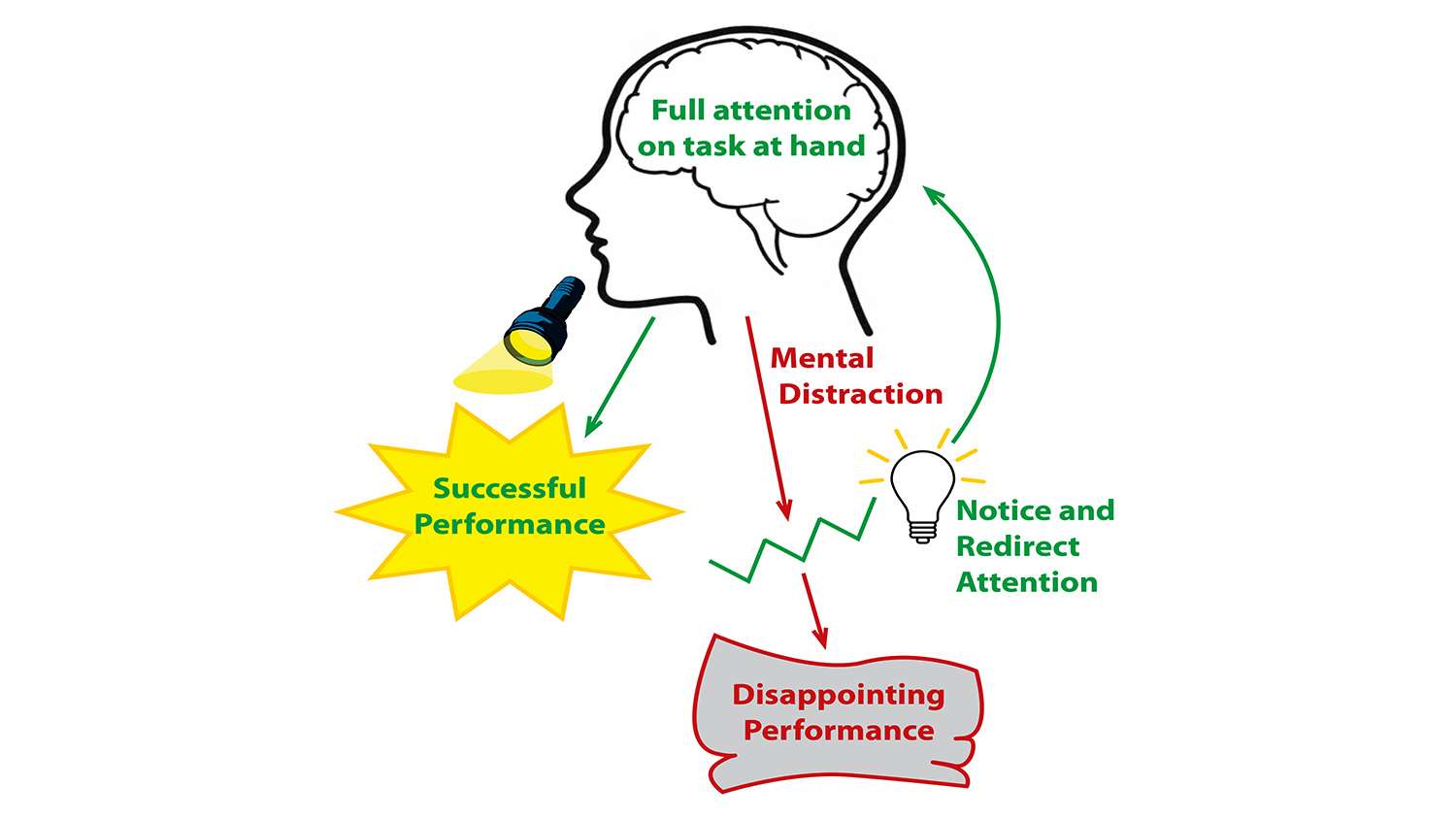
Hoping you can eliminate such thoughts from ever occurring is a losing proposition. The key is to notice them. You must notice when your thoughts wander away from what you should be focused on, then bring your attention back to the moment and task at hand. Ideally, do this step before pulling the trigger!
How do we improve our ability to be mindful of what we are doing? Just like any skill, it requires practice. One method is similar to meditation. Sit in a quiet area and try to keep your attention on one thing for 10, 20, 30 minutes, or more. You may close your eyes and focus on the sensation of the air moving past the tip of your nose as you breathe, for instance. Every time you notice your mind has wandered, bring it back. Additionally, try slowly walking barefoot and keeping your mind on the feeling of the soles of your feet making contact with the floor at every moment. You can even practice while you eat or shower. The key is to make a continual effort to maintain mental attention to the moment, notice when it wanders off, and bring it back. After some time, you may see improvement in the duration of time you can stay focused and your ability to more quickly notice when your mind has wandered.
When you shoot is the time to bring this skill to its practical use. During one class, the then team psychologist made a great analogy. He likened the mind’s attention to a flashlight in a dark room. During your shot process, imagine your attention is the flashlight’s beam of light as it goes from one task to another, each done properly before continuing to the next. For example, the rifle is placed in your shoulder, your support hand in its proper place, cheek placement and pressure correctly done … each step, one by one, all the way to when your mind’s attention “flashlight” is focused intensely on the image of the sights, allowing for subconscious trigger release. Keep the flashlight on at all times during your competition, focusing solely on the present moment. You’ll find that not only will random thoughts about feeding the cat be kept at the wayside, but thoughts more harmful to your performance will too—worries about outcome, confidence, fellow competitors, etc. They will never completely go away, trying to pop up at the worst times, but with your improved skills, you can quickly notice and redirect your attention to where it should be: the task in this moment.
After several months of practicing mindfulness and long days at the range, I had a breakthrough performance at a big air rifle competition. Nerves and fears of outcome have haunted my performance for as long as I can remember shooting. In this match, the nerves were still there, but somehow they felt under control. My heart was pounding, but not as hard. I fought the entire time to stay mindful, focused, and push aside the mental distractions. I was aware of the sensation of the pellet against my thumb, visualized that flashlight beam as my focus went from shoulder to hand to hip and elbow to muscles relaxing—each of many checkpoints in my shot process, culminating in a laser beam at the sight picture. The shot happened without flinching, subconsciously, and I restarted the process. Even when a positive thought such as, “I’m doing great!” came up, I redirected my attention, telling myself, “All that matters is this moment.” After the last shot, a wave of relief and accomplishment came over me when I knew I just had a great performance. I only wish I’d known about mindfulness years ago!
The practice of mindfulness in sport is a growing field and multiple resources exist online. I encourage you to start your own practice and apply it to your shooting.
“You can’t stop the waves, but you can learn to surf.”—Jon Kabat-Zinn
Most Popular