WARNING: All technical data in this publication, especially for handloading, reflect the limited experience of individuals using specific tools, products, equipment and components under specific conditions and circumstances not necessarily reported in the article and over which the National Rifle Association (NRA) has no control. The data has not otherwise been tested or verified by the NRA. The NRA, its agents, officers and employees accept no responsibility for the results obtained by persons using such data and disclaim all liability for any consequential injuries or damages.
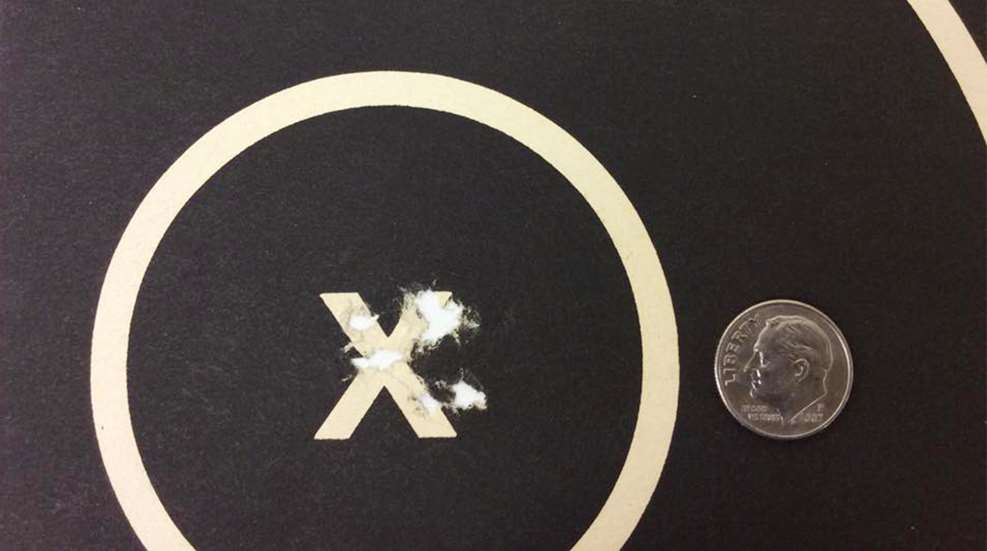
Above photo: 0.67", 10-shot, 300-yard test group of the AMU's standard 75 gr., 600-yard ammo from a test fixture. Obviously, not all groups look like this—the next 10-round group measured 0.96" at 300 yards. Virgin, factory-primed brass and un-selected bullets.
Today, we’ll switch gears somewhat, from mechanics to the philosophy guiding one’s loading goals and approach. This column is not intended to make firm recommendations, as everyone’s skill levels, rifles and accuracy needs differ.
Rather, we’d like to offer thoughts to help shooters systematically evaluate their goals and skills first, and then tailor their techniques towards accomplishing those goals.
One perk of life at the U.S. Army Marksmanship Unit (AMU) is that one gets to meet shooters at varying ability levels—from extremely well, to National and International champions. With these varying levels of progression come different needs, perceptions, priorities and focus.
Presented here are some general themes which may be thought-provoking and—hopefully—helpful to our readers in attaining their shooting goals, even as their goals evolve.
So, what do you, the reader, primarily value in your handloads? Some prize consistent, excellent medium/long-range accuracy enough that they’re willing to give up some extra velocity (and reduced wind deflection) to obtain that. Their underlying philosophy could be stated: “Superior accuracy is present for every shot, but the wind isn’t.” One’s ability to hold well, aim well and read the wind are all factors in making this type decision.
Another approach: some shooters value obtaining the highest safe velocity, even if one’s pure, consistent mechanical accuracy at medium/long-range isn’t quite as brilliant. The theory here seems to be that a really good hold extracts as much mechanical accuracy from the rifle/ammo as possible, and faster bullets equal occasional “bonus” points snatched from the jaws of wind. Consider how a shooter’s skill level could play into which camp they currently fall into.
E.g., a memorable conversation with one of the AMU’s many Service Rifle National Champions revealed his philosophy. It can be stated thus: a super-accurate, but [relatively] “slow” load “required him to have a Ph.D. in wind reading for every shot, while a faster, but less accurate load netted him more points.”
Note—this was not mere speculation; his score book data backed up his claims, due to less wind effects. Remember, however, this fellow has a consistent, National Championship-level hold, and other Champions on the same team would have opted different.
Still another approach is to place heavy emphasis on fine accuracy with absolute stability in changing temperatures. When this writer was actively earning his Distinguished Rifleman badge that was his goal. The reason? Sighting shots are not allowed in EIC (“Leg”) matches. The first shot out of the barrel was for score. It had to be 100 percent consistent, with very reliable, predictable elevation and wind deflection regardless of the ambient temperature—even if it wasn’t the lowest wind deflection possible.
Naturally, selecting a powder that is insensitive to temperature changes is a key element here. Elevation zeros and wind effects had to be consistent every time. Hunters and military snipers might be among those who fall into this camp, as well as those in pursuit of their Distinguished Rifleman badges.
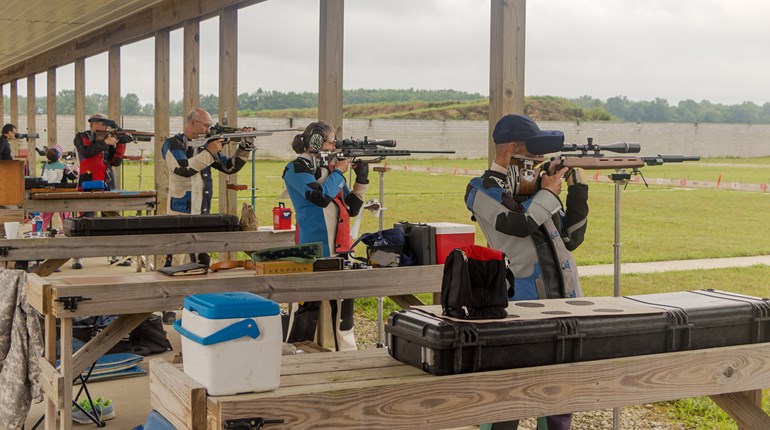
Contrast that with a traditional high power shooter who gets two sighter shots before each event (offhand, sitting rapid, prone rapid, prone slow fire.) If there is a zero change on any given day, he/she can correct during sighters. This writer well remembers talking with another very high-level Service Rifle competitor who was happy to have high temperatures boost the velocities of his ammunition above their usual level.
Note: his ammo still performed safely and well in hot weather—these factors are all evaluated here at the AMU’s Handloading Shop before a load is fielded. Safety and reliability are of utmost importance.) As far as this SR competitor was concerned, 60-80 FPS more velocity—even if only due to high ambient temperatures—meant less wind deflection, and he was mighty happy to have it. As they say, he was such a good shooter that temperature related velocity increases weren’t a “bug,” they were a “feature!”
This article has been confined to NRA high power rifle competition, which has relatively generous 10-ring dimensions in relation to the accuracy of well-built competition rifles. Hopefully, it will provide food for thought. For some, this might be an opportunity to ensure that one’s load development approach helps them attain their desired results.
Our next article will build upon information given here. However, we’ll focus within the context of International-style rifle competition, which features more demanding 10-rings. This makes decisions re: wind effects and accuracy more critical—except perhaps, for the rarified few high power shooters who are in contention to win the Nationals year after year.
For the International shooter, the paradigms might be a bit different—but they are nonetheless relevant to high power rifle competitors.
We hope this article has been helpful and, as always, stay safe and good shooting!
Thanks to the U.S. Army Marksmanship Unit for allowing the reprint of their handloading series.
Most Popular