WARNING: All technical data in this publication, especially for handloading, reflect the limited experience of individuals using specific tools, products, equipment and components under specific conditions and circumstances not necessarily reported in the article and over which the National Rifle Association (NRA) has no control. The data has not otherwise been tested or verified by the NRA. The NRA, its agents, officers and employees accept no responsibility for the results obtained by persons using such data and disclaim all liability for any consequential injuries or damages.
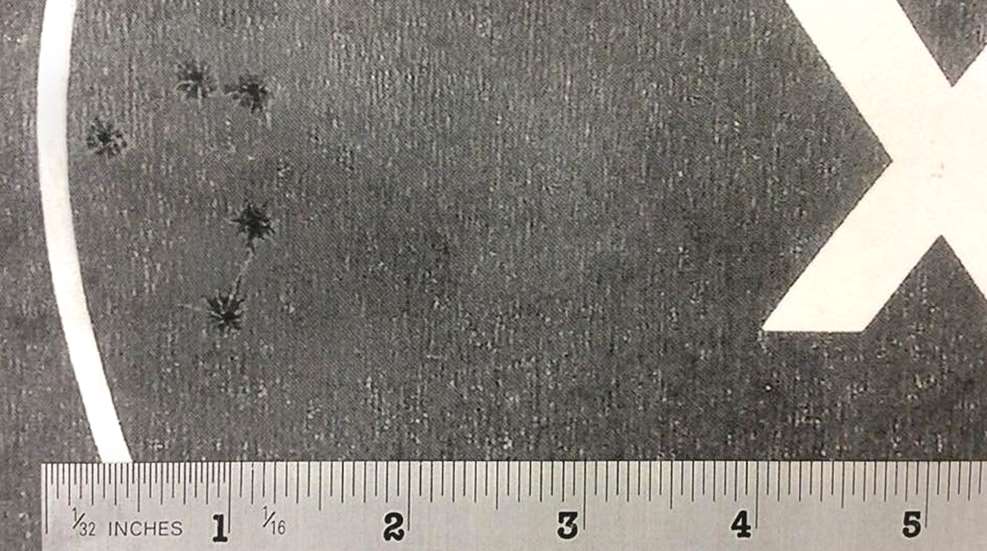
Above: A 1.319”, 5-shot group fired from one of our 7mm R-SAUM long-range prone rifles in machine rest testing at 1000 yards. The sorting techniques mentioned here were used.
In our previous article, we provided an introduction to the process of sorting match bullets to improve accuracy. In this article, we suggest methods for grouping your sorted bullets by dimensional increments.
When setting up your bullet sorting operation, your method will be determined in large part by the purpose for which you intend to use the bullets. For example, if you are preparing for an extremely important long-range match, you may choose to do a double-sort (first by OAL, and then by base to ogive, using a bullet comparator. This will be covered in detail in Part 3.) However, this is very time-intensive and requires a relatively large basic lot to winnow down to a usable quantity of super-sorted bullets.
For most important long-range (LR) uses, a single sort of good match bullets by OAL is likely to be sufficient. Using the sample/histogram as shown in our previous article, you will see that based on your particular lot of bullets, they will fall into certain groups by 0.001" increments. Here at the AMU, on the rare occasions that we sort bullets, we are fielding ammunition for a number of shooters in any given event; thus, our need for sorted bullets is for relatively large groups.
Therefore, we may often combine groups of 0.001" into lots of 0.003" variation. Thus, say, .005", 0.006" and 0.007" sorts will be combined into 1 lot. Then, the next bullet lot might be sorts 0.002", 0.003" and .004". The histogram will tell you the most plentiful increments to expect when sorting, and what your logical combinations will be to get the largest 0.003" ranges of bullet OAL's.
However, for individuals, loading for a single rifle, the sorts can be much tighter. Depending on the size of the initial bullet lot, you may have many batches of bullets, all grouped into 0.001" increments, that you can use to load individual ammo lots with. Keeping track of the original sort length (say, 0.005") used in the match ammo lots allows using ammo lots with adjacent 0.001" sorts for ultimate consistency. I.E., after you shoot up the lot with all 0.004"-length bullets, the next logical lot to use would be either 0.005"-length bullets or 0.003"-length bullets, for minimum variation between lots.
Another, less time-intensive approach is to look at your histogram and evaluate the "peak" and adjacent 0.001" sorts. See how many naturally fall into a 0.003", 004", or even 0.005" spread of adjacent 0.001" increments. If you find that, say, 60 percent of your bullets fall into the desired range of OAL's, you might decide to just use that center 60 percent for important matches.
The remaining bullets—the left and right "tails" of the bell curve—are fine for practice and other less-important uses. Keeping all the "left tail" bullets together as a batch, and "right tail" bullets together as another batch will reduce inconsistency vs. combining them all together. Naturally, that would result in a wide spread of OAL's with a gap in the middle where your match bullets were removed.
Tip: This is a small, common-sense tip learned the hard way by this writer many years ago that might save you some trouble someday. While driving to a rural range about an hour from his house to test assorted long-range recipes for accuracy, he had his test ammo meticulously arranged by type in loading blocks (not sealed ammo boxes, hint hint), sitting neatly arranged on the passenger seat of his car.
Making good time on a rural road near the range, he rounded a curve and noticed a mobile home on the right, with a cat sitting by the side of the road. He continued on, as the cat showed no intention of wanting to cross the road. At the last second, the cat dashed into the road, and our hero slammed on the brakes, narrowly missing the feline dare-devil. However, all his meticulously prepared test ammo slid off the seat and onto the floor, where they were all jumbled together out of order.
A lot of bench-work was wasted that day, and ever since, this writer has marked his test-recipe ammo with a Sharpie marker in case of another such "cat-astrophe". (Sorry... just couldn't resist!) After policing up the remains of a lot of meticulous work, the writer Almost wished he'd just hit the accelerator instead of the brake ... almost!
Over the years, the system has evolved to using one, two or three stripes on the sides of the projectiles to denote particular powder charges or OAL increments. By marking the projectiles rather than the cases, when the rounds are fired, the ink is gone, and cleaning cases by tumbling is significantly easier than it would be if there were ink remaining on the cases. If there are several test batches, different colors of ink are used as needed. It doesn't take long to run the marker along a row of bullets in a loading tray to make a small stripe on each, and the peace of mind is reassuring.
In Part 3 we will further discuss grouping sorted bullets for use at different levels of precision.
SSUSA thanks the U.S. Army Marksmanship Unit for allowing the reprint of this article.