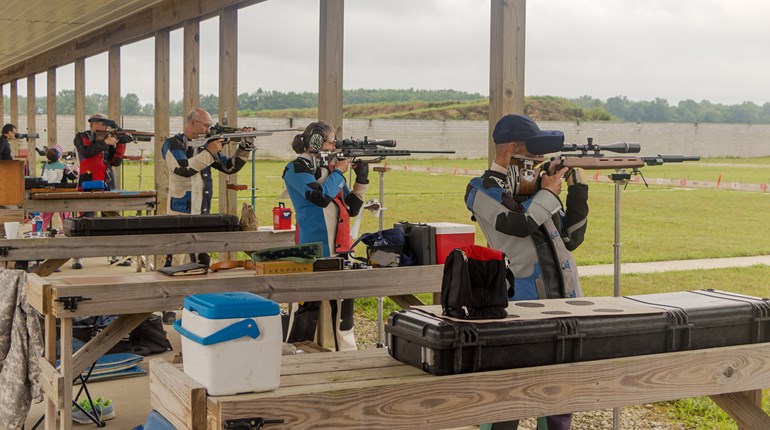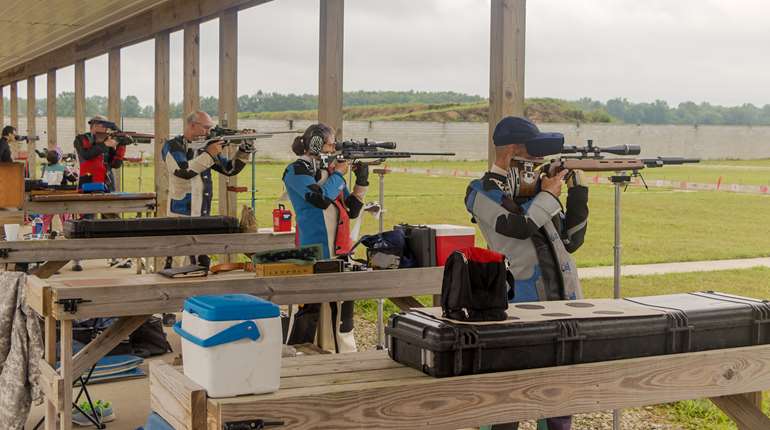
"Camp Perry is more than a rifle and pistol tournament, it is a shooters' convention and an established American institution. The announcement of the (National Match) dates annually acts as a hypodermic to the shooting game."
—American Rifleman, April, 1938
"The bulletin shows plainly how police and civilians, National Guard and Regulars, now meet each other on an 'even-Stephen' basis in Service Pistol competition."
—American Rifleman, October, 1938
The excitement and momentum that had embodied the revitalized National Matches over the last three years almost came to an abrupt halt when the 1938 War Department Appropriation Bill was presented to Congress. In the bill, the Budget Bureau had reduced National Board funding by $153,000, but the reviewing committee, led by Congressman J. Buell Snyder of Pennsylvania, reinstated the appropriation to its original level of $500,000.
Once funding was secured, preparations for what would become the last peacetime matches before World War II were underway. And before the first shot was fired, match officials, led by Executive Officer Col. F.C. Endicott, were praised for offering qualified shooters a class of advanced .30 caliber instruction during the Small Arms Firing School. From the looks of the results bulletin, the school had an immediate impact as civilian teams from California, Washington state, Massachusetts and Kansas placed among the top 15 finishers that comprised Class A of the National Team Rifle Match. Specifically, California's Soldier of Marathon victory and fourth place finish overall tied its 1935 accomplishment for highest finish ever by civilians in the highly competitive and prestigious contest that this year featured 125 teams.
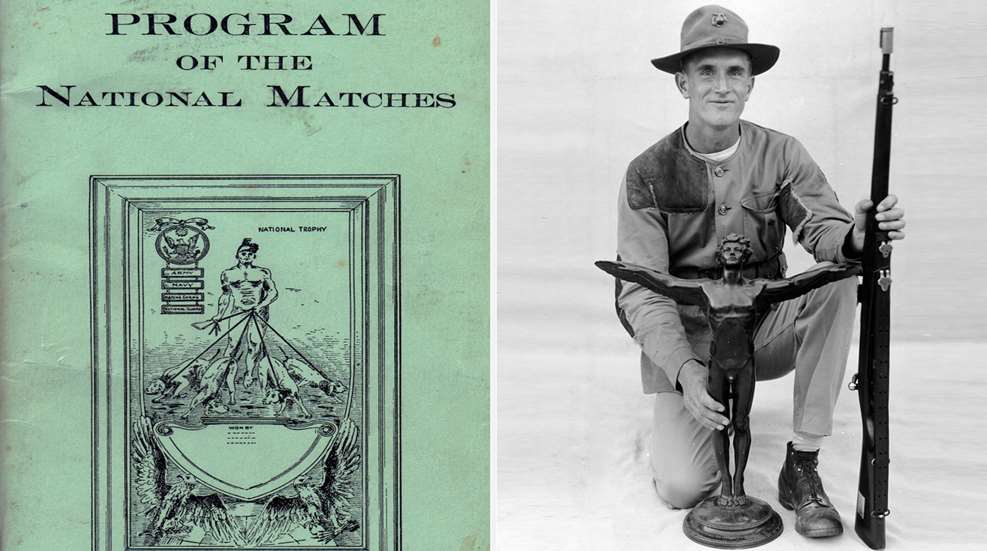
The Infantry ended the Marines' bid to be exclusive holder of the national trophy this decade in a true down-to-the-wire contest while their comrades in the National Team Pistol Match also played the role of spoiler in its victory over the Los Angeles Police Department, which had won the event in 1936 and 1937 and this year comprised primarily new members due to a change in eligibility rules. The California National Guard won the Infantry Match and in the individual Board matches, Marine Corp. M.J. Holland won national rifle honors while LAPD Officer C.E. Ward earned the national pistol title. (Holland is pictured with the Wright Memorial trophy at the top of this article.)
On the NRA side, Infantry Corp. Wadie Giacobe won the Leech Cup while two Marines, Sgts. Valentine Kravitz (1936 President's Match winner) and Edward Seeser (1937 Leech Cup winner) added to their prestigious trophy résumés when they won the Wimbledon and President's Matches, respectively. For Seeser, victory included the honor of reviewing a parade of the President's Hundred, a ceremony that changed from the prior practice where the winner stepped out of the parade formation upon reaching the reviewing stand to receive his reward.
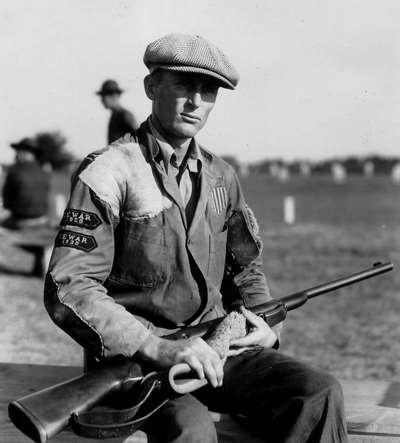
Outside of the big bore arena, legendary shooters Bill Woodring, Harry Reeves and Al Hemming had memorable performances that contributed to this year's labeling of the National Matches as the "best ever held." Reeves and Hemming were especially dominant and spearheaded a strong police presence in pistol as members of the Detroit team while Woodring proved to be a master of consistency, and the recipient of good sportsmanship, when he claimed his third straight national smallbore championship title. His victory came only after a self-protest was filed by 1930 champion Vere Hamer, who was named this year's winner by virtue of Xs in the preliminary results. Hamer explained that what was ruled a double shot on his target was in fact a single shot since he ran out of time before firing his last round. His admission resulted in a 10-point drop and gave Woodring the win outright.
Perhaps the splendid weather, a good rifle and ammunition combination, or the momentum from the two previous years helped Woodring. Certainly Hamer's strong sense of right and wrong was admirable, as expressed by C.B. Lister in his coverage of this year's matches in American Rifleman where he wrote of Camp Perry's code of ethics: "Take only what you have fairly won." In the end, Woodring became the first to earn the smallbore national title three consecutive years.
The growth and competitiveness of the smallbore game as a whole was evident in the number of possibles and ties. Consequently, issues were addressed to further develop and enhance a sport that had been so warmly embraced.
Unique to this year's program was the first radio broadcast of a National Match event from the firing line. And the grounds of Camp Perry also sported a new administration building in addition to an auditorium that ended the era of the outdoor theater.
Most Popular