Although Lt. Col. (later Major General) Julian Hatcher had shown a prototype of the new Springfield Armory cal. .22 rifle at the 1919 National Matches at Caldwell, NJ, it was not until 1922 that the rifle made its commercial appearance.
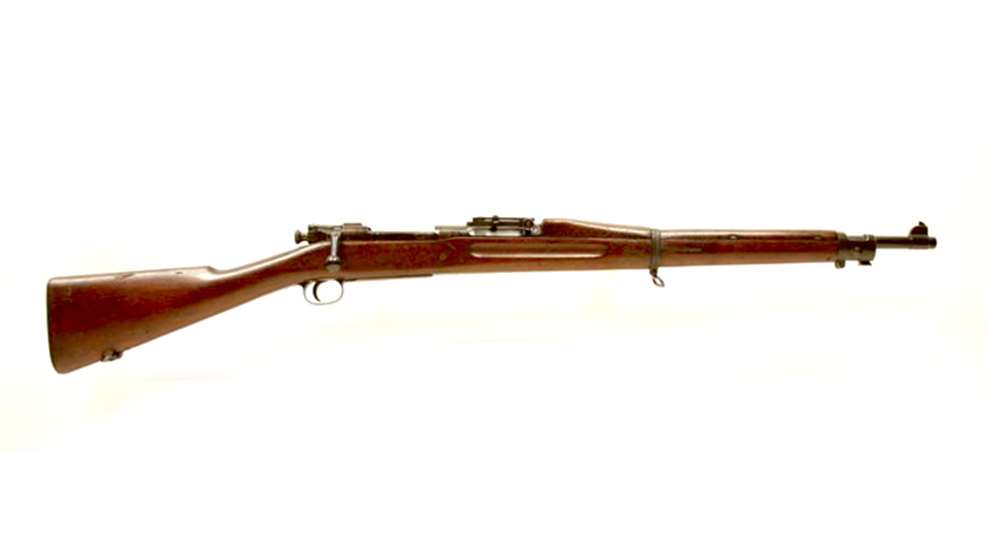
Designed by Springfield employees Fred Coon and Al Woodworth, the rifle was styled the "Gallery Practice Rifle, cal. .22, Model of 1922;" its market was to be the military and civilians under the DCM program. Two versions, civilian and military, were to be produced although none of the military variants were ever assembled. All 2,020 of the rifles went to non-service users and all were fitted with the "NRA" stock: well shaped for prone shooting (by contemporary standards) with the finger-grooved fore-ends of the then-current straight gripped Style S stock on the Model 1903 Springfield. They bore headless cocking pieces similar to those later used on the .30 cal. National Match rifles. The Model 1922 had a Lyman 48 rear sight and a service front blade, often replaced by a Lyman 17A. The "shotgun-type" buttplates were steel and deeply checkered with a shoulder fitting curve.
Model 1922 rifles were made only in 1922, 1923 and 1924. Twelve were used to build match rifles for the 1924 Olympic Shooting Team. (These rifles were assembled from scratch in 15 days by Springfield Armory and the USMC Small Arms Arsenal and Armory in Philadelphia, PA.)
In 1925, the original design was superseded by a major change in the bolt mechanism and the magazine. The new rifle was designated the Model 1922M1. Two stock styles were manufactured, one for service use (and this time the planners got their way and service-use rifles were made until service requirements were fulfilled, then civilian-style rifles began to be assembled) and one for civilian use. The civilian version differed from the earlier 1922 model in that the stock had no finger grooves and used the same buttplate as did the National Match rifles. The barrel was heavier, too, being larger in diameter than earlier barrels, though the length stayed the same at 24 inches. Interior dimensions were increased .0005" (min. bore .2180", min. groove .2230") across the board, purportedly to complement the improving .22 rimfire ammunition.
Civilian Model 1922M1s were made available beginning in about December 1926 and were routinely drilled and tapped for telescope sight blocks as part of the manufacturing process. Nonetheless, old timers maintained—to a man—that the .22 Springfield never would quite shoot as well as a Winchester Model 52.
M1922M1 rifles were standard until the mid-1930s when Ordnance Officer Capt. George A. Woody (later Colonel), working at Springfield Armory, revamped the M1922M1 design to maximize commonality of major parts and assemblies between M1903 rifles and the trainers. Woody's revised design was type classified as the Gallery Rifle, Cal. .22, M2 and was produced in both service and civilian sales versions from 1933 until production ceased in 1942. Total production of .22 Springfields included 2,020 Models of 1922, 13,708 M1922M1s and 11,355 M2s.
In the "for what it's worth" department, as new models of the .22 trainer were introduced, rifles returned to Ordnance facilities for repair or refit were updated to include the latest changes in parts and assemblies. The purpose was to bring rifles into conformance with the latest configuration and to minimize needed parts stocks (which it did), not to create collectors' arms (which it also did). When modified, a rifle's receiver markings were overstamped to show the upgrade and, because serial numbers of all post-World War I types of .22 caliber trainers began at No. 1, the serial number of the upgraded rifle was given a letter suffix—"A" for an upgrade to M1922M1, "B" for an upgrade to M2 configuration. Ordnance types were thorough.
Today, an unmodified M1922M1 is less than common, and unmodified Models of 1922 are downright rare.
The thousands of mid-level training rifles—Winchester Model 75s, Remington Model 513s, Mossberg Model 144s and Stevens Model 416s, to name a few—left no niche for the .22 Springfields to re-occupy following World War II. That fact, plus changing philosophy where military marksmanship training was concerned, spelled the end of the breed.
See more: Looking Back At Camp Perry's Mess Hall
Most Popular