The below is an excerpt from the 1978 book, Olympic Shooting, written by Col. Jim Crossman and published by the NRA.
1936—Berlin: Amateurs Once Again
By Colonel Jim Crossman
The 1932 Olympic ruling—that only those shooters were amateurs who had never competed in a match in which that dirty stuff, money, had been offered as a prize—was not much of a solution to the problem of amateurism that led in part to shooting being eliminated from the 1928 Olympics. As experienced American shooters soon discovered, many foreign teams took the 1932 ruling very lightly. In fact, they did not pay any attention to it: out people spotted many familiar faces they had seen in money-matches overseas.
For several years the National Rifle Association, the United States Revolver Association, the International Shooting Union and other shooting organizations pleaded and argued with the International Olympic Committee to change the amateur rule to something appropriate for the shooting sport as practiced worldwide. While the rule itself was bad enough, the worst feature was the way it was handled. By suddenly announcing and enforcing the rule, in effect it eliminated almost all of the old shooters. People who had, in all innocence, shot in matches in which money was offered as a prize, where suddenly told that what they had done some years ago was now bad, even though at the time it was not bad.
It was with considerable joy, then, that the shooters got the word that the Olympic Committee had relented and that as of Aug. 1, 1934, everyone was an amateur again, pure and clean and without blame. This put a different complexion on things—the shooter who had Olympic medals in his eyes could now keep his amateur status simply by not shooting for money awards.
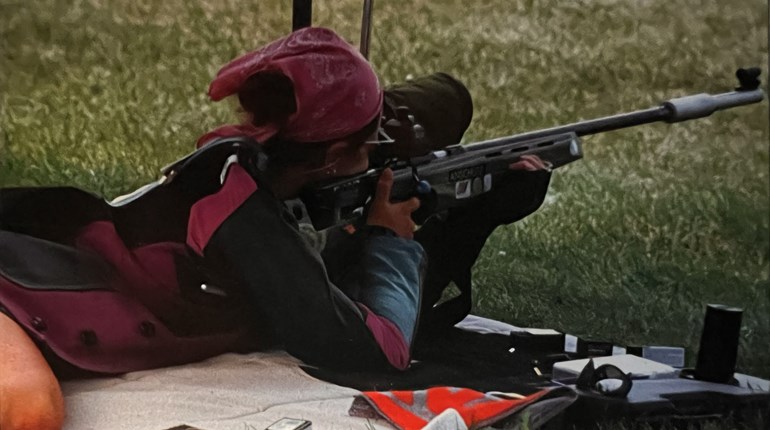
Then the program for the 1936 Games was announced, and the rifle shooters were once again without joy. There were no rifle or pistol team matches, and the pistol shooters had twice as many matches as the riflemen—two to one. The one rifle match was a repeat of the 1932 match, 30 shots prone at 50 meters with the .22 rifle. No hoped-for military rifle matches, no free rifle matches—nothing but 30 shots prone. After much argument and discussion among the riflemen of the United States, it was finally decided that this program was completely inadequate and that this country, therefore, would not enter a rifle team.
The pistol shooters were in better position, since their number of matches had doubled, from the single one of 1932 clear up to two in 1936. One of the matches was in the old fire of defense event, in which the competitor shot at six silhouettes in a limited time, the same idea as in 1924 and 1932.
A UIT rule change from the match of 1932 now required that the butt of the pistol touch the shooter's thigh before the targets appeared. This was a little lower than the position which had been required before, in which the shooter's arm was pointed at a 45-degree angle downward. The match, as before, was three strings of six shots in eight seconds, with the inevitable ties being down to two seconds. The title of the match was changed to Rapid-Fire Championship.
The Slow-Fire Championship was the old free pistol match fired at 50 meters on the international target. Eighteen sighting shots and six series of 10 record shots were to be fired in a two-hour time. There were virtually no restrictions on the pistol.
But then arose the question as to whether or not to send a pistol team. No, not on a technical question, since the pistol program, although not really good, was far better than the rifle schedule. The question arose on political matters. Nor were the pistol shooters alone in their predicament. All over the United States, people were engaging in heated debates over whether or not to send an Olympic team to Adolf Hitler's Germany.
The United States Revolver Association and the U.S. Olympic Committee finally decided that the name of the game was sport, not politics, and that a team should go. The handgunners' feeling for this was not entirely theoretical, since the USRA President, Dr. I.R. Calkins, had shot on the 1908 Olympic-winning U.S. team, had won the World Championship in 1923, and had shot on the 1924 U.S. international-Olympic team, while vice presidents Karl Frederick and Raymond Bracken had been medal winners on the 1920 Olympic team. Nevertheless, all this discussion and argument made it very difficult to collect the money necessary to send the teams over and some of the athletes had to advance the money necessary to pay their way over.
Read Part 2 of our look back at the Berlin 1936 Olympics. And be sure to subscribe to the free Insider newsletter for the latest updates.
Photo: The Berlin 1936 Olympic logo by Johannes Boehland includes the Olympic bell and German eagle, the Olympic rings and the inscription: "I call the youth of the world!"
Read more: Antwerp 1920 Olympics: Everything But The Kitchen Sink
Most Popular