
“Mind the 180 … Where is the 180 … That’s really close to the 180 … Where is the 180 …?” If one didn’t know any better, they could get the idea that the 180 is about as elusive as Charlie Mike. (Who is Charlie Mike? I can never find him, despite everyone constantly saying his name.)
I’ve always taken issue with the term “180” despite its common usage. It often works in the pistol world because for the most part, USPSA pistol matches exist in a square box, or at least a rectangular one. If I were to offer you a red pill/blue pill opportunity, what if there would still be times where a straight edge would not, could not, or—dare I say—should not govern the muzzle-safe points of a stage?
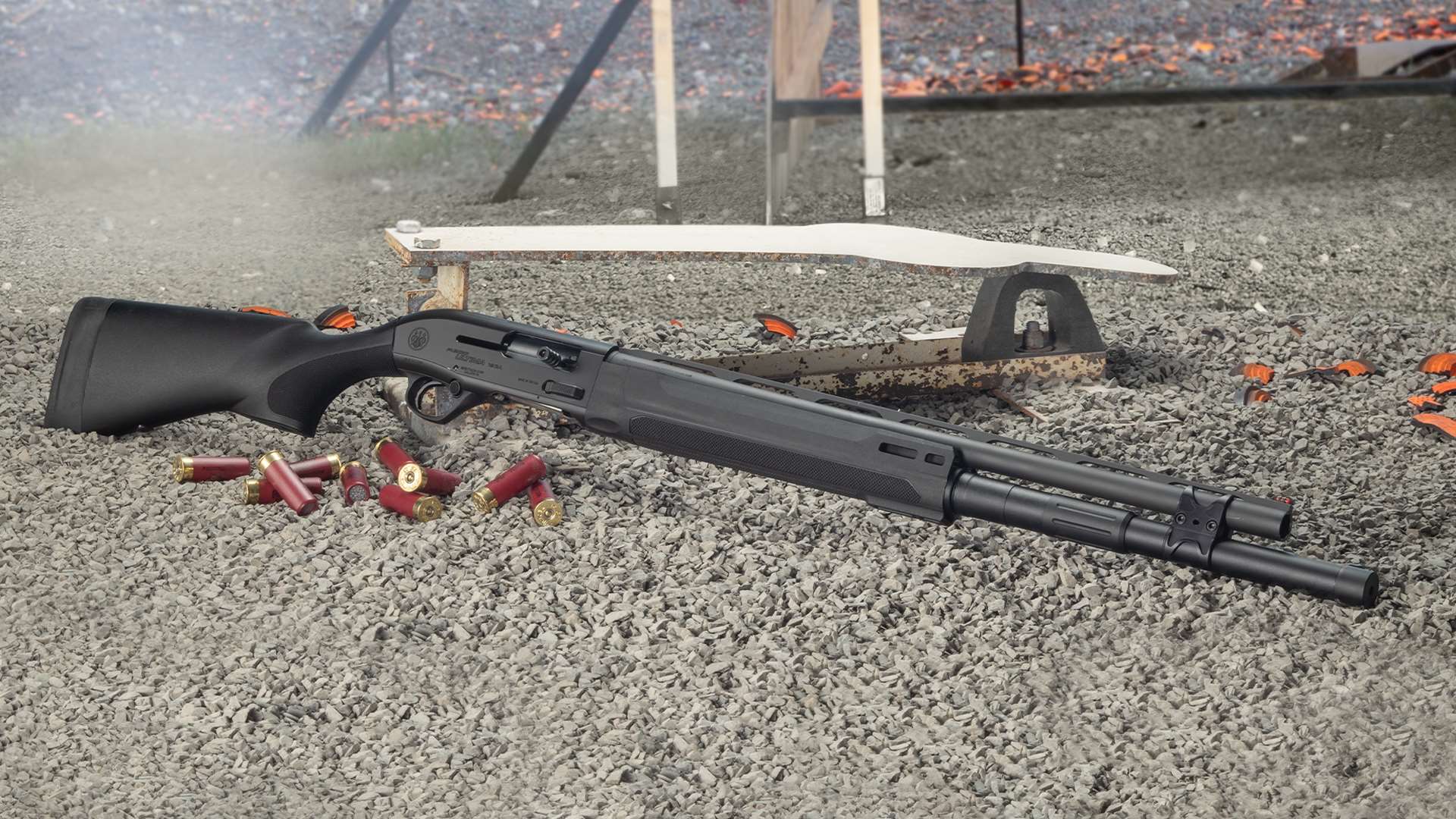
I invite you outside the box to the world of multigun. For decades, multigun matches have had what we call terrain stages: stages that exist with safe backstops outside the confines of a single square bay. They come in various forms—gully or jungle runs, shoot houses or bay-to-bay progressions—in places a Caterpillar has never touched, where our “downrange” meanders, progresses or even flips directions. Believe it or not, there are objective and safe ways to facilitate such things.
From a Match Director (MD) or Range Officer (RO) standpoint, when laying out such stages, at some point someone will appear with a puzzled look on their face and their arms outstretched like a scarecrow, and they utter that phrase we knew was coming: “But what of the 180?”
I don’t so much take issue with a squared away 180; it is his drunk cousin, “floating 180,” that should be avoided. A floating 180 inserts subjectivity into a Range Officer’s officiation of a match, and a Match Director/Range Officer’s subjectivity must be avoided at all costs. Many of the scarecrow-armed folks are simply confused by the term 180 itself, as if a defined 180-degree reference is mandatory to govern safe muzzle direction. However, muzzle safe points are really what we are governing. Where is it safe to point and discharge firearms, and where is it not?
Dare I say it, the military probably did this better with the term “range fan”—extreme right and left limits of where guns may be pointed. All 180s are range fans, but not all range fans are 180 degrees. In action shooting sports, a vast majority of the time, the range fan is 180 degrees, which has led to the term’s common usage. This common usage leads to confusion when a range fan is not a 180 angle.
The onus is always on a stage designer to set a visual and objective reference to where the range fan is. Often, this is 90 degrees to a berm or fault line, but if it’s not, the requirement is still there. In such cases, it is almost more important that it be made abundantly clear with a concrete constructed visual reference, and for it to be briefed by the staff as such. This is the situation we often find ourselves in with multigun, and uniquely so at last year’s USPSA Multigun Nationals.
Multigun stages, by their very nature, tend to be two or even three times bigger than typical USPSA Pistol stages to accommodate multiple guns. In a multigun match, it is a time-honored tradition to highlight each gun with a large single-gun stage for the rifle, the shotgun and—yes—the pistol. An all-pistol stage is a novel concept (I know), but this is where Tim “Tanfo Timmy” Dunderi enters the chat. Tim joined our multigun family with one desire: to design a pistol stage with more than 32 required rounds. Who were we to stand in his way?
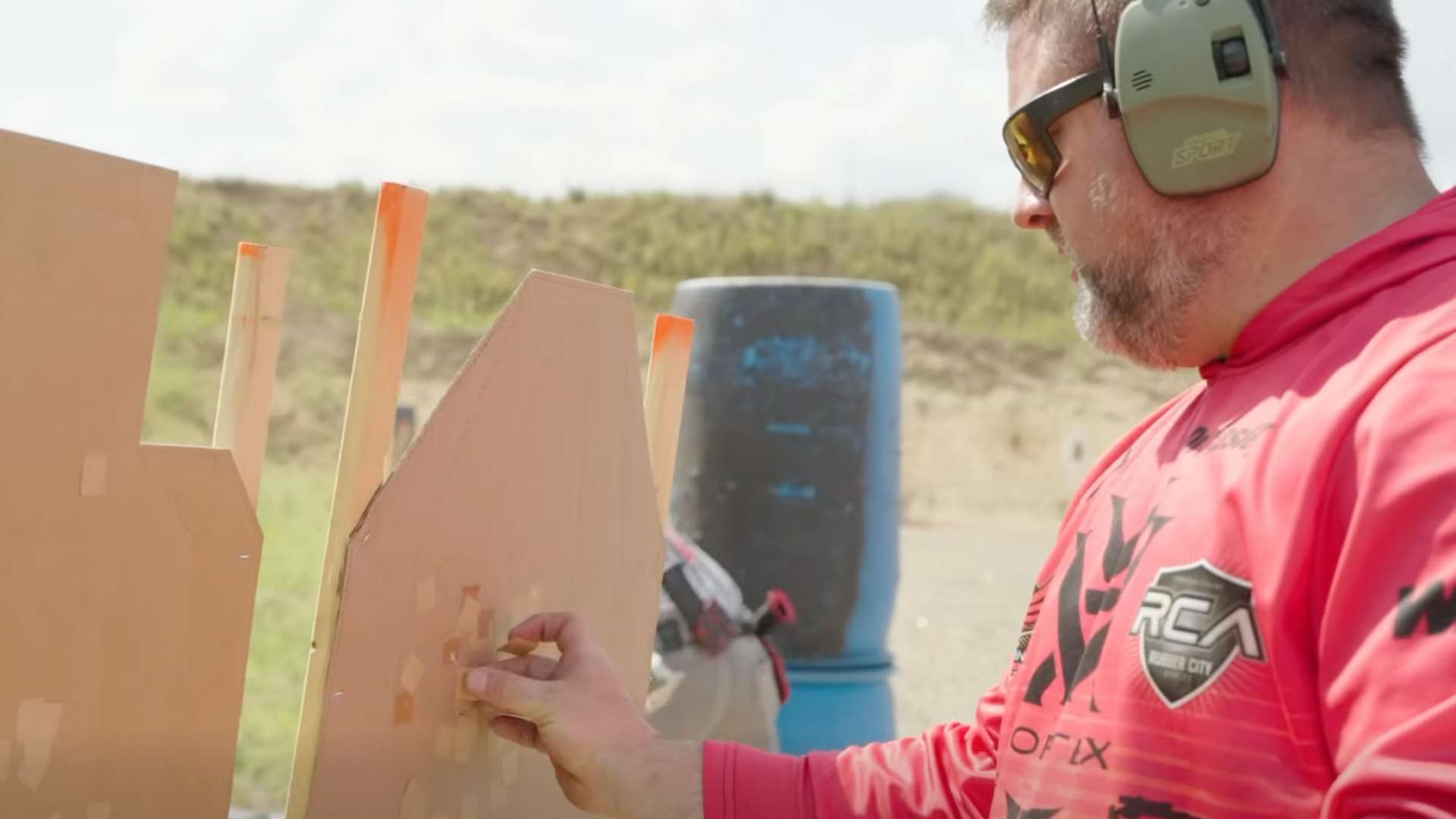
Last year at the 2025 USPSA Multigun Nationals, we gave Timmy a fresh canvas. At the Forest Lake Sportsmen’s Club, we have a 360-degree bay. Okay, maybe it’s a 270-degree bay for those who want to be specific, but anyway, it’s 100 yards long and 50 yards wide, with berms on all sides and a cut entrance at the 50-yard mark on one side. It has a 270-degree range fan, if you will. This bay was the canvas we gave Timmy to paint his masterpiece. His only direction—make sure the competitors reload at least two times. The result gave Limited and Open gun shooters a taste of Single-Stack. The resulting stage plans resulted in at least three, if not four or more, reloads. The question remained: “But what of the 180?”
The answer was pretty simple. From a range fan standpoint, there were essentially three zones (right, left and center). The fault lines represented a type of polygon that I’m sure doesn’t have a name, but offset from them about five feet or so were freestanding fencing panels (3x8—the kind they use at concerts and parades). Essentially, there were three zones the shooter would seamlessly transition through, and behind those zones were three sections of fencing in a straight line, defined as 180 for the shooter. The starting position was in the middle, with what all of us would recognize as a traditional 180, but as soon as they ran right or left a few yards, they were in a different zone with a different, visually defined 180 reference. There were places within the stage in which the shooter had perhaps 250 degrees of range fan available, but it was not floating; it was objectively defined based on their foot position, and the ROs and spectators had a safe place to stand and watch in the middle—without being chased back to the parking lot after reset.
Fencing out the stage this way gave us several things. Most importantly, the shooters had a freestyle environment to engage targets. The ROs had a safe place to stand (between the fence and the fault lines) and officiate. The squad had a defined, safe and close-by place to stand/watch/film and access to reset. The latter is often overlooked. I think the sport would do well to dispense with ROs shooing a squad back from the action so that they can both watch and be engaged in reset. It’s human nature that, once shooed out of an area, people don’t like to return and a crotchety “Reset!” call doesn’t really help (contrary to popular RO belief ). Here, the squad was in the center of the action, had multiple pass-through points to access rest, and had a defined and naturally constricted place to be after “Make Ready.”
So don’t be a square; with proper backstops and reference points, a 180 doesn’t have to define or confine a stage. What a stage needs are concrete and defined muzzle-safe points, apparent to both the shooter and the Range Officer, and defined concrete areas for bystanders to observe close at hand. Our sport would do well to explore more possibilities in stage design to present new and interesting challenges to our shooters.
Ironically, at a multigun match, this single-pistol-only stage was perhaps the highlight of the weekend for many. It did not bottleneck the schedule, and it did not cause a single person to be disqualified. It was perhaps one of the most unique shooting challenges presented to competitors in recent memory. It tested the Dangerous Violation of Course with a pistol. It was a favorite for all who attended. Go ahead—break (out) of 180.
Article from the January/February 2026 issue of USPSA’s magazine.
Most Popular