
Competitive shooters and handloaders today routinely rely on digital electronic computers for direction. From online load data and trajectory calculators to handheld wind meters to smartphone ballistic apps, modern technology is changing the face of marksmanship. But while electronic computers are comparatively new, we’ve used mechanical ones at the bench and firing line for a long time.
History’s earliest so-named computers were not electronic or even mechanical—they were people. The term goes back at least to 1613, credited to Richard Braithwaite who applied the term to people who perform mathematical computations. In the late 19th and early 20th centuries, astronomers didn’t want to spend the time laboriously crunching the numbers derived from their observations, so they hired women as cheap labor to carefully compute their reams of numerical data and referred to these patient ladies as “computers.”
Perhaps the best-known mechanical computer is the slide rule, a sliding-scale analog device for computations from simple math to trigonometry. This “slipstick” ruled engineering from the 1800s until finally succumbing to digital computers. Today, we can only find slide rules in antique stores, near the rotary dial telephones. Shooters and handloaders of the 20th century also used sliding-scale devices—commonly made of cardboard—that qualify as computers or calculators. Rugged? No. Inexpensive? Yes.
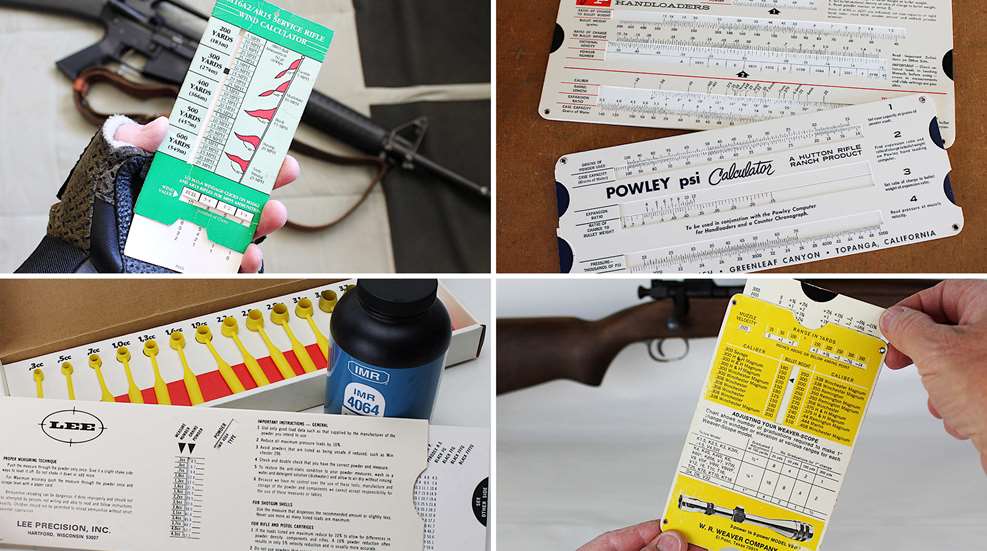
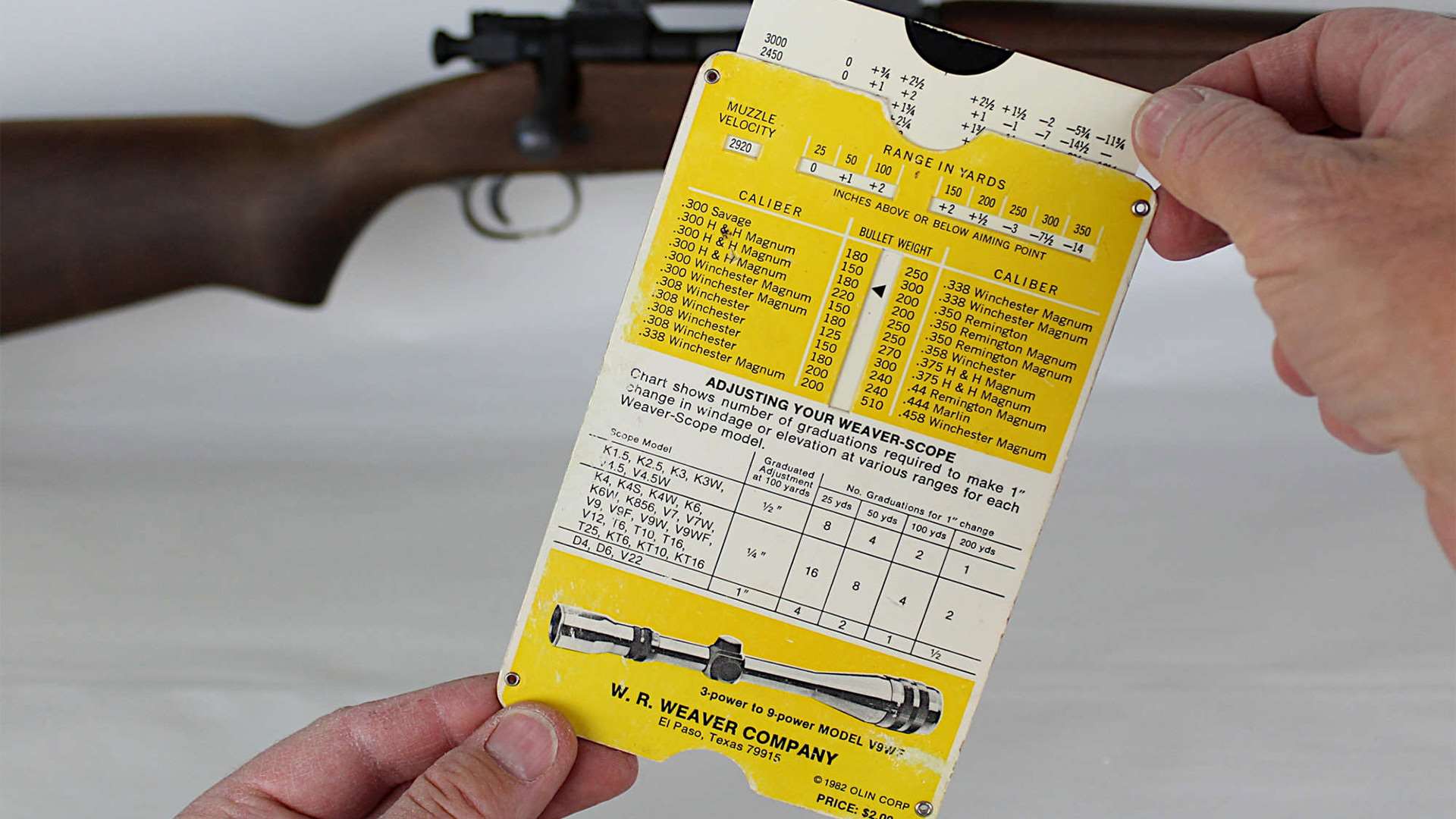
An example is the Sighting-In Guide from the W.R. Weaver Company. With this cardboard slipstick, the shooter slides the carboard insert so that a pointer in a cutout window selects a cartridge and bullet weight; a second window displays the corresponding muzzle velocity and bullet drop in 50-yard increments out to 350 yards. The device lists 50 cartridges, plus a chart showing which Weaver scopes have 1-minute, ½-minute and ¼-minute adjustments. Printed next to the copyright date of 1982 is the price, $2.00.
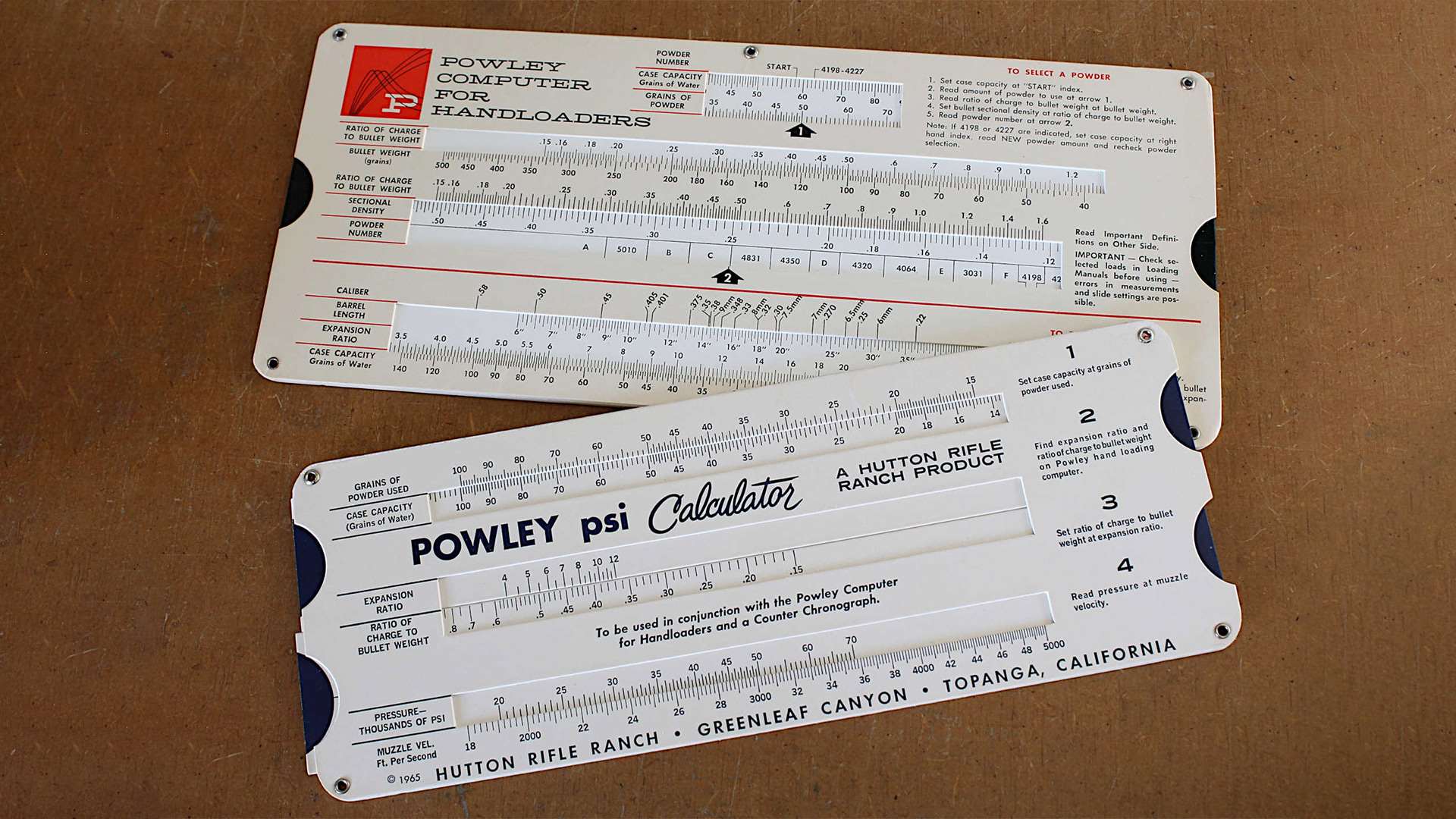
Most such cardboard calculators were relatively simple, some even handed out as promotional freebies. The Powley Computer for Handloaders, however, was more like a slide rule in appearance, performed more complex calculations and can be considered a genuine computer. The handloader first inputs the weight of water held by a selected cartridge case; the Powley Computer then outputs the optimum grain weight of a specific smokeless powder that is likely to give best performance, based on expansion ratio. The Powley also computes the ratio of charge to bullet weight which it then converts to a muzzle velocity. The Powley can also estimate muzzle velocity when the user inputs a specific barrel length, cartridge and, again, the grains weight of water held by a case.
The companion Powley P.S.I. Calculator works similarly in taking information from the Powley Computer a step further to compute chamber pressures from 20,000 to 70,000 p.s.i. That’s a handy trick when our handloading goal is to keep pressures low for older and weaker firearm action designs. The Calculator has a copyright date of 1965, the Powley Computer, 1962. Homer S. Powley, an engineer who worked at Colt, designed both devices. It was about this time that electronic transistor-based computers came on the scene, eventually displacing slipsticks. But, ingenious cardboard computers held on until the internet descended upon our living rooms.
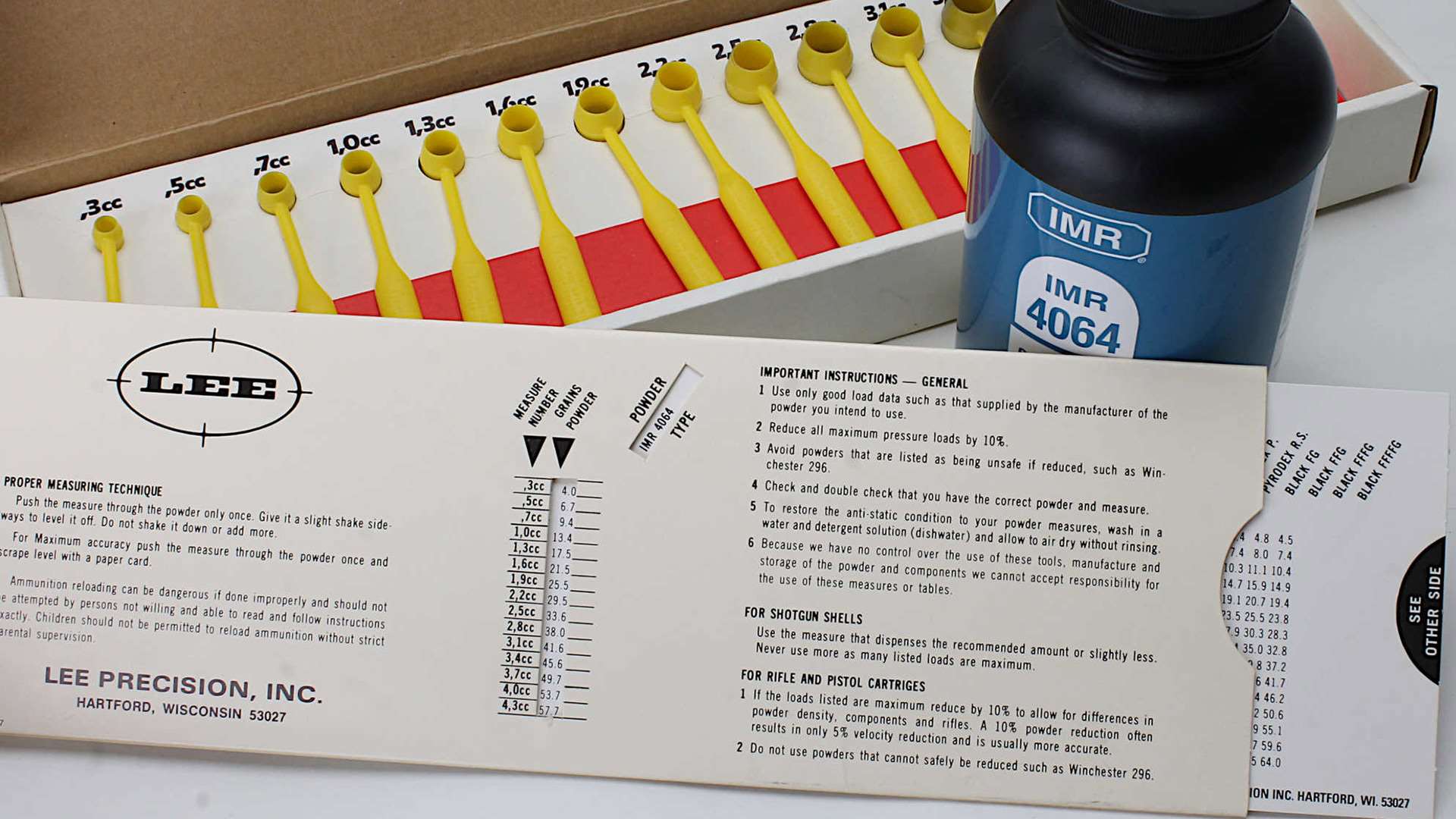
Despite now living in the technical vastness of the digital future, they are still with us today. For the reloading bench, one accompanies Lee Precision’s Powder Measure Kit (MSRP: $13.98). Lee’s kit contains 15 plastic measures graduated from 3cc to 4.3cc to measure powder charges by volume. The accompanying cardboard slipstick has two windows; one shows a selected powder, the other converts each plastic measure’s volume to equivalent weight in grains for that powder. The conversion is necessary, as load data smokeless powder charges are universally given in grain weight, not volume.
Another is a pocket-size wind calculator for use at the range, available from Creedmoor Sports (MSRP: $2.95). The shooter moves the cardboard slider to a specific estimated wind speed at a specific range between 200 and 600 yards, and reads out in a separate window the number of ½-MOA windage clicks needed to compensate for the wind. Though the M16A2/AR15 Service Rifle Wind Calculator provides results for full, ¾, ½ and ¼ wind values, it is necessarily specific to M855 Ball ammunition of 62 grains and muzzle velocity of 3,100 f.p.s.
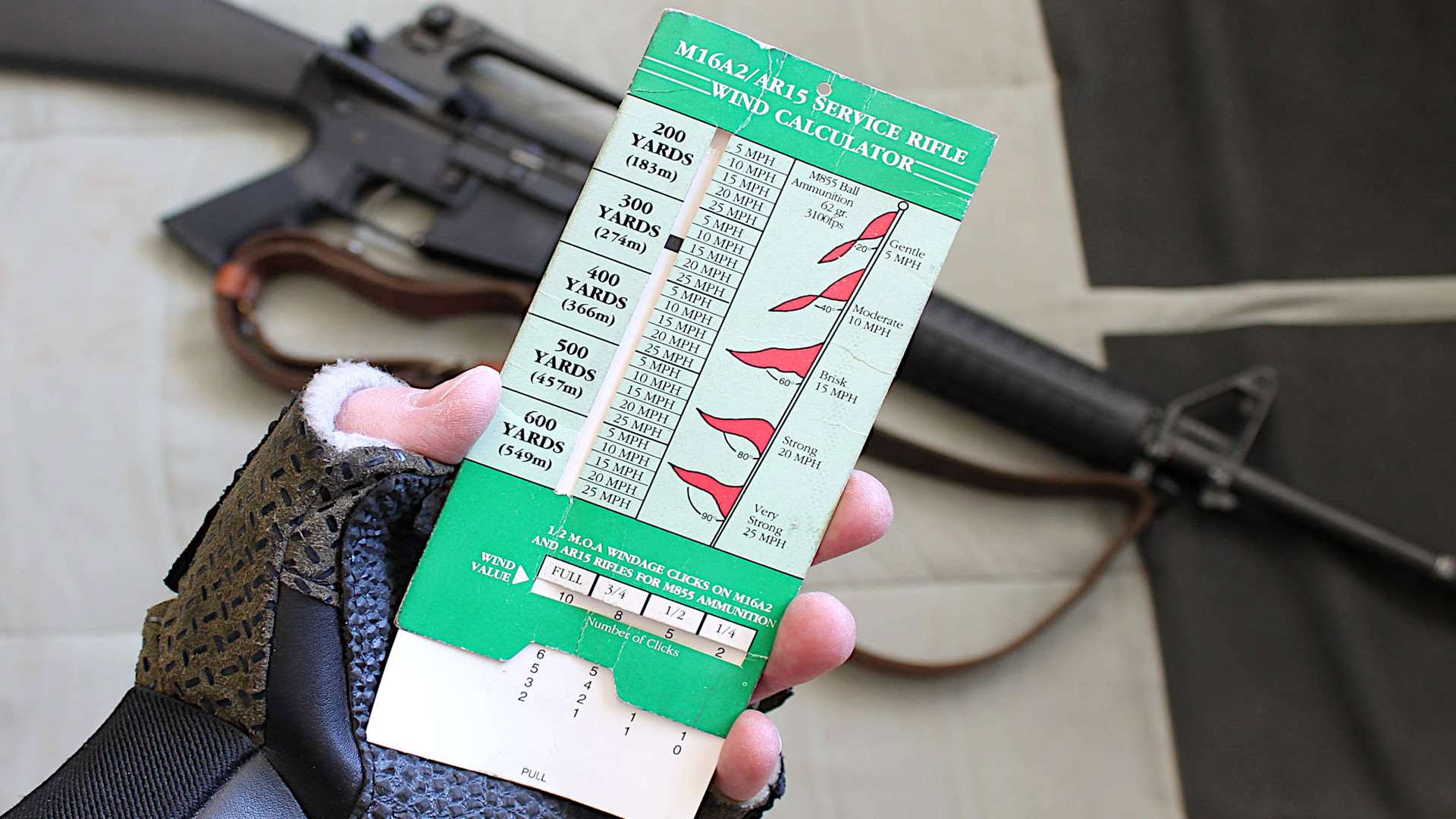
And such is the limitation of cardboard computers—they only work within limited parameters of preset specific values, whereas digital computer software allows for any number of variables. There are many software programs and smartphone apps available to today’s handloader and shooter that calculate trajectories, wind drift, BCs, optimal barrel twist rates, Coriolis effect and more. Many are free. There’s no argument that such nearly unlimited data is superior to cardboard calculators. But if you ever see a Powley Computer at an antique store, you might consider taking it home—just in case the electricity fails.
Read more: VMR Triggers: “Careful Fitting” vs. Modification
Most Popular