
There is a thread that runs through the American sporting tradition that has nothing to do with ballistics or bag limits. It’s the impulse to look at the natural world, study it closely and make something beautiful from the encounter. Hillsdale College pulled on that thread February 6 and 7 when its Art Department and Nimrod Education Center hosted “Art and the Sporting Tradition,” a two-day program that gathered wildlife painters, decoy carvers, duck stamp champions and conservation thinkers under one roof.
“In different ways, art, hunting and conservation have the power to inspire us with beauty and connect us with our heritage and with nature,” said Al Stewart, director of the Nimrod Education Center. “Wildlife art—from Duck Stamps to decoys—invites us into the beauty of nature and the joy of conservation.”
The program opened with an exhibit of wildlife art by Bob Kuhn, the celebrated American painter who spent decades translating the movement and tension of wild animals onto canvas before his death in 2007. His work is on display in Hillsdale’s Daughtrey Art Gallery through March 22. Award-winning sculptor and painter Tim Shinabarger led attendees through the gallery while presenting on the artists of the Boone and Crockett Club, the conservation organization founded by Theodore Roosevelt in 1887.
Shane Newell, collections curator for Hillsdale’s Blake Center for Faith and Freedom, delivered a presentation on the origins of American wildfowl decoys and the modern culture of collecting them. His talk traced the decoy from practical hunting tool to recognized art form, a journey rooted in Native American ingenuity and carried forward through centuries of American carving tradition.
“Decoys as a traditional and valuable art form are a recent enlightenment,” Newell said. “The origins of wildfowl decoys, born from the need for self-reliance, created through Native American ingenuity, carved into American life and culture, invite you to be lured by taking care of a decoy and honoring the legend.”
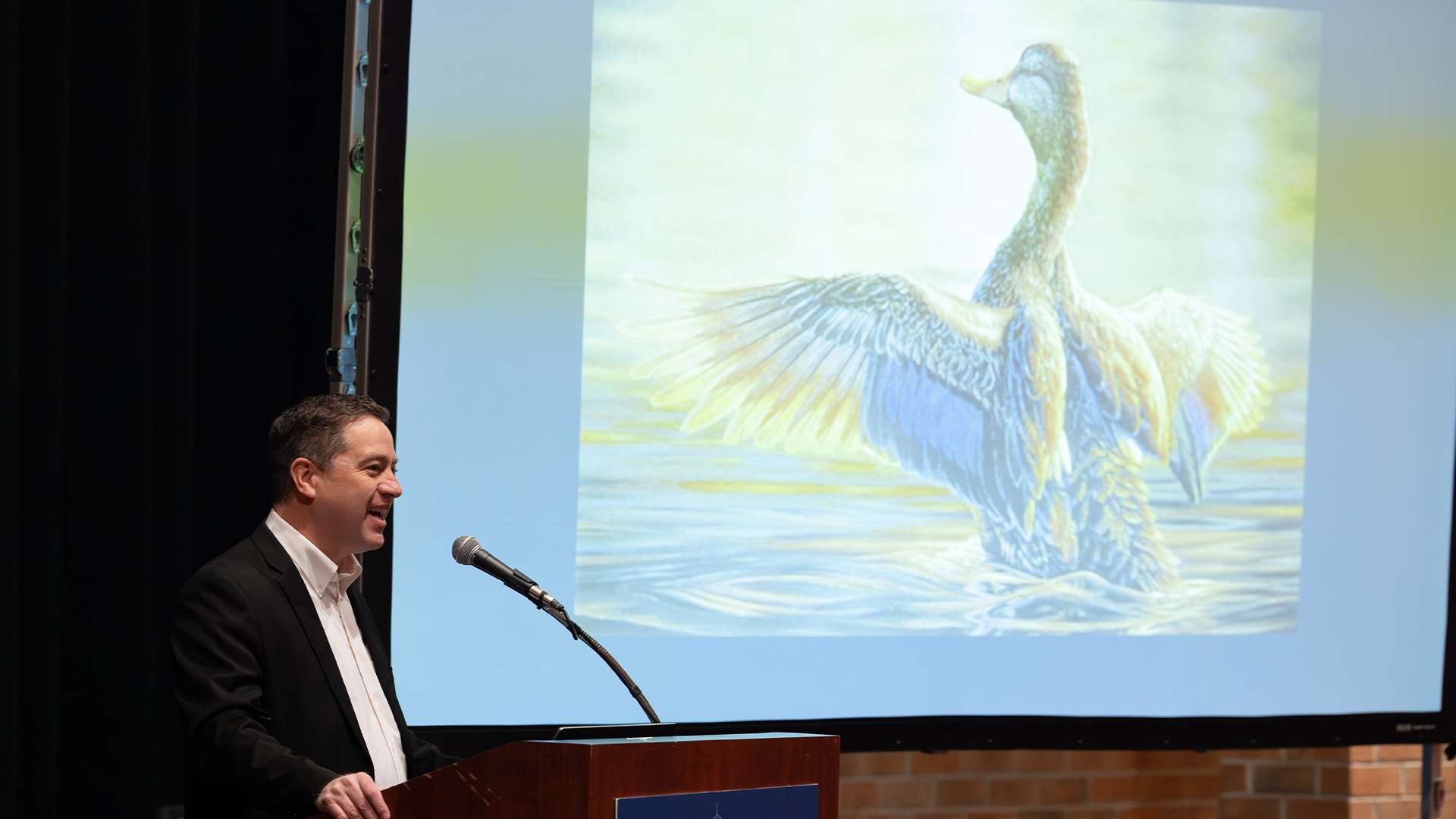
Adam Grimm, a wildlife painter and three-time winner of the federal duck stamp competition, spoke about his experience competing for and winning what is arguably the most prestigious prize in American wildlife art. The Federal Duck Stamp Contest, administered by the U.S. Fish and Wildlife Service, produces the design for the Migratory Bird Hunting and Conservation Stamp purchased annually by waterfowl hunters across the country. Revenue from the stamp funds wetland habitat acquisition through the National Wildlife Refuge System.
“One of my goals with my art is to get people to look closer at nature,” Grimm said. “That’s kind of my goal with painting and with trying to capture those details, because I find that when I take the time to paint it into a painting, people look closer—because, I think, they can’t believe I actually spent the time to paint it in there. But it’s actually there in real life. And when you look at a bird in hand up close, and you look at how detailed they’re made and how perfect and the patterning on the feathers, it really is spectacular to see.”
The program closed with a panel discussion on art and conservation featuring Brian Shaw, an artist and art teacher at Hillsdale who won the 2022 Michigan Department of Natural Resources deer patch design contest; Pat Gregory, a 1980 Hillsdale graduate and Illinois River decoy carver; Corey Lucas, founder and CEO of Cedar Run Decoys; and Chris Smith, a professional artist, author and six-time winner of the Michigan Duck Stamp contest.
For more information about Hillsdale College, visit hillsdale.edu.
Most Popular