
WARNING: All technical data in this publication, especially for handloading, reflect the limited experience of individuals using specific tools, products, equipment and components under specific conditions and circumstances not necessarily reported in the article and over which the National Rifle Association (NRA) has no control. The data has not otherwise been tested or verified by the NRA. The NRA, its agents, officers and employees accept no responsibility for the results obtained by persons using such data and disclaim all liability for any consequential injuries or damages.
The .357 Magnum is a potent cartridge that debuted in 1935 as the world’s most powerful handgun round, a title it held for two decades until the .44 Magnum was born. Today, it remains popular for its versatility, offering serious performance for hunting, target shooting and self-defense in revolvers of all sizes—and even a few semi-automatic pistols.
Factory loads are the hallmark of the cartridge’s raw power. Power is requisite when hunting or using as a defense against large animals. Speed means flatter shooting over distance which comes in handy with distant targets, whether animated or made from paper or steel. Elmer Keith shot rabbits at up to 175 yards with an 8.75-inch Smith & Wesson revolver back in 1935 (then known as the Registered Magnum, eventually named the Model 27). The .357 worked well for me to reliably take down metallic silhouette rams at 100 yards in my younger days. Light bullets are especially effective on varmints, and heavy bullets offer deep penetration. The .357 has a lot to offer, and getting the most from the ammo makes this possible.
Handloads can equal factory ballistics, but it requires the right powder. Generally, large quantities of slow burning powder are required to push bullets to the highest speeds in the .357 Mag., as they take advantage of the cartridge’s long 1.29-inch case length and high 35,000 psi pressure limit. (The Copper Units of Pressure limit is 45,000 CUP.) Here, I look at various handloads that match the performance of factory ammunition.
Two bullet weights are common for this caliber. The 158-grain bullet is the iconic weight for this round, having been the first weight used in factory ammunition. The original lead bullet version reached an impressive 1,510 fps from 8.75-inch barrels of the day. This produces 800 ft.-lbs. of muzzle energy, which was an impressive number to toss around with respect to what you could get from a handgun. Later, when jacketed bullets were introduced around 1963, these new 158-grain slugs increased the speed to 1,550 fps from 8.38-inch barrels.
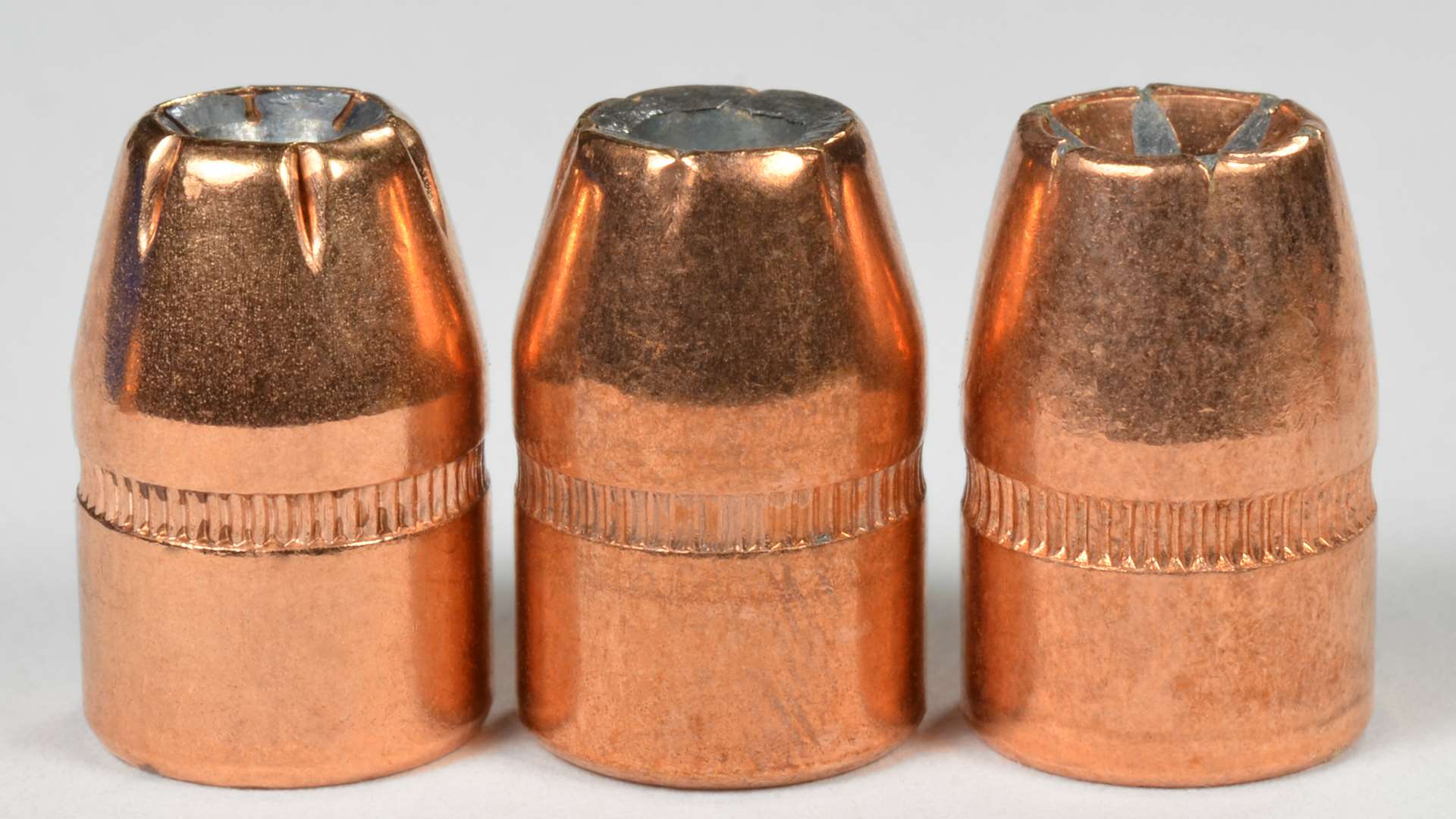
The second common bullet weight for the .357 Mag. is 125 grains, being introduced around 1977. Being lighter, it can be driven faster, reaching 1,675 fps from an 8.38-inch barrel. This weight became popular with law enforcement and earned a reputation of quickly stopping bad guys.
Today, most .357 factory ammo speeds are reported from 4-inch vented barrels. With the same ammo, the 158-grain bullet clocks at 1,235 fps, and the 125-grain bullets run 1,450 fps from this shorter length.
A third, less common bullet weight for the .357 Mag. is 110 grains. In the 1960s and 1970s, Super Vel offered a 110-grain JHP bullet in their .357 Mag. load at 1,400 fps, but the barrel length was not given in my resources. Unfortunately, they closed in the 1970s. The reintroduced Super Vel ammo company currently offers a 110-grain solid copper hollow point with a real-world speed of around 1,400 fps from a 4-inch barrel.
Major ammo makers introduced their 110-grain bullets around 1972, but common factory loads did not exploit the cartridge’s potential and were a reduced power offering. Winchester and Remington’s current published speed for these bullets are 1,295 fps from a 4-inch barrel. Corbon lists a high-performance JHP with this bullet weight at 1,500 fps from the same size barrel.
Let’s not forget 180-grain bullets. I didn’t have access to enough past catalogs to determine when 180-grain bullets were introduced in .357 factory ammunition, but they were not present in Remington’s 1983 catalog but were in the 1992 catalog. Remington lists the speed of their 180-grain SJHP at 1,145 fps, but from an 8.38-inch vented barrel. That surprises me because the 8.38-inch barrel as a standard test length was dropped in the 1970s. Federal’s Power-Shok 180-grain JHP bullet is reported to run at 1,080 fps from a 4-inch barrel.
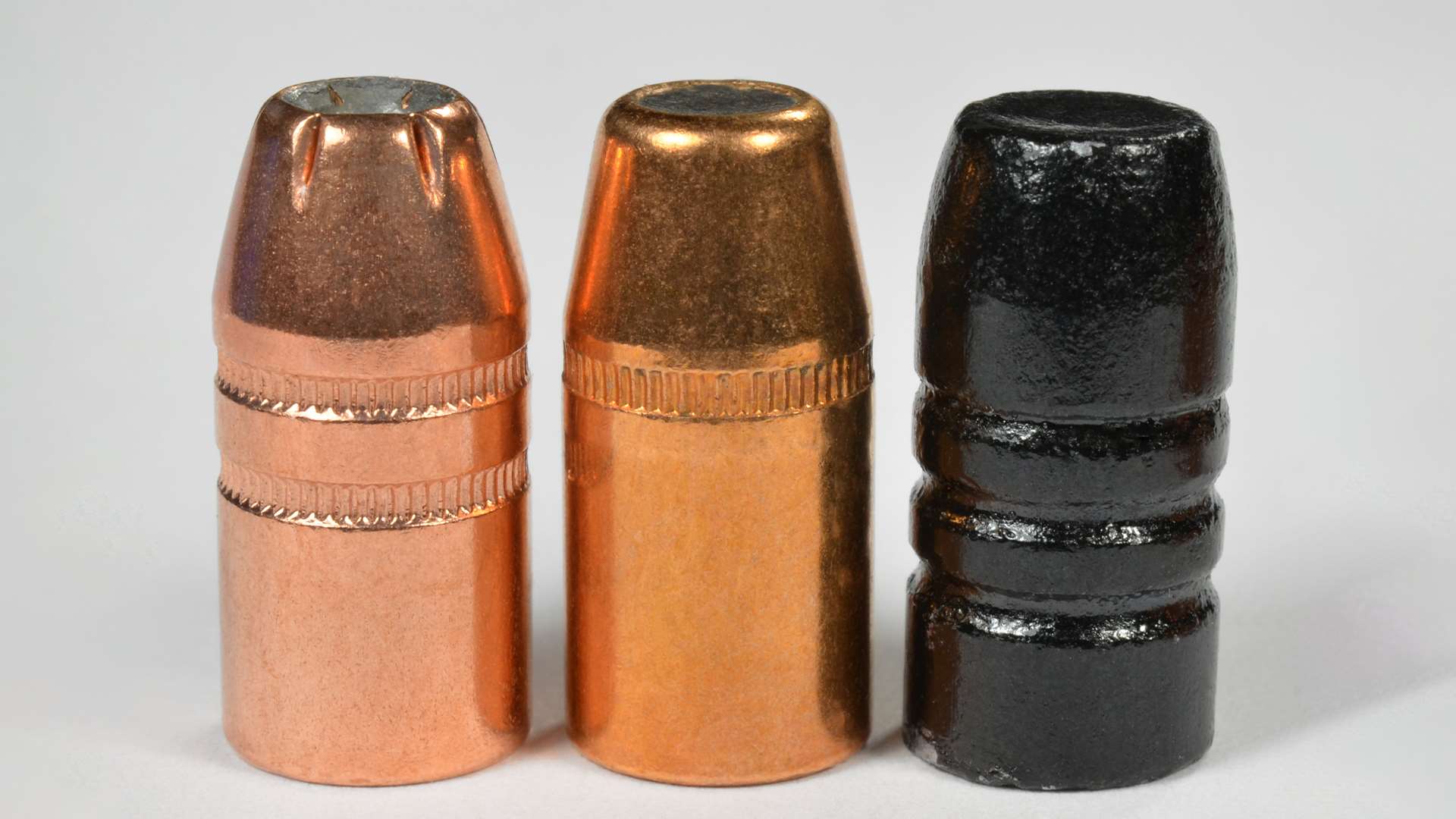
Some boutique ammo manufacturers enhance the performance of the .357 Magnum. These companies include Buffalo Bore, Corbon, DoubleTap and Underwood. They offer faster speeds and different bullet designs than the mainstream manufacturers like Federal, Hornady, Remington, Speer and Winchester. The mainstream manufacturers often load their ammo to a nominal velocity standard, such as a 158-grain bullet at 1,235 fps. Boutique ammo companies might push the bullets faster while still staying within SAAMI pressure limits. For example, Buffalo Bore .357 loads exceed common speeds by 100 fps or more in 125- and 158-grain bullet weights.
I followed published recipes from several sources: Hodgdon, Hornady, Lyman, Nosler, Sierra, Speer, Vihtavuori and Western Powders. Load data can vary different from one source to another, even when using the same bullet and powder, so it pays to have several load manuals for reference. I suspect the biggest reason for the disparity is the lot number of the powder, because the real-world performance of a powder can be different from one batch to another. If you look closely at some gunpowder descriptions, the manufacturer might make a specific statement that the powder has good lot-to-lot consistency. It implies that some powders aren’t as good at this as others.
In most instances, I used the same components in the manuals, because changing components can produce different results, and most importantly, using the same components and specifications should help keep the loads within safe operating pressure.
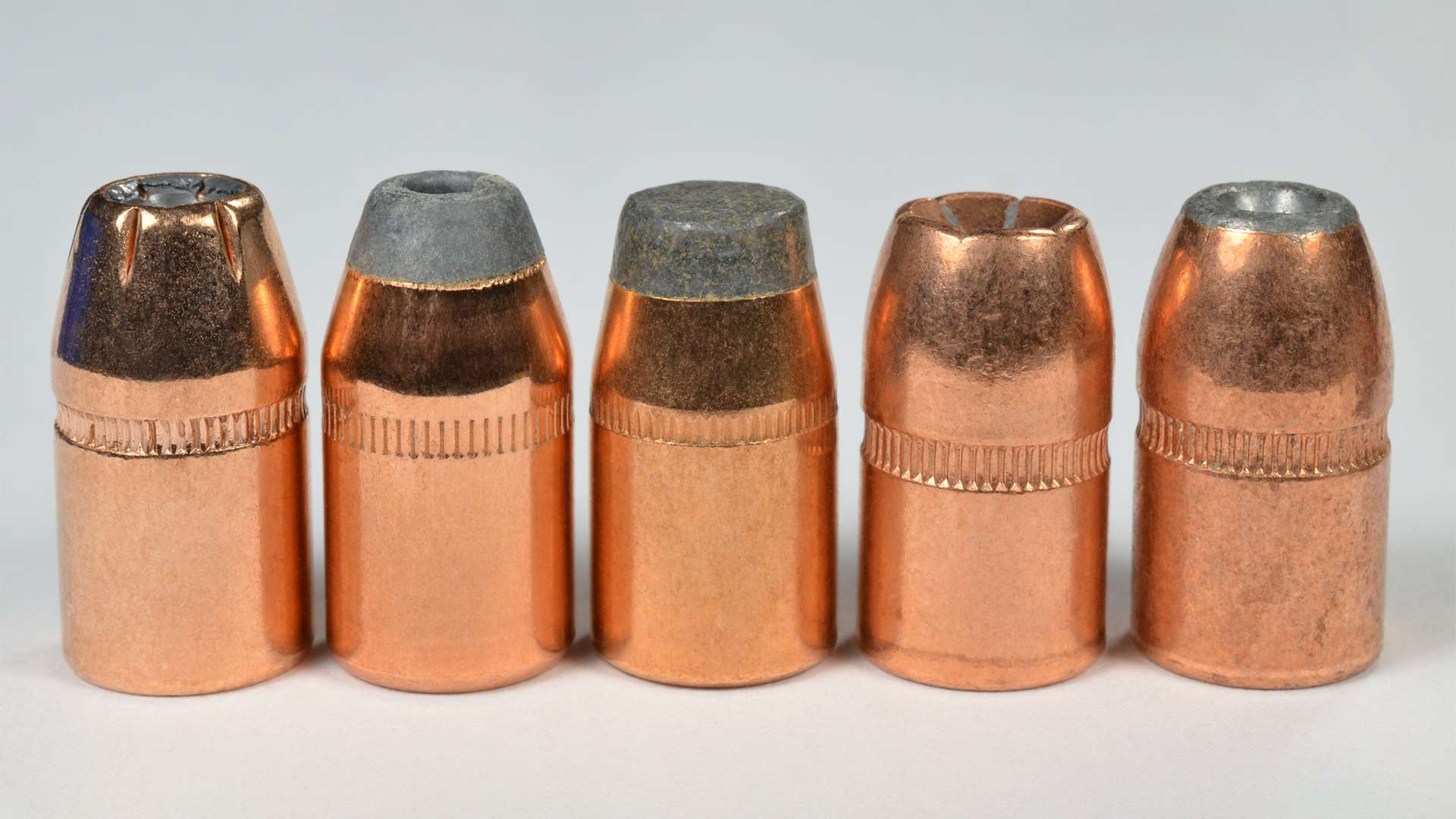
All the loads used for jacketed bullets in this article are from published resources, and none of the charge weights exceeded the published weights. The same is true for some of the lead data, but for some loads I used QuickLOAD ballistic software to aid determining a safe powder charge.
Here’s how I did that. My load data for lead 158-grain bullets was derived from Lyman’s data for their 160-grain round nose cast bullet from mold #358311. I bought bullets of this mold design from Matt’s Bullets, though they weighed a little heavier at around 165 grains. The 158-grain bullets are common in the .357, but that Lyman bullet design is not.
I used QuickLOAD to calculate powder charges for 158-grain lead bullets based on using Lyman’s 160-grain design at Lyman’s loaded length of 1.59 inches. The 160-grain Lyman bullet has a length of .72 inches, while the 158-grain bullets I used are shorter. For example, the SNS 158-grain round nose bullet is .685 inches long, and I used that length for the calculations, loaded to the same overall length. The shorter bullets, loaded to the same length as the Lyman bullet, will not be as deeply seated. This will reduce pressure and allow for more gunpowder to reach the same pressure. My calculations were meant to determine how much gunpowder I could use. All calculations were designed to not exceed QuickLOAD’s estimated pressure of the Lyman 160-grain bullet at the maximum load.
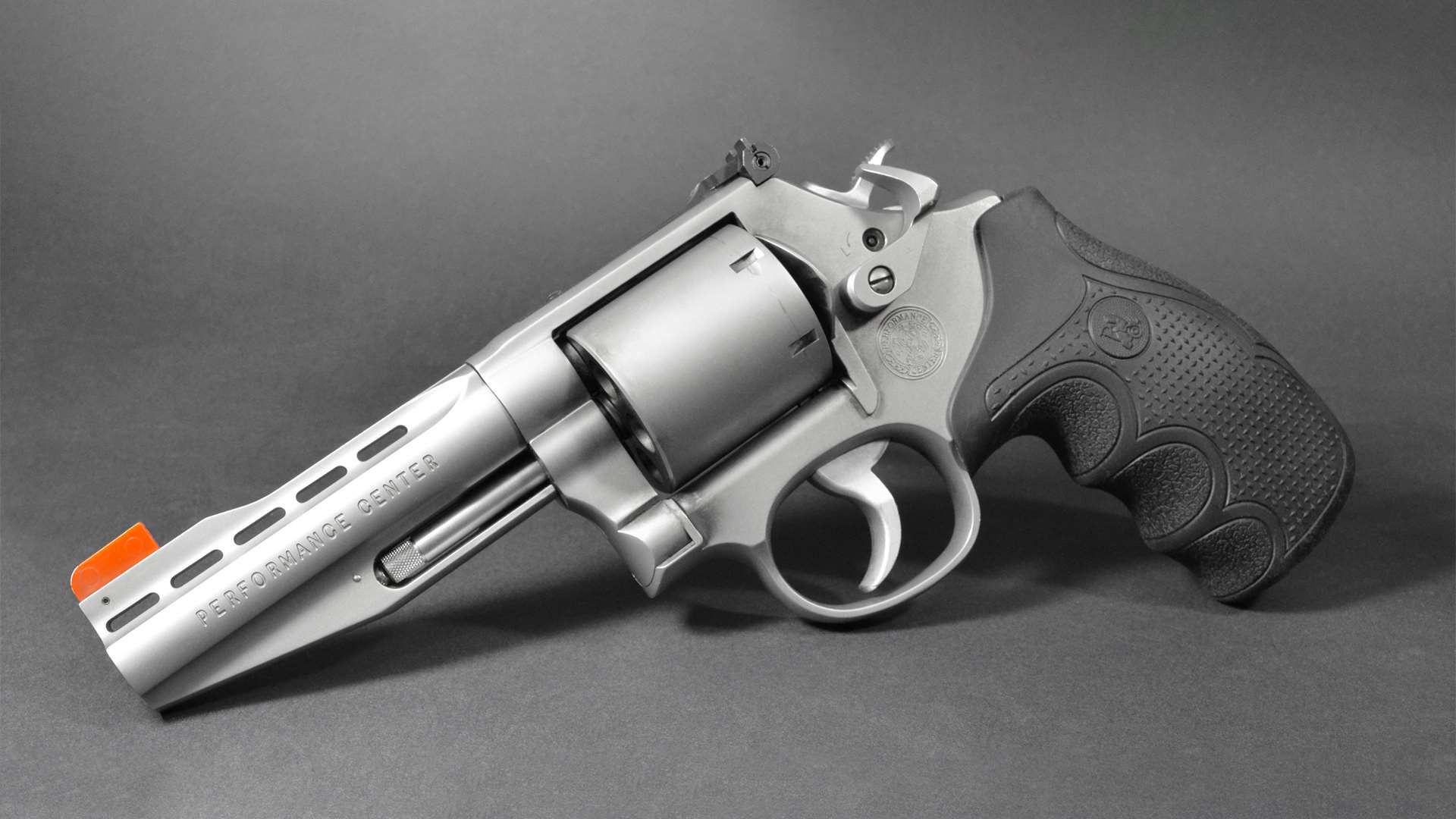
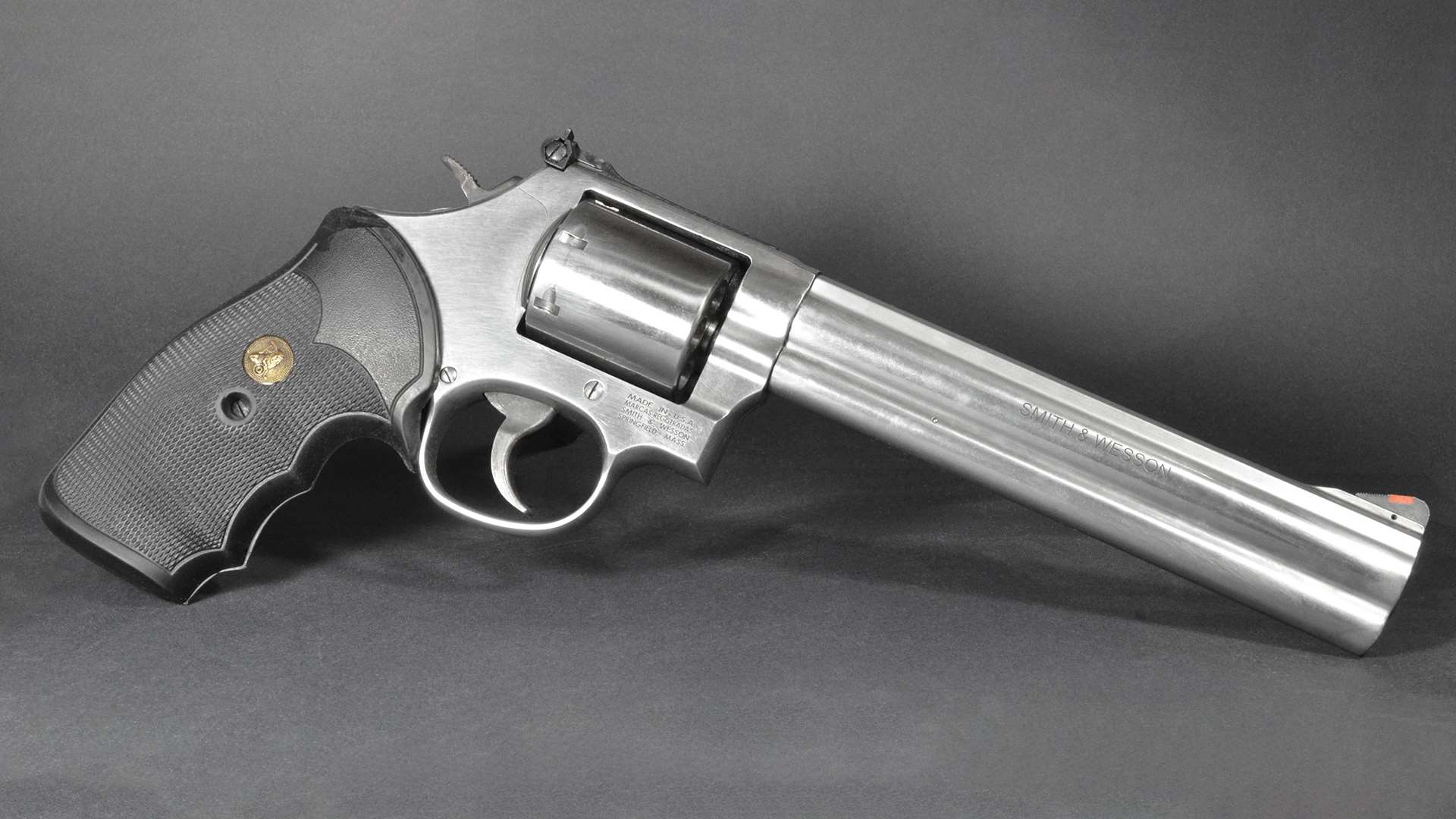
My test gun was a Smith & Wesson Model 686 with a 4-inch barrel, an L-frame gun with a beefy design to handle the .357 Magnum round. Some loads were also fired in a Smith & Wesson Model 686-plus with a 7-inch barrel to see their performance in the longer barrel.
Target speeds for this article are nominal published speeds from a 4-inch barrel. These are 1,235 to 1,240 fps with a 158-grain bullet, and 1,440 to 1,450 fps with a 125-grain bullet. Nominal speeds for the 180-grain bullets should be around 1,080 fps, based on Federal’s reported velocity from a 4-inch barrel. The 110-grain bullets should run around 100 fps faster than the 125-grain bullets, so I expect nominal speeds for full power loads should be around 1,550 fps from a 4-inch barrel.
Factory ammo was fired to demonstrate typical velocities from my 4-inch gun, and the results are shown in Table 1. In general, the speeds from my gun were close to the published speeds of the major manufacturers, apart from the 180-grain bullets which were faster than expected. It suggests that my gun is a fair representation of a 4-inch .357 Magnum revolver.
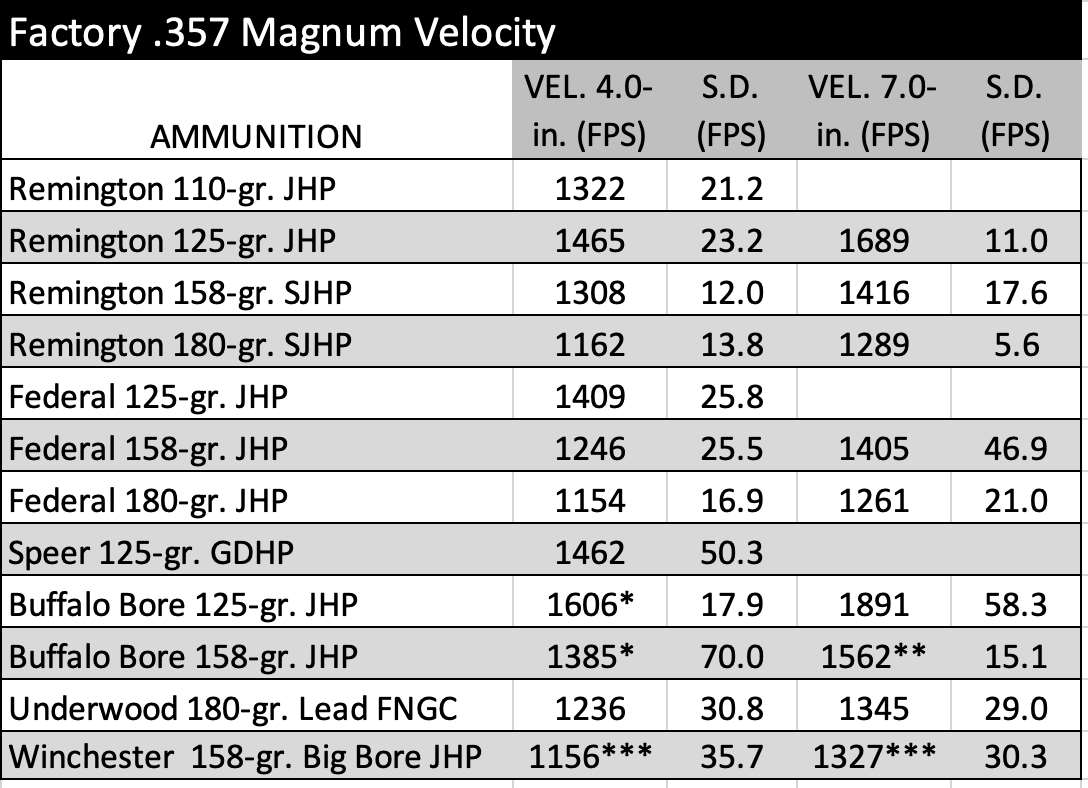
Remington’s lightly loaded 110-grain JHP has a published speed of 1,295 fps. They clocked at 1,322 fps from my 4-inch barrel.
Factory 125-grain .357 Magnum ammo speeds were variable, with some under the nominal 1,450 fps, and some over. Buffalo Bore’s heavy load with this bullet weight clocked at a hand-bruising 1,606 fps.
Federal’s 158-grain JSP load ran 1,246 fps, while Remington’s 158-grain SJHP load ran faster at 1,308 fps. Not to be outdone, Buffalo Bore’s 158-grain load ran 1,385 fps. They clocked at an average of 1,562 fps from the 7-inch gun. This equals the speed of the old 158-grain jacketed bullets from an 8.38-inch barrel.
I was surprised at how fast the 180-grain bullets were in my 4-inch Smith & Wesson, because they exceeded their published speeds by more than a little. Remington’s 180-grain bullets clocked at 1,162 fps, which beats their reported speed of 1,145 fps from a longer 8.38-inch barrel. Federal’s 180-grain load clocked at 1,154 fps, easily exceeding their published speed of 1,080 fps. Underwood’s load with a 180-grain lead bullet ran at 1,236 fps.
Two of the factory loads were a little sticky in my 4-inch gun. This same ammo was not sticky in the 7-inch gun. By sticky I mean the cases had resistance during extraction. Both were with the Buffalo Bore ammunition. Assuming there is not an issue with rough chambers, sticky cases are generally viewed as a warning that the load is too much for that gun.
I experienced some sticky cases during load testing. As with the factory ammo, some were sticky in the 4-inch gun but not the 7-inch gun. But some loads were sticky in both guns.
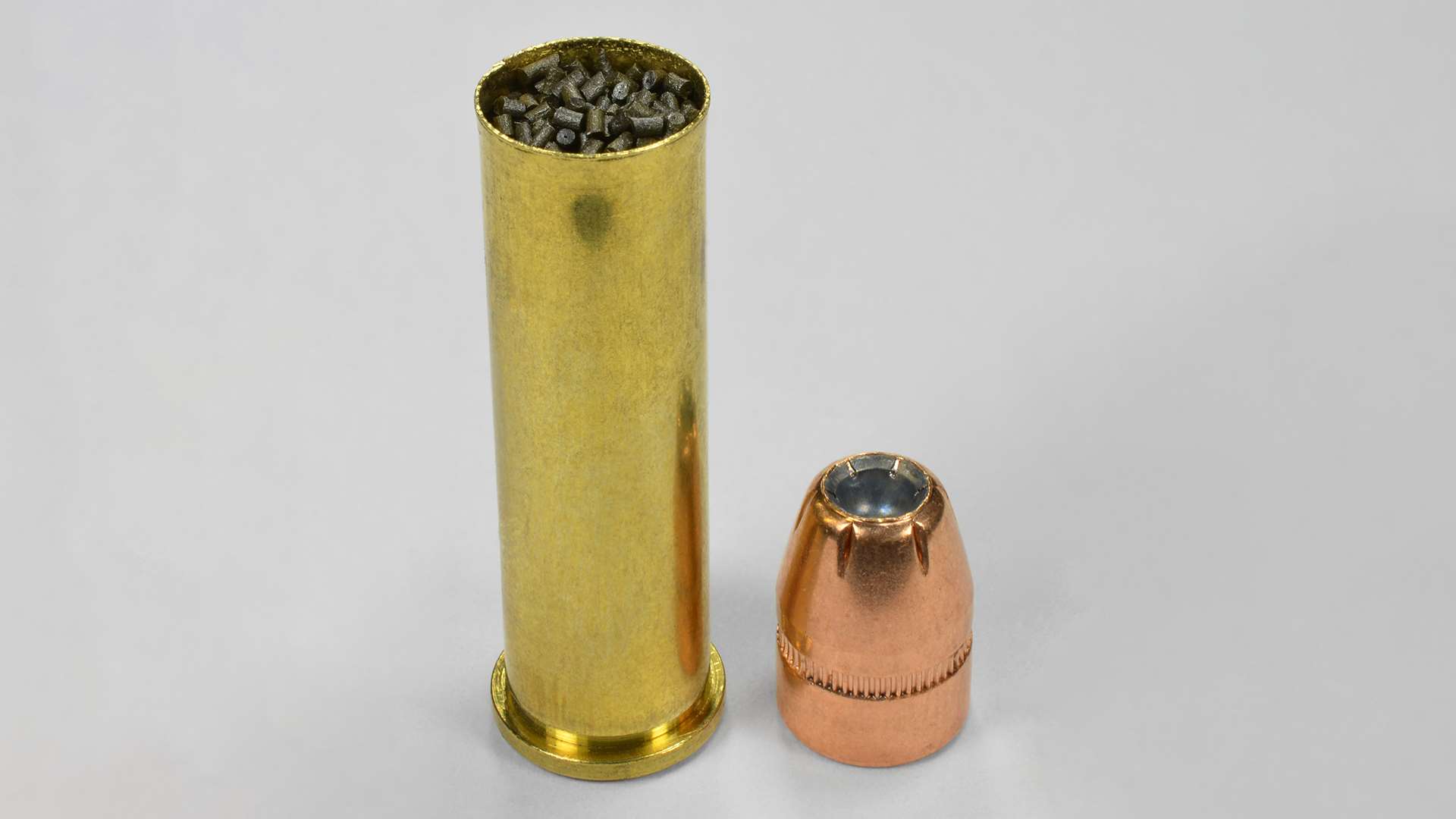
I include two examples of sticky cases in my load data. One example each is shown with the 110- and 125-grain bullets. Both were powered with Winchester 296, a popular powder for magnum handgun cartridges. Both loads were the maximum charge weight listed in loading manuals. They were sticky in the 4-inch gun but not the 7-inch gun, and I include them as an example of how different guns will react to the same ammunition. Watch closely for this if you’re handloading for more than one gun. My rule of thumb when loads start to stick is to back off 0.5 to 1.0 grains of powder and use that as my maximum load for that gun.
Stickiness can vary with the brand of cases, so keep good notes of which brand you’re using. It can also depend on how many times the brass has been fired. Cases bulge near the case head, and sizing dies don’t reach all the way down to iron out the bulge, so part of the bulge remains. Firing the brass again increases the bulge, and at some point, the cases might get sticky with the same load that they were not sticky with before. You might find you need to switch to new brass after a few firings to prevent sticking.
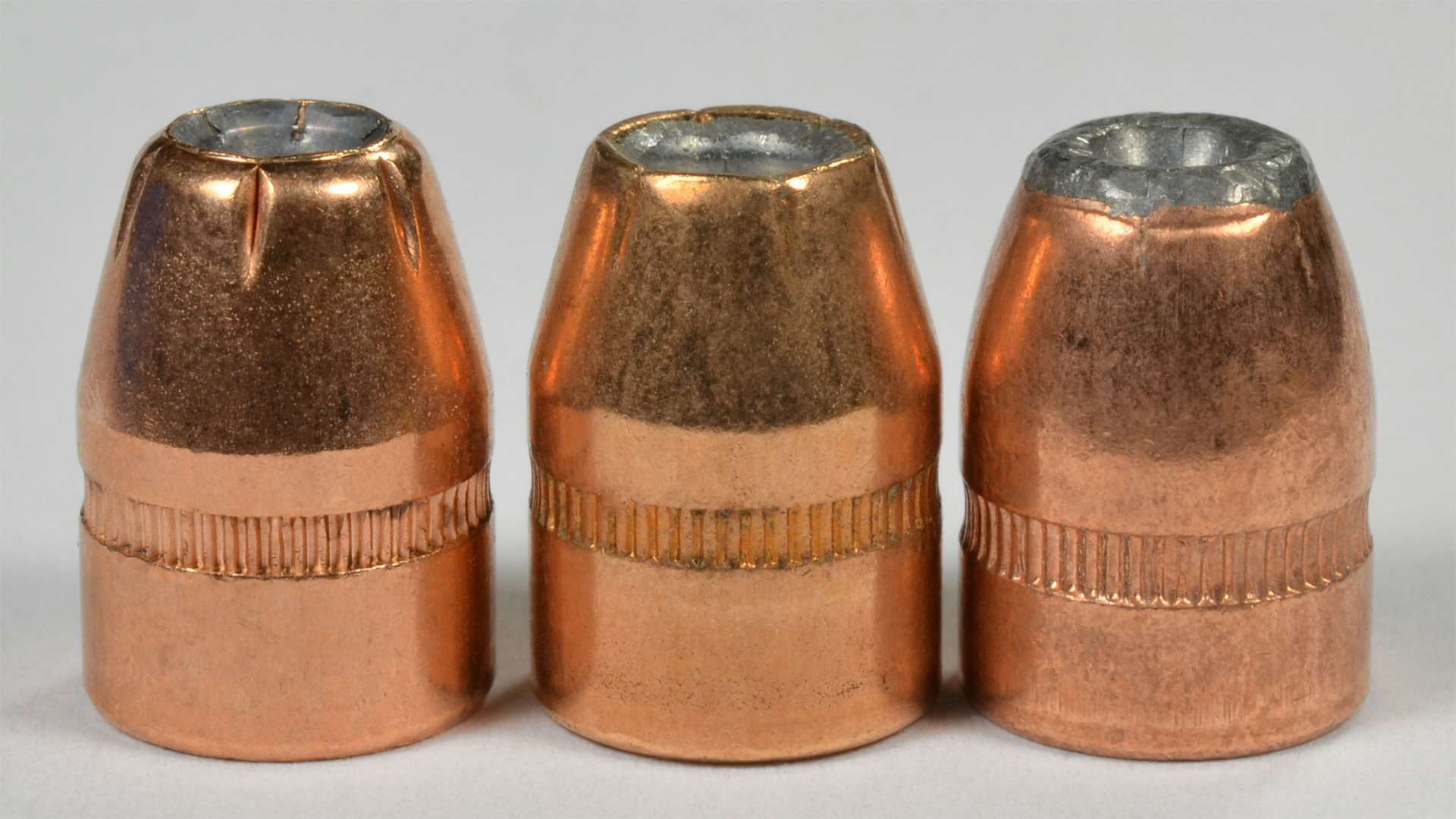
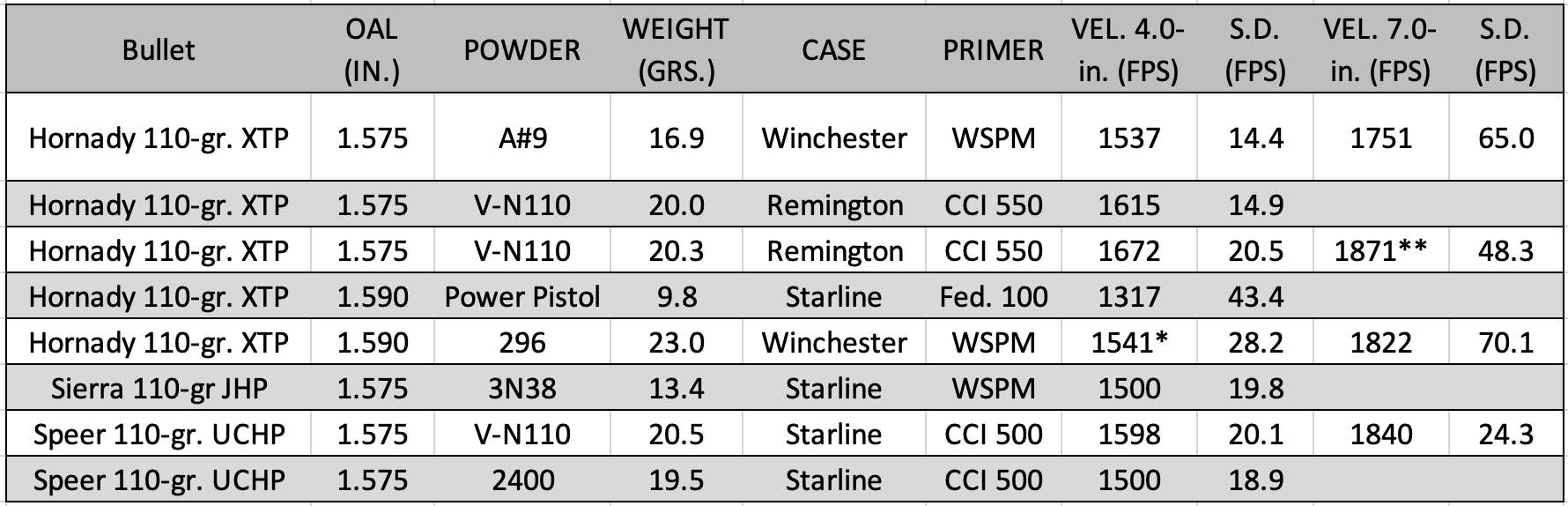
It’s easy to duplicate the watered-down factory .357 Mag. 110-grain ammunition. Power Pistol gets you in the 1,300 fps range to match factory Remington and Winchester speeds. Full power 110-grain bullets reached between 1,500 and 1,672 fps from my 4-inch barrel. Accurate #9, 296, 2400 and 3N38 reached 1,500 fps with their bullets. Vihtavuori N110 produced the highest speed at 1,672 fps with Hornady bullets. Three loads were more than 1,800 fps in the 7-inch barrel.
If you’re using Speer 110-grain bullets, don’t use their Gold Dot Short Barrel version for full power loads. The Speer manual notes they are too soft for high speed and will deform in the barrel. Use only Speer 110-grain UCHP for fast .357 loads.
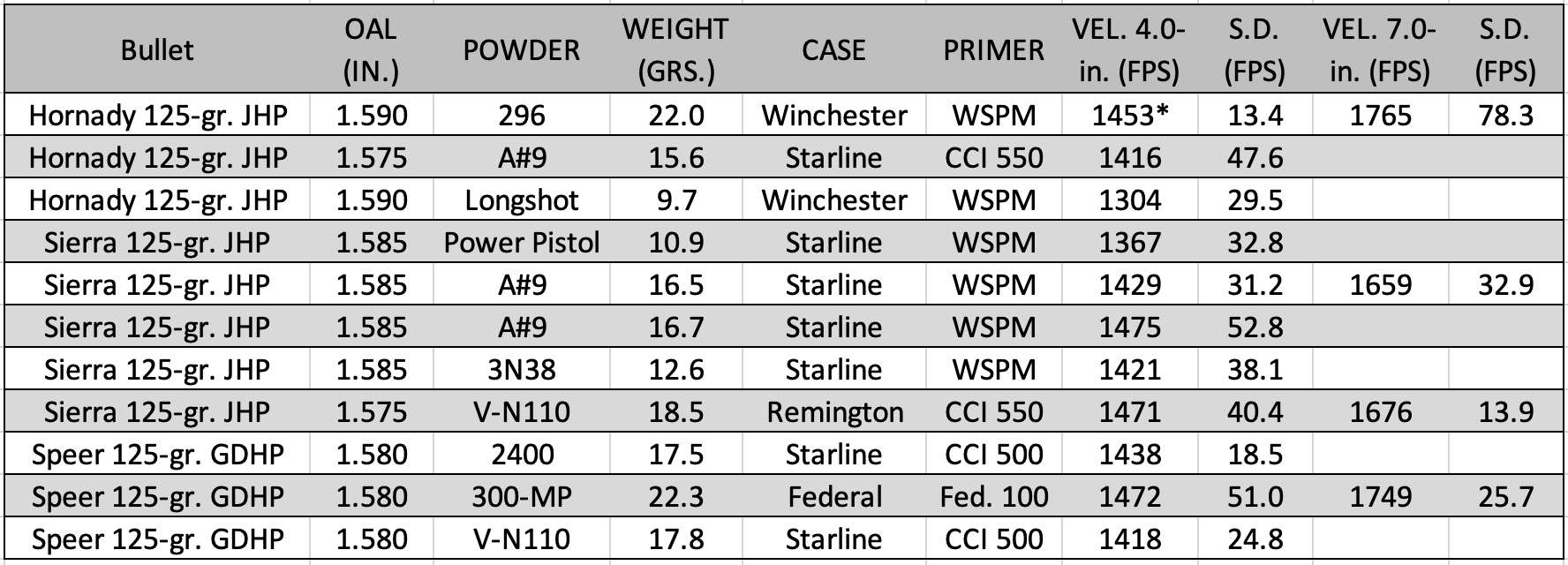
Several of the 125-grain handloads achieved the 1,450 fps factory speed. Winchester 296, Accurate #9, Vihtavuori N110 and Alliant 300-MP performed best with this bullet weight. But most are right at the maximum charge weights shown in the loading manuals, so at least for my gun, I had to load them heavy to equal factory ammunition. Velocity from my 7-inch barrel equaled or exceeded the old 8.38-inch speed of 1,675 fps. None of these handloads topped 1,500 fps from my 4-inch barrel, a long way from Buffalo Bore’s 1,600 fps.
Some of these slow powders demonstrated a substantial velocity gain when fired in the 7-inch gun. Winchester 296 behind the Hornady 125-grain XTP ran at 1,453 fps from the 4-inch barrel and gained 300 fps to clock at 1,765 fps in the 7-inch barrel, or about a 100 fps-per-inch increase. That’s a big boost in velocity where the general rule of thumb for handguns is 50 fps. per inch. Which powder is used makes a big difference. Vihtavuori N110 showed only a 200 fps velocity gain with the same two guns.
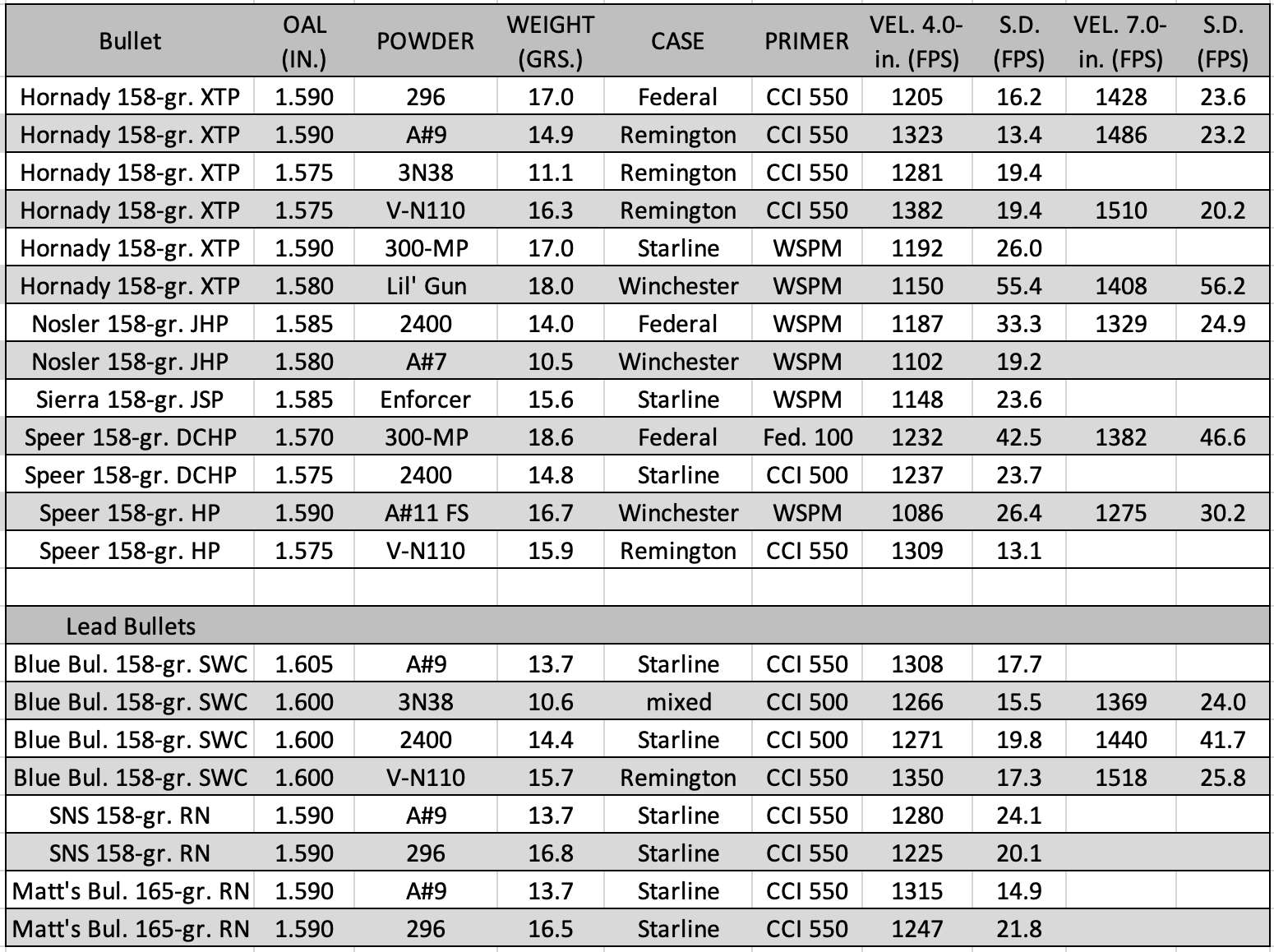
There’s no shortage of data for 158-grain bullets in the .357 Magnum, and several powders were able to match factory ballistics of 1,235 to 1,240 fps, or close to that. These are all slow, magnum handgun powders and includes 300-MP, 2400, Accurate #9, 3N38 and N110. The load with 296 was a little shy of target speed at 1,205 fps from my gun. Loads with Accurate #9 and Vihtavuori N110 with jacketed bullets exceeded 1,300 fps from the 4-inch barrel, right up there with Remington’s speedy ammunition. The fastest load with a jacketed bullet was the maximum charge with Vihtavuori N110 and the Hornady 158-grain XTP that reached 1,382 fps from my 4-inch barrel, which is on par with Buffalo Bore’s 1,385 fps. It ran 1,510 fps from my 7-inch barrel, which would easily equal the old 1,550 fps if it was fired in a 8.38-inch barrel used in the old days.
All loads in my table with lead bullets in the 158-grain category were on par with the factory velocity goal. These are with the same powders that did the same with jacketed bullets, and this time included 296. Three loads exceeded 1,300 fps. Vihtavuori N110 produced the highest lead bullet speed at 1,350 fps, topping 1,500 fps from my 7-inch gun.
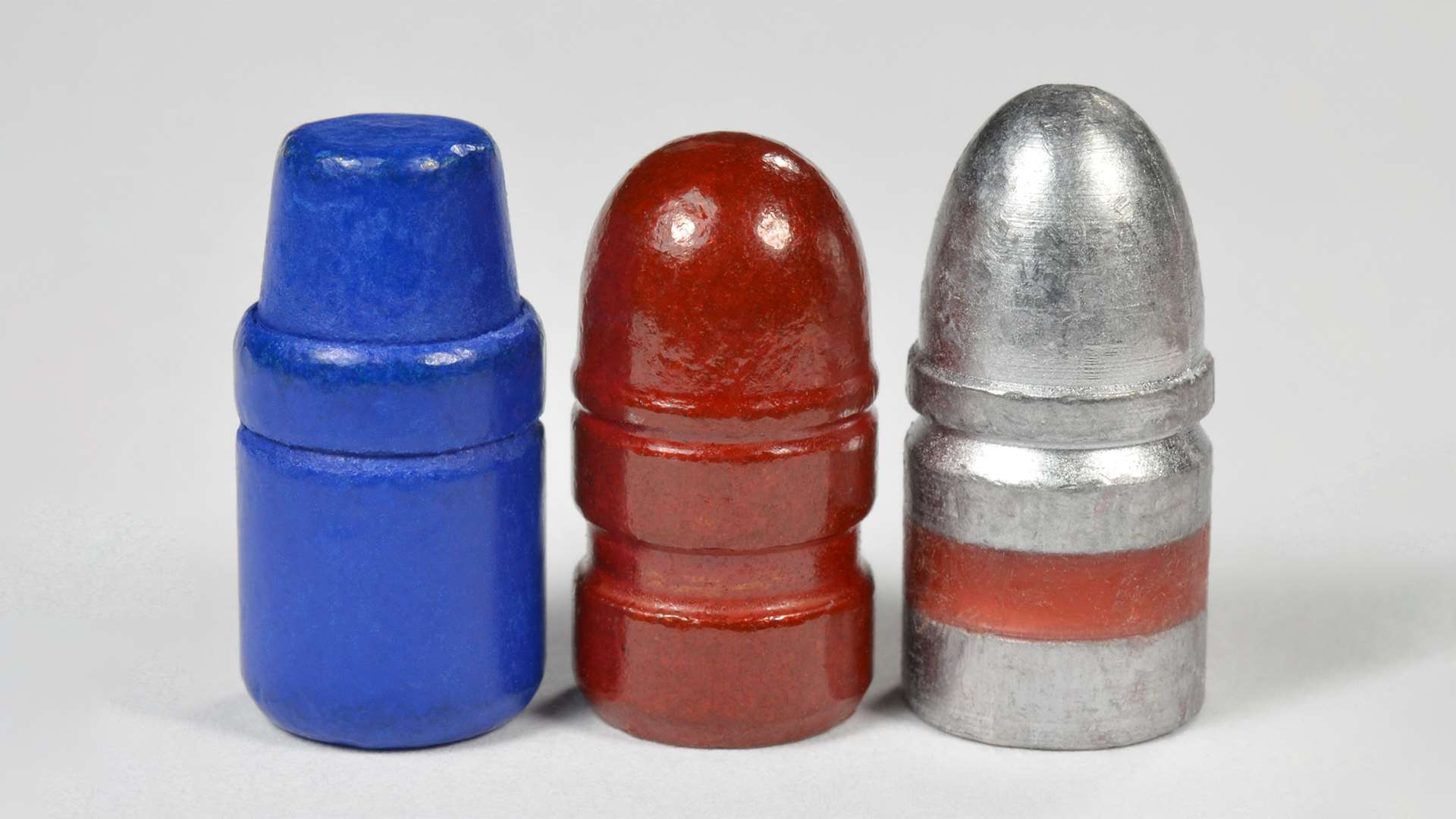
Readers will notice that the loads with Blue Bullets’ 158-grain SWC are loaded to 1.600 to 1.605 inches, which is longer than the SAAMI maximum overall length of 1.590 inches. This was done to allow crimping in the crimp groove. Many .357 Magnum cylinders will accept this length without it being too long and protruding from the chamber.
I included data in the table from powders that didn’t produce the expected velocity with 158-grain jacketed bullets, even when I used the maximum listed charge weights. These are slow handgun powders, such as Enforcer, Accurate #11 FS and Lil’ Gun. Published data showed high speeds, but they fell short of that in my 4-inch gun. And Accurate #11 FS didn’t do well in my 7-inch gun either, with speeds just above what it should have produced in my 4-inch barrel. Lil’ Gun redeemed itself reasonably well in my 7-inch gun, producing a speed of 1,408 fps with the Hornady 158-grain XTP, but its speed in the 4-inch barrel wasn’t so great at 1,150 fps.
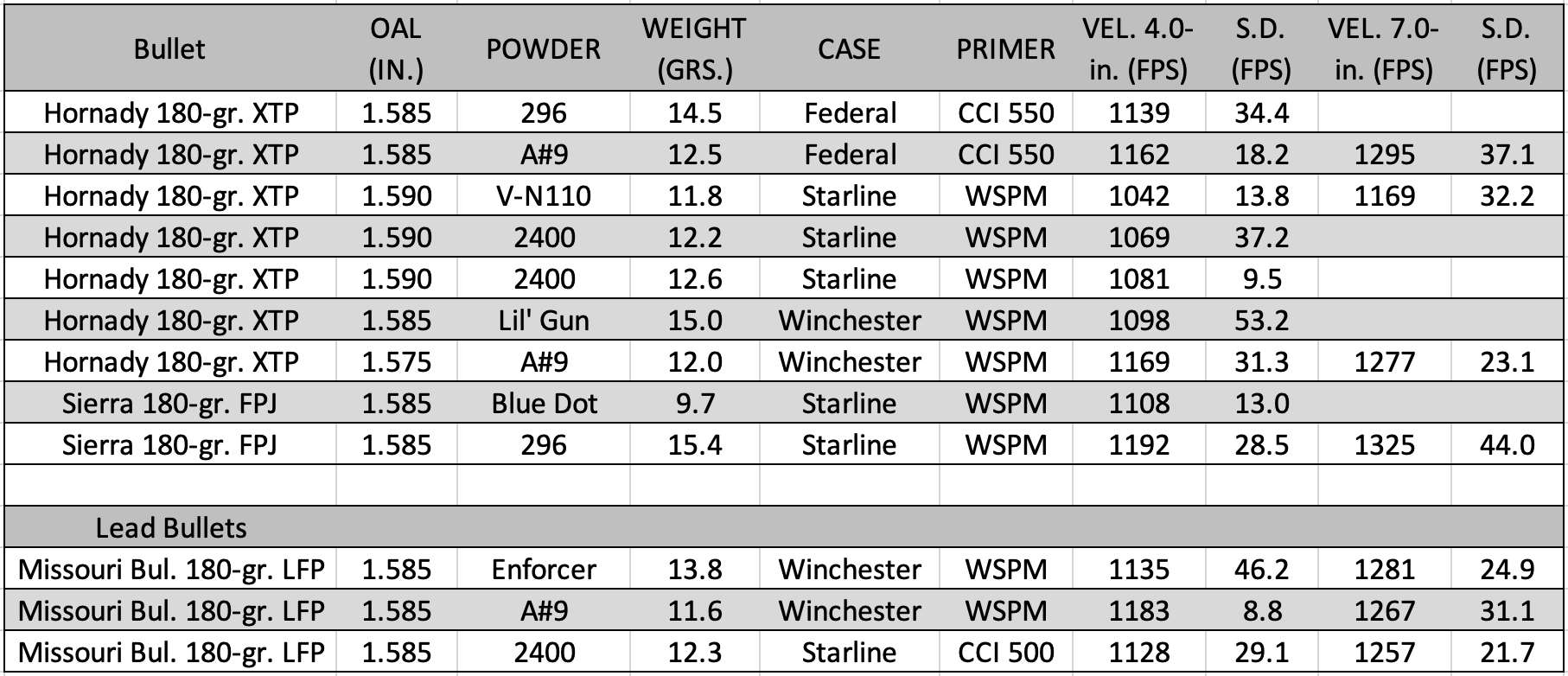
Based on the results I had with factory 180-grain loads, which were much faster than expected, I wondered how the handloads would perform. Federal and Remington factory loads exceeded their published speed by quite a bit in my 4-inch gun, reaching slightly more than 1,150 fps. In any case, the top speeds I found with handloads would cover the range of Federal and Remington published (and actual) speeds with no difficulty.
Four loads with 180-grain bullets exceeded 1,150 fps in my gun. They were powered by Accurate #9 and Winchester 296. The fastest was at 1,192 fps produced with 296 pushing the jacketed Sierra 180-grain bullet. It also was the fastest from the 7-inch barrel at 1,325 fps, which was close to Underwood’s lead bullet speed of 1,345 fps from the same gun.
Top speeds with 180-grain lead bullets were quite good, with all three in the table exceeding 1,100 fps. Here, Ramshot Enforcer produced good performance with 1,135 fps from the 4-inch barrel and 1,281 fps from the 7-inch barrel. The fastest load was 1,183 fps from the 4-inch barrel driven with Accurate #9. I could not match Underwood’s 180-grain lead bullet velocity with these handloads, but wasn’t too far off, being only 53 fps slower.
Final Thoughts
In summary, it was possible to match factory .357 Magnum ballistics of the major ammo manufacturers for 110-, 125-, 158- and 180-grain bullets. Matching the performance of the boutique loads from Buffalo Bore and Underwood was not as easy. Buffalo Bore’s super-fast 125-grain JHP was more than 100 fps faster than the results I achieved. Commercial loaders have access to more powders than the public, so this isn’t too surprising, since powder choice can make a big difference in muzzle velocity.
Gunpowders that proved useful with several bullet weights were Accurate #9, Winchester 296 (same as Hodgdon H110), Alliant 2400 and 300-MP, and Vihtavuori 3N38 and N110. These powders provide several excellent options to handloaders.
The responsibility of a handloader is to work your loads up from a starting charge 10% to 15% below the max load, or at the starting load recommended in the manual. This is necessary because you don’t know how the lot number of your powder will shoot relative to the published load maximums. Also, your specific gun might react different than the manufacturer’s test equipment. Be careful with your handloading to stay safe.