Our first article in this series highlighted Five To Go because it is the simplest stage in terms of how to shoot it. It’s a straight left-to-right transition. The remaining seven stages aren’t that simple because all will require one or more reverse transitions.
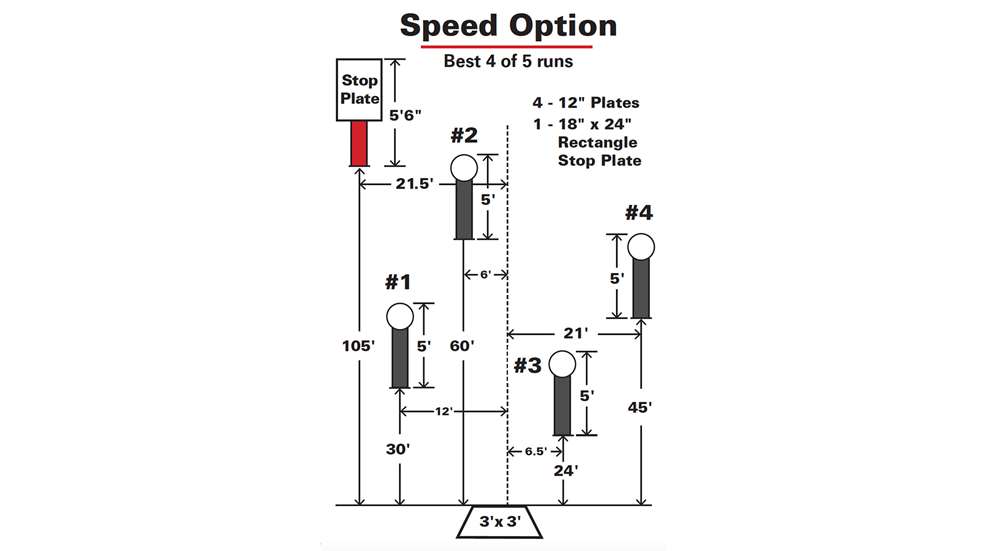
A reverse transition sees the gun moving smoothly in one direction, followed by an abrupt stop and then a reverse swing in the opposite direction. This tends to eat up those precious fractions of seconds critical to a good score. Savvy shooters will try to figure out how to avoid as many reverse transitions as they can while fitting the target array into their most favorable shooting rhythm. The misnamed Speed Option stage (SC-107) is an excellent example.
I say “misnamed” because when Speed Option was originally incorporated in Steel Challenge, there was an option for shooters. Target No. 2—a 12-inch plate at 20 yards—was an optional plate. If a shooter didn’t engage it, or engaged and didn’t hit it, there was no three-second missed plate penalty. If a shooter did hit No. 2, they received a two-second deduction from their score for that string. This resulted in many shooters flinging a round at it on their way by and hoping for the best. Those that hit it achieved some blisteringly fast times.
Apparently, those times were too blistering, so around 2005, that option was removed and the No. 2 became a hit target. The only option remaining now is a three-second penalty if it’s missed.
This is one of the more challenging stages because the swing arc between the two widest targets—target No. 4 and the rectangular Stop plate—is a hair over 14 yards. That’s a lot of gun movement, and there is no way to shoot it without at least one reverse transition.
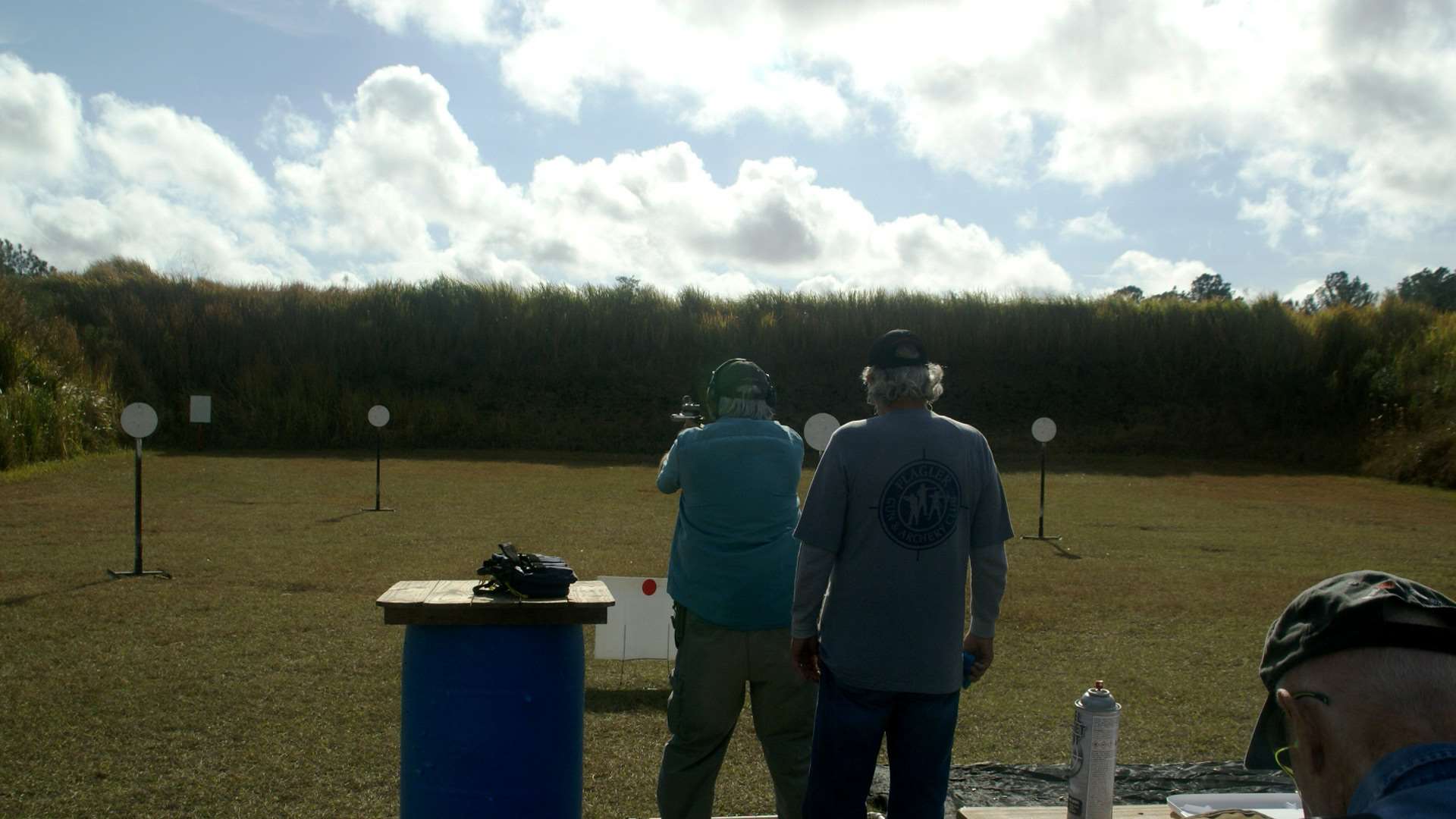
The most effective way I’ve seen this shot among the Grand Master, Master and the other A shooters that I regularly shoot with is No. 4, No. 3, No. 2, No. 1 then Stop. Once a shooter comes up to No. 4, the No. 3 target can be taken on the move to No. 2. This is the toughest target and most shooters set their natural point of aim on it. It often takes a slight pause to assure a hit, but then No. 1 is a quick transition on the same swing arc. From there, a short right reverse transition hits the stop plate.
Some shooters have trouble with that right reverse transition. Their alternative is to set the same NPA on No. 2, but shoot No. 4, No. 3, No. 1, No. 2 then Stop. That’s two reverse transitions, but they’re short and the shooter comes to the Stop plate from the right, which many find more positive.
For the Speed Option stage, the fastest peak time is 9.00 seconds, Rimfire Pistol Open (2.25 average) while the slowest is 14.00 seconds for Iron Sight Revolver (3.50 average). It pays for a shooter to figure out the fastest way to deal with this deceptively challenging stage.
Steel Challenge Targets
In Steel Challenge, all round steel plates are five feet high to the top of the target as viewed from the shooting box and all rectangles are five feet, six inches to the top of the target as viewed from the box. The Pendulum stage is the exception, with two round targets that are six feet to the top of the target as viewed from the shooting box. Set properly, all targets should appear level from the shooting box, although the rules provide leeway for up to two inches of height variation. All of the plates are generally painted white for the eight official Steel Challenge stages. In snowy conditions, alternative colors can be used. For the Stop plate, the post or pole used for mounting should be painted red, orange or yellow on the surface facing the shooting box for clear identification.
Next month, we’ll review the fan-favorite Smoke & Hope stage. Learn more about Steel Challenge at scsa.org.
Read more: Review: Taurus TX22 Competition