WARNING: All technical data in this publication, especially for handloading, reflect the limited experience of individuals using specific tools, products, equipment and components under specific conditions and circumstances not necessarily reported in the article and over which the National Rifle Association (NRA) has no control. The data has not otherwise been tested or verified by the NRA. The NRA, its agents, officers and employees accept no responsibility for the results obtained by persons using such data and disclaim all liability for any consequential injuries or damages.
Read the previous article in this series—Progressive Presses: Optimum Powder Metering Tips.
This article will answer a special request from several competitive shooters in Alaska. They asked about procedures for morphing once-fired GI 5.56 mm brass into accurate match brass for NRA High Power Rifle use. The U.S. Army Marksmanship Unit (AMU) has used virgin Lake City (LC) 5.56 mm brass to win National Championships and set National Records for many years. In this 3-part series, we'll share techniques proven to wring match-winning accuracy from combat-grade brass.
The AMU handloading shop does not reload fired 5.56 mm brass. We use virgin LC brass with our chosen primer already staked in place. However, our staff has extensive personal experience reloading GI brass for competition, which will supplement the shop's customary steps. In handloading, as in life, there are many ways to accomplish any given task. Our suggestions are note presented as the "only way," by any means. Time for loading and practicing is always at a premium. Readers who have more efficient, alternative methods that maintain top accuracy are invited to share them with us.
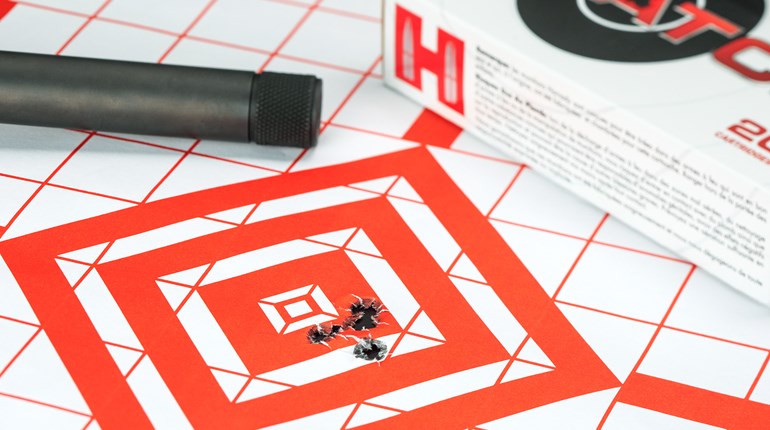
So, how accurate can previously-fired GI surplus brass be in a good NM AR-15? Well, here's a data point from many years ago that might be of interest. A High Power shooter who wrote for the late Precision Shooting magazine took a Bill Wylde-built AR match rifle to a registered benchrest (BR) match. His first group ever in a BR match officially measured at 0.231-inches at 200 yards (five rounds). This was in front of witnesses, using a moving target backer that confirmed all five rounds were fired.
He recounted that his ammo was loaded progressively with standard match bullets using mixed years of LC brass with no special preparation whatsoever. Obviously, this was "exceptional" (read: "fluke of universe"). However, he had no difficulty obtaining 0.5 MOA accuracy out to 200 yards using LC brass in subsequent testing. He later refined his accuracy to 0.3 MOA using high quality, selected commercial brass.
Assuming our readers will be getting brass once-fired as received from surplus dealers, the following steps can help process the low-cost raw material into reliably accurate components. First, clean the brass of any dirt/mud/debris, if applicable. Depending on the brass's condition, washing it in a soap solution followed by a thorough rinsing may help. This step also extends the life of ones' tumbling media. Approaches range from low-tech, using gallon jugs half-full of water/dish soap plus brass and shaking vigorously, to more high-tech, expensive and time-consuming methods.
When applying the final cleaning/polish, some use tumblers with liquid cleaning media and stainless steel pins for a brilliant shine inside and out, while others take the traditional vibratory tumbler/ground media approach. Degree of case shine is purely personal preference, but the key issue is simple cleanliness to avoid scratching ones’ dies. If a liquid cleaner is used, be sure to dry the cases thoroughly to preclude corrosion inside.
One method is to dump the wet brass into an old pillow case, then tilt it from left to right so the cases re-orient themselves while shifting from corner to corner. Several repetitions, pausing at each corner until water stops draining, will remove most water. They can then be left to air-dry on a towel, or can be dried in a warm (150° F-200° F max) oven for a few minutes to speed evaporation.
Once dry, inspect each case for significant deformation (i.e., someone stepped on it), damaged mouths/necks and case head/rim damage. Some rifles’ ejectors actually dig small chunks of brass out of the case head—obviously, not ideal for precision shooting. Similarly, some extractors can bend the case rims so badly that distortion is visible when spinning them in one’s fingers. These can be used for plinking, but our match brass should have straight, undamaged rims.
Dented case mouths are common, and these can easily be rounded using a conical, tapered tool. A dummy 7.62 mm or .30-06 cartridge with a FMJ spitzer is ideal. If most of your brass is of one headstamp, this is a good time to cull out any odd cases.
The clean, dry and inspected brass is now ready for full-length sizing, decapping and re-priming. Historically, primer crimps on GI brass have caused some head-scratching (and vile language) among handloaders. In our next article we will detail efficient, easy and practical methods to remove primer crimp, plus other useful handloading tips.
Continue to Part 2.
SSUSA thanks the U.S. Army Marksmanship Unit for allowing the reprint of this article.
Most Popular