
“Civilians, with a greater personal investment of time and money, often challenge the military shooters to heights of performance they seldom encounter.”
—Gun Week, July 1990
The onslaught against the National Matches intensified in 1990 when the House Armed Services Committee cut DCM funding and set in motion a plan to make the government program a self-supporting agency.
In May 1990, the U.S. General Accounting Office, an investigative arm of Congress, submitted a report entitled “Military Preparedness – Army’s Civilian Marksmanship Program is of Limited Value” to the Chairman of the Armed Services Committee. By November, the legislative pressure cooker had produced a mandate that was signed into law by President George Bush. While appropriations for the matches were secured for the short term, a bill (H.R. 4739) amended several sections in Title 10 of the U.S. Code to the extent that National Board funding and free issue privileges were eliminated and the DCM was to become self-sufficient within two years.
“Never before … had an entire championship sub-aggregate, including the corresponding team match, been canceled.”
—American Rifleman, October 1990
As it turned out, the concept of elimination had direct implications during the 1990 National Matches, specifically the pistol program. Severe wind and rain, while not uncommon at Camp Perry, led to the unprecedented cancellation of a complete day of firing. No .45 scores were factored into the 1990 aggregates (individual or team) when the combination of a downpour and 30 m.p.h. winds rendered one of the four ranges inoperable before all relays could be fired. With no time available for rescheduled firing, this year’s national champions were determined by .22 and center-fire scores only—for an 1800 possible.
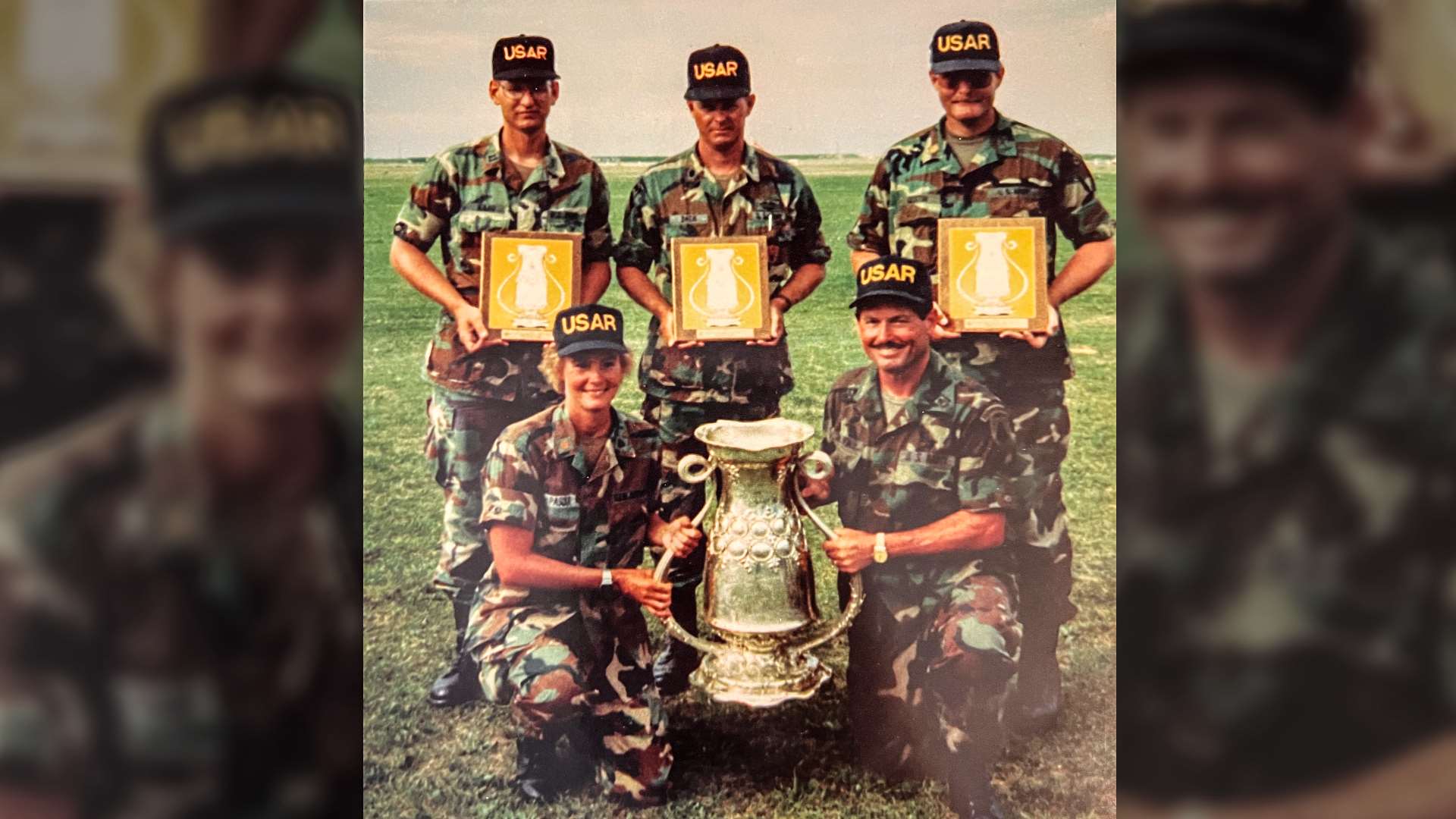
The inoperable range also required the resquadding of two Board events and the concurrent firing of the President’s and National Trophy Individual Matches. Marine Staff Sgt. Mitchell Reed garnered both titles as his high NTI score counted for both contests. Reed then completed his Board sweep by leading USMC Scarlet to a one-point victory over USAMU Blue in the National Trophy Team Match.
A few days prior, James Lenardson of the Air National Guard made the biggest impact before it was known that the championship would be determined on an abbreviated firing schedule. His 1764-90X did not include high scores in either the 22 or Center-Fire Championships—civilian champ Allen Fulford and Army Reserve Champion Norm Girardin won those—but Lenardson’s total topped the Army’s Jimmie McCoy by three and Girardin by four to secure his second Harrison Trophy in three years. Lenardson also fired on the Guard foursome that won this year’s Twining Trophy for NRA Team Aggregate honors. Fulford finished five points off the pace to earn his fourth civilian win in as many years while Marine Sgt. Roxane Conrad successfully defended her women’s title. In addition, Wanlace Yates, Jr., topped the junior field and Joe White reclaimed the senior trophy he last won in 1988.
A lot of fine young talent came to Perry in 1990 to take on the legendary Lones Wigger, Jr., possessor of 19 national position crowns. One challenger was Army Maj. Jim Meredith, 38, whose military obligations had kept him away from Camp Perry for the previous six years. Meredith proceeded to make up for lost time in memorable fashion—he denied Wigger a 20th title in a final shot showdown.
College shooter Erin Gestl, who had won some sort of smallbore title each year since 1986, jumped to the front of the pack early and performed consistently to win the metallic-sight championship with a score of 1123-40X. Wigger stood six points off the lead yet quickly gained ground once scopes were affixed. Meredith and Army teammate Mike Anti were hot on Wigger’s heels and the championship came down to the final match, kneeling. The uncomfortable position was Wigger’s forte, and everyone knew the match would not be decided until the loading blocks were empty. Wigger seemed in control of his game, but he let slip a seven on his 40th shot.
Wigger still managed to win the any-sight championship and tallied a 2259 overall, but Meredith finished two points up and earned himself the Parson’s Trophy along with service honors as the national position champion. With his gold medal, Meredith matched what his older brother Bruce did at the national prone championship in 1967. The two siblings thus became the first (and only) brother combination to win national titles at Camp Perry. Wigger accepted his second silver position medal and civilian championship in as many years. Army Lt. Rhonda Barush claimed the women’s title and Mary C. Camp Trophy while Fred Cole continued his winning ways with his seventh position title as either an intermediate senior or senior. Gestl picked up collegiate honors and Ken Benyo topped the juniors.
After the position team matches, which the USAMU Blue team of Meredith, Barush, Anti, Dave Chesser and Troy Baker dominated, the line filled with prone shooters anxious to get started. Juniors, especially, proved right away that they were not taking back seats to their elders as young shooters like Shawn Wells, Nicole Panko, Alyssa Cosmo and Beth Herman posted 400s early.
The Hoppe Trophy for the metallic-sight championship went to Wigger, who held a two-point edge over Gestl and T.R. Bishop. Edie Reynolds led the women and was also within striking distance of Wigger. Longtime veterans and juniors alike shot impressively over the second half of the championship and the multitude of 400s fired indicated both the high level of skill and pretty good conditions. The winning score in the any-sight aggregate was a 3199-245X posted by Ron West, who went on to claim the intermediate senior national title.
Overall, Bishop finished with the highest total and garnered the prized Critchfield Trophy. Up until this time his greatest claim to fame at the National Matches was that he was the father of 1984 sub-junior champion Liza Bishop. His 6388-483X bettered Wigger and service champion Douglas Clark of the Air Force by one and two points, respectively. Bishop’s Black Hawk Rifle Club teammate Reynolds collected her second Remington Trophy as women’s champ while Richard Hanson ran his consecutive senior win streak to four.
Stand-by lists were needed in 1990 as high power attendance neared 2,200 competitors, the highest count in 25 years. Nearly 1,600 shooters lined up for the President’s Match, won by Army Specialist Lance Hopper. Teammate and defending service rifle champion Vince Greiner, who coached the 1990 winning Whistler Boy team, finished atop the NTI field while Army Reservists edged Army and Marine units by one point in the NTT. Rattle Battle laurels were awarded to the All National Guard Spruill team for their 27-point victory over Army Blue in the National Trophy Infantry Team Match.
Two-and-a-half decades earlier, Army Lt. David Meredith won the NRA high power title with a rare service rifle win. Back then, the championship consisted of a seven-match aggregate for an 800-point possible. Now 25 years later, with the aggregate tripled in point value, the leader of the pack was none other than G. David Tubb, whose mastery with the match rifle produced a fourth national title over a six-year span.
Tubb’s 2380-108X included Nevada and Clarke Trophy Aggregate wins for a score just one point off the championship record he set two years earlier, and a full eight ahead of Carl Bernosky, who finished second. Bernosky carries the National Match distinction as the first high power shooter to win four straight titles (1977 through 1980).
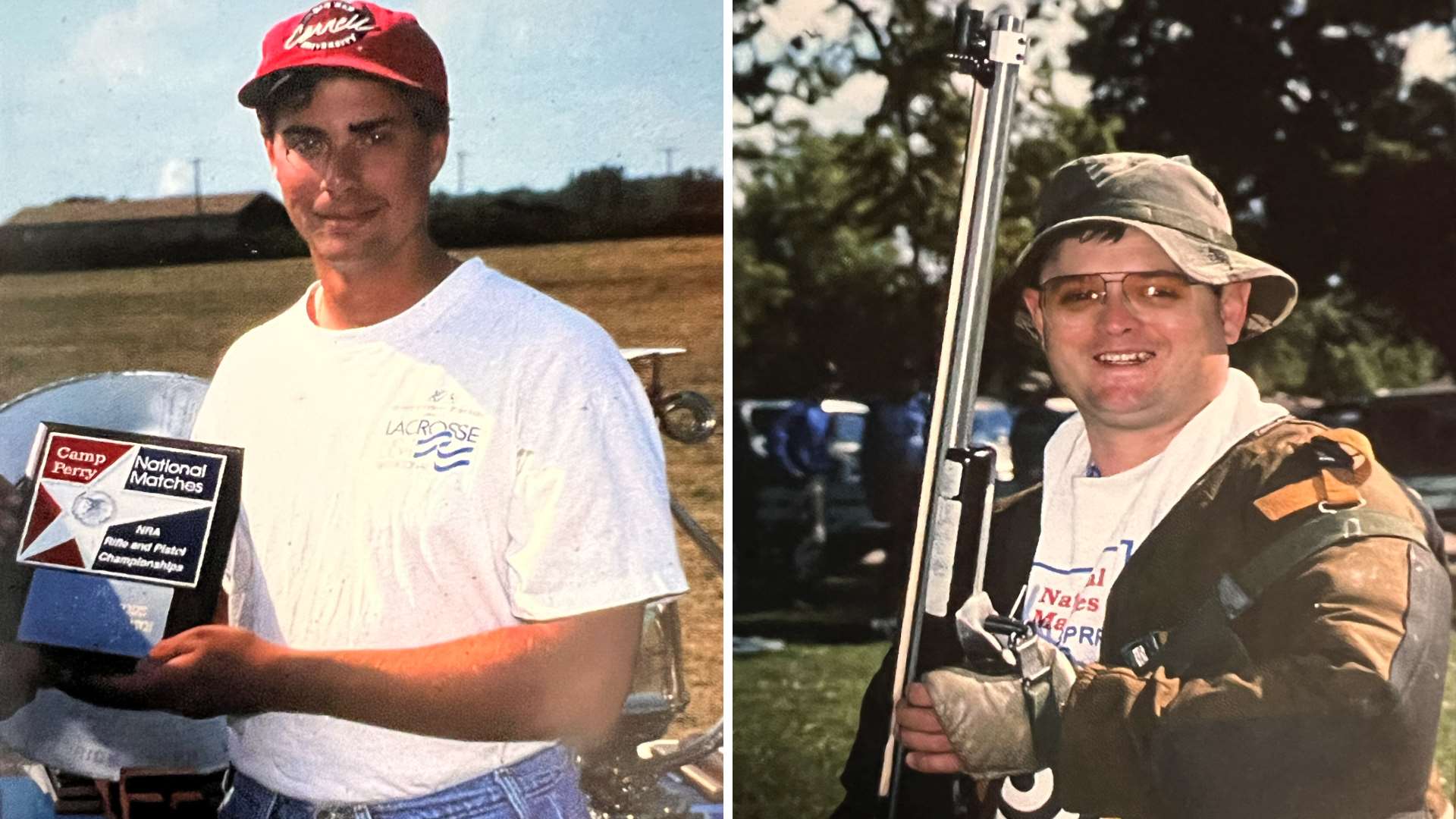
“As competitive rifle shooting enters the final decade of the 20th century, David Tubb … is emerging as one of America’s premier riflemen, perhaps of the century.”
—American Rifleman, October 1990
Throughout the championship, Tubb was also challenged by Vandenberg Cup victor and eventual service winner Army Sgt. Eric Uptagrafft and four-time match rifle champion Pat McCann, who finished third. A crossfire in the Navy Cup Match all but eliminated McCann from title contention but his competitive demeanor did not diminish, and he ended up with the high aggregate score in the rapid-fire matches to claim his second straight namesake award—the McCann Trophy. Tubb sealed his title bid with trademark consistency and a victory in the final 20-shot match (Crowell), his only single-match win of the championship.
Nancy Tompkins-Gallagher won her second straight women’s championship and teamed with former women’s champ Noma Zinsmaster, her husband Steve Zinsmaster and 1990 senior champ Bob Jensen to fire the winning score at 1,000 yards in the Romanian Trophy Team Match. Tompkins-Gallagher also placed second in the Palma Individual Trophy Match, finishing behind husband and renowned National Match presence Mid Tompkins. The pair also finished third and fourth in the long-range battle for the award bearing the family name (Tompkins Trophy), determined by scores fired in the 600-yard matches of the NRA championship plus the 800-, 900- and 1,000-yard scores logged in the Palma Individual, Leech and Wimbledon Cup matches. Leech Cup winner Mitchell Maxberry nabbed the honor while Earl Liebetrau garnered his second Wimbledon Cup. The Canadian Cup for high combined score in the Palma, Leech and Wimbledon was won in record fashion by Johnie Franklin with a score of 841-39X.
1990 National Matches Fact
Two former high power champions and contenders for the 1990 title share a rare distinction. Both Pat McCann and Carl Bernosky had years in which they won the match rifle championship, but not the overall championship. The last two times service rifle shooters were named NRA National High Power Rifle Champions were in 1987 when Greg Strom edged McCann and in 1981 when D.I. Boyd denied Bernosky a fifth straight overall title.