WARNING: All technical data in this publication, especially for handloading, reflect the limited experience of individuals using specific tools, products, equipment and components under specific conditions and circumstances not necessarily reported in the article and over which the National Rifle Association (NRA) has no control. The data has not otherwise been tested or verified by the NRA. The NRA, its agents, officers and employees accept no responsibility for the results obtained by persons using such data and disclaim all liability for any consequential injuries or damages.
Welcome to Part 3 of the U.S. Army Marksmanship Unit’s (AMU) series on sorting bullets for long-range accuracy. As before, if you missed Part 1 or Part 2 on this topic, you might want to review them for helpful background information.
Previously, we discussed sorting bullets by OAL, and how to select sorted groups/dimensions based on your needs and sample sizes. A reader asked the question whether the AMU considers sorting by OAL to be more important than sorting by base to bullet ogive. There is typically significantly more OAL variation within bullet lots than there is base-ogive variation, so, yes, the primary sort is by bullet OAL.
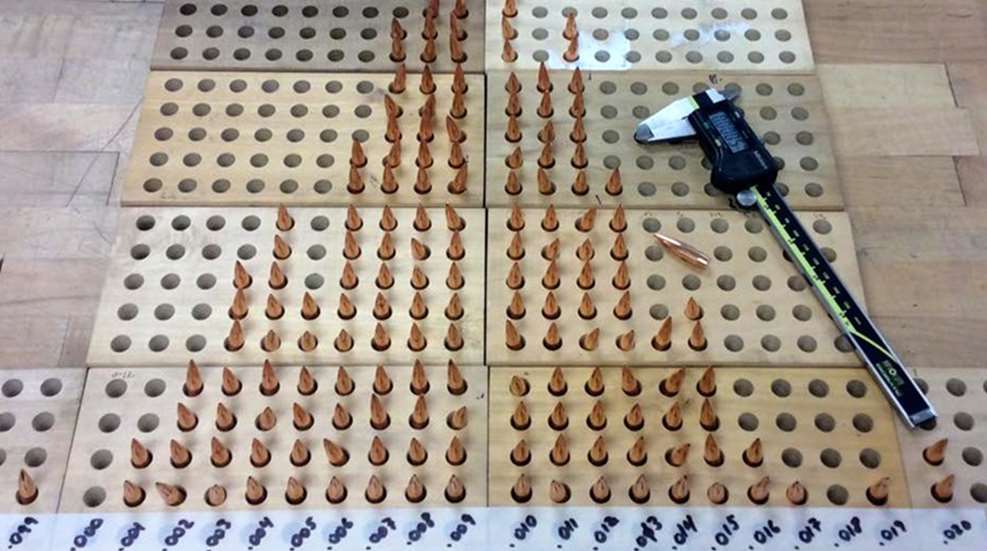
If one wishes to go still further for the most demanding long-range applications, one can apply a “double sort”—i.e., sort first by OAL in 0.001-inch increments, and then sort those groups by 0.001-inch increments using a bullet comparator which reads on the ogive. When setting up OAL of your loaded cartridges, it is normally more precise to use the cartridge base-to-ogive length than cartridge OAL from tip to base, due to the lower variation inherent in the ogive measurements.
A couple of basic points bear mentioning: individual lots of bullets can vary significantly in their uniformity of bullet OAL (base to tip). Thus, some lots will give many bullets that fall within tight sorting parameters, greatly shortening the sorting procedure time and also increasing the percentage of bullets that meet the desired specifications.
Second, it's our anecdotal, not statistically proven experience that bullets from highly-uniform lots shoot better at distance in our machine rest testing than bullets from less-uniform lots. That is, even after sorting bullets from both lots to the same tight tolerances, the ones from the more-uniform lots seem to shoot tighter, with few fliers.
The sorted bullets from the less-uniform lots shoot almost as well, but may have occasional fliers that open up groups that would otherwise be very small. Intuitively, this makes sense—there are factors other than bullet OAL and ogive length that affect accuracy, and the less deviation present to start with, the more accurate the final product will be.
So, as a dedicated long-range shooter wanting the utmost in accuracy for very important matches, it might be worthwhile to assess the variation in each new bullet lot, using the histogram method outlined in part one. Super-uniform lots might be reserved for the most important uses.
The “double-sort” method can be quite time-consuming, and we rarely use it except for the most demanding applications. To give an example of the numbers involved, using an average (not great) lot of match bullets, one such sort started with 0.002-inch total allowed overall variance in OAL (to increase the number of usable bullets significantly while still holding very tight tolerances.) Sorting approximately 1300 bullets yielded about 400 in a 0.002-inch OAL range.
The second sort was for bullets from that 400 that fell into a 0.001-inch base-ogive length range. That sort yielded a little over 150 super-sorted bullets. These did shoot quite well at long-range, as expected.
As mentioned in Part 2, here the individual shooter, handloading for one particular rifle, has an advantage vs. the AMU, which must load larger quantities of bullets for multiple shooters with different rifles. The individual can use bullets from each 0.001-inch bullet OAL sort if desired, then sort by ogive, making small but highly-uniform lots which can be kept together for given events. This is not practical on the scale of loading which the AMU does for its' teams.
Again, we'll close with the reminder that one should always tailor the level of precision of one's ammo to one's ability, the rifles' accuracy, and the application. Many shooters would be better served to get more practice in the wind, than to spend endless hours sorting bullets, only to shoot a few times per year. The overall goal must always be kept in mind when loading, practicing, dry-firing, etc.
That goal is to win, and the sub-goal is to add points to one's score where needed, in the most efficient manner possible, in order to increase the probability of a win. Thus, if offhand is your particular challenge, but long-range prone is going well, it would make more sense to emphasize offhand than to spend those hours at the loading bench tweaking an already excellent long-range load.
Next up—How to Check Your Work: Accuracy and Chronograph Testing, Part 1.
SSUSA thanks the U.S. Army Marksmanship Unit for allowing the reprint of this article.