WARNING: All technical data in this publication, especially for handloading, reflect the limited experience of individuals using specific tools, products, equipment and components under specific conditions and circumstances not necessarily reported in the article and over which the National Rifle Association (NRA) has no control. The data has not otherwise been tested or verified by the NRA. The NRA, its agents, officers and employees accept no responsibility for the results obtained by persons using such data and disclaim all liability for any consequential injuries or damages.
As most reading this know, tailoring COAL to one’s individual rifle can significantly affect both accuracy and functioning. Even within the same caliber (e.g., .223 Rem. or .308 Win.), there are many different chamber designs and each can require different COALs for best accuracy.
Barrel throat erosion may also require increasing the COAL over time to maintain the bullet’s desired relationship to the rifling. In general, the less distance a bullet has to travel to reach the lands when leaving the case mouth, the better one’s accuracy potential is apt to be. This travel leaves the bullet unsupported; longer “bullet jump” increases chances the bullet may enter the rifling off-center. However, this rule is not always true; keep an open mind when experimenting with seating depths. Sometimes, bullets perform better with more “jump” to the rifling, rather than less.
The techniques we’ll discuss are used by advanced handloaders for competition shooting. Additionally, they have applications for hunting and informal long range target shooting.
Some firearms, such as repeating bolt actions and semi-autos, require cartridges loaded within specified maximum and minimum lengths for proper function. However, their accuracy can often be improved by matching COAL to fit their individual chamber.
This length may exceed the standard “magazine” COAL for repeaters and require single-loading each cartridge—e.g., the Slow Fire 600-yard phase of the National Match Course. When developing loads for a new rifle (or with a new bullet design), it’s important to establish and record the maximum COAL for one’s individual firearm. This is the length at which the seated bullet touches the rifling lands. Depending upon one’s chamber and choice of bullet design, this may or may not match up well (for accuracy) with the “standard” magazine length.
“Bullet Comparators” or “Cartridge Overall Length Comparators” can be very helpful. These measure the area where the bullet engages the rifling (ogive), rather than measuring at the bullet’s tip. Depending on many factors, individual bullets, even from the same box, can vary in length by up to ~0.020 inch. This reduces precision when measuring COAL from tip-to-base of the cartridge. Cartridge ogive-to-base measurements using a comparator usually vary only ~0.004 inch or less, offering much greater precision.
However, some commercially-available COAL gauges allow the bullet to be seated into a dummy case, chambered, and then manually pushed forward in the case neck with a rod until the bullet touches the lands. That measurement is then recorded; this method saves considerable time vs. older, less-precise methods. Saving/reusing the exact bullet used for the original measurements helps the handloader accurately track barrel erosion over time.
One easy approach is to keep this “reference bullet” in your loading die box. If you load for many different rifle calibers, the cost savings of the homemade vs. commercial dummy cases can be significant (several dollars each).
Since different bullet designs have different ogive shapes, one should take new measurements whenever beginning load development with new bullet designs. These measurements should always be taken in a clean barrel—for best precision.
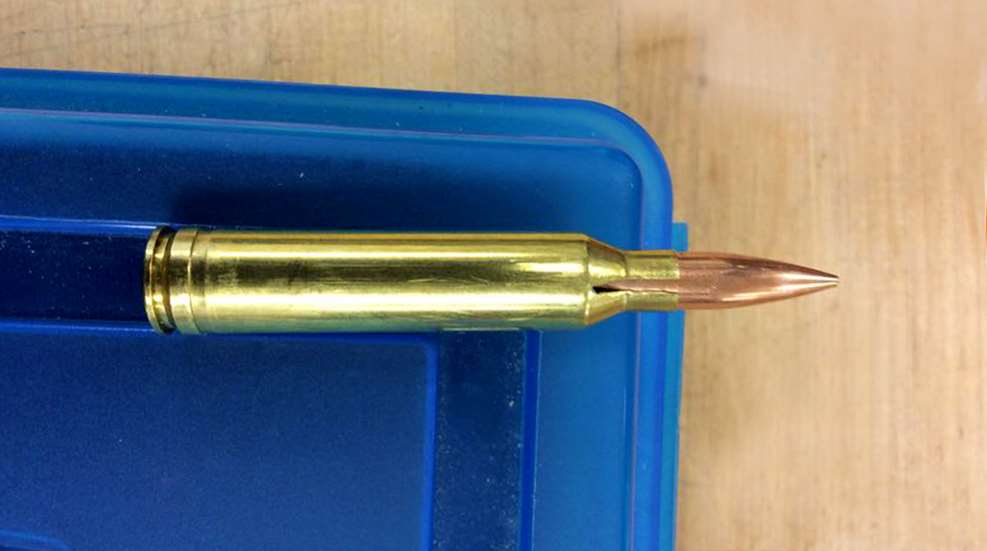
Cost savings alert: As promised, here’s a proven method of making a quick and easy COAL gauge for free. Take a sized case, and cut two slots across from each other in the case neck with a Dremel tool cut-off wheel, etc. Case neck tension can be adjusted by squeezing the two neck halves together.
Seat the bullet beyond the maximum COAL, and chamber the dummy. Carefully extract it, and the bullet will have self-seated to touch the lands. Repeat this process until one is satisfied that readings are accurate. One staffer here makes small “teeth” on his gauge case mouths with a knife so that the bullet is scratched when seating, permanently marking the max. COAL. This type gauge has proven quite accurate/repeatable in our informal testing. It also allows seeing the bullet base location relative to the case neck/shoulder junction.
When loading for maximum accuracy, it’s best to start by seating bullets shorter than the maximum COAL. Loading so that bullets touch the rifling increases chamber pressure, while allowing some “jump” to the rifling eliminates this. One good COAL to begin accuracy testing is by seating the bullet 0.020 inch off the rifling. As load development progresses, this COAL may be fine-tuned by changing bullet jump to 0.010 inch, 0.030 inch, etc.
NOTE: Loading with bullets “just touching” the lands can sometimes reduce accuracy, as individual bullet variations may cause some to jump to the rifling, and others to engage it, reducing consistency.
SSUSA thanks the U.S. Army Marksmanship Unit for allowing the reprint of this article.