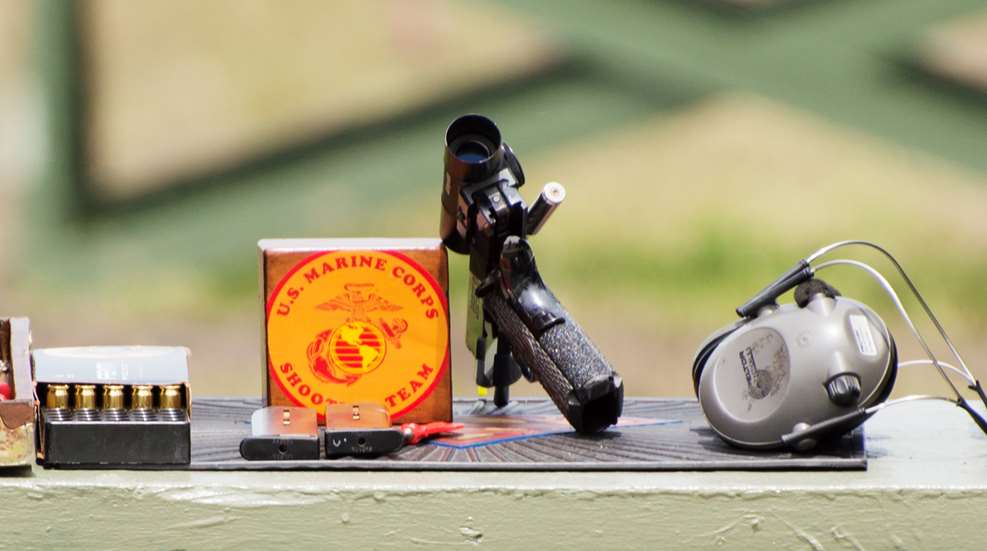
Twelve-time NRA National Pistol Champion Brian Zins knows a thing or two about NRA Precision/Bullseye (Precision is the new official name for Bullseye) pistol competition. Brian’s thoughts on competition and technique are especially valuable, because he doesn't always follow the old traditions with his technique. Previously, Brian shared his tips on trigger control and proper pistol grip, in this article he shares his method of aiming the red dot sight.
Before I get into my theories on looking at the target or the dot (not iron sights), let me share an observation. I have found that many shooters think entirely too much. This is not rocket science, because if it were, I would not be a shooter. Hence, I am not smart enough to shoot badly. When Erich Bujung was the Olympic Pistol Team coach, he always said, “No stinking thinking. The mind is a terrible thing to waste and in Bullseye on the firing line, the mind is just a terrible thing.”
Some history
Thus, I submit to you another way of accomplishing the goal of shooting better. I learned to shoot under the guidelines that legends such as Don Nygord and Bill Blankenship wrote about. I have had the opportunity to shoot with and learn from some of the greatest marksmanship instructors the Marine Corps has had to offer. We were allowed to think out of the box and try out new ideas. I can take only partial claim to the ideas presented here, as they were a collaboration of Andy Moody, Mitch Reed, Mario Lozoya, Chris Hill and myself.
Our goal was to get Marines to shoot a 2600 as fast as possible because unlike the Army, the Marines do not get the luxury of staying on the Team for life. Therefore, we came up with ideas to get Marines to shoot better and faster.
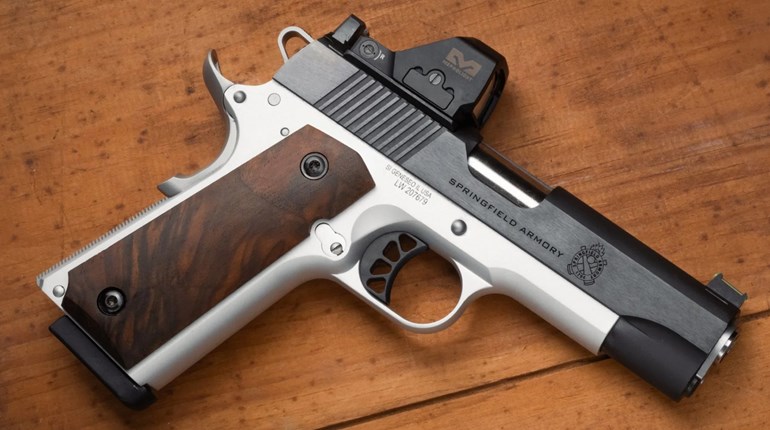
I use an Aimpoint Micro with a 2 MOA dot, not the match four dot, though that is an awesome scope and recommend it for anyone with failing vision. So, on a bright day outdoors my dot level is on about an eight in order to have a small dot. Additionally, with a dot I am not a big advocate of the iris on my shooting glasses but with iron sights, that’s okay.
So I am sure at some point or another you have thrown a ball to someone right? When you threw the ball, what were you looking at? The ball, or the person or object you were throwing at?
Let me explain. With iron sights, three items come into play. Front sight, rear sight and the target or aiming area. However, with the dot you have but two items in play. The DOT and the target. Before I forget, I do understand the difference between sight alignment and sight picture.
Target vs. sight
When I first started shooting, Andy Moody and I were talking about looking at the target vs. looking at the sight. I was young and didn’t know any better so I tried it. Keep in mind this was my first year as a bullseye shooter. I then proceeded to shoot my first ever 100 long-line with my .22. Heck, it was my first 100 long-line period. The team captain called everyone into a circle and asked me to tell them what I did during that string and if I learned something. I told him I turned my dot down and looked at the target as opposed to the front sight. He about had a fit, but some learning had occurred, and not just for me. From that moment on, it became not so uncommon for Marines to look at the target.
Here lies the problem. Many shooters that try this and do not get the desired results are not truly looking at the target. Keep in mind, to shoot a dot in Bullseye and to do it well, you have to either focus on the target or on the dot. Too many people are focusing somewhere between the dot and the target. This is equivalent to looking at the target with iron sights. It’s not going to work. Be true to yourself when determining where your focus is.
For me, I find that when looking at the target I accept the wobble of the dot more and do not get hung up on the trigger. NOTE: if you have a big wobble area this is harder to achieve. There are days that my dot may not sit as still as I like and on said days I will bring my focus back to the dot. So, if you have a decent hold you should be able to do this with a good deal of success. And if you have a big wobble, the true method of looking at the dot is great. Remember that is how I learned to shoot.
Does your dot need to stay centered?
Another question is does the dot need to stay centered in the scope? The answer to that is a great big maybe. First of all, we humans like to see things correct geometrically. What I mean is we like to see a circle in a circle in a circle. If we had change sitting on our desk at some point or another we are going to stack it in the following order: quarter, nickel, penny and then dime. If you stack another way that just means you are little more creative than the average bear and good on you. So it makes sense to put the dot in the center of the scope.
Some dots you have to put in the center, or you will get some parallax and the dot is really not where you think it is. Andy Moody shot with the dot in the bottom of his scope because that is where it rested when he brought the gun to the target. Why fight it? Why muscle the gun to the place you want it to be as opposed to allowing the gun to rest where it wants to be?
Overall, please keep in mind that when it comes to shooting pistols, I have had the opportunity to shoot with and learn from the likes of the earlier mentioned Marines along with Steve Reiter, Doc Young, Jim Henderson and Jimmy Dorsey. I would like to think that I have an original idea to make people shoot better. I try to relate what I have learned over my career, and shed a different light on it.
For more tips from Brian Zins, or if you are interested in his training classes, please visit his web site: www.brianzins.com.
Most Popular