I do not at all think that an adjustable gas block is the best answer to tame an over-active AR-platform gas system—and that means one that operates too quickly, too forcefully. When that’s at issue, gun parts and cartridge cases get beaten unnecessarily, and, if it’s “bad enough,” function problems result—most commonly ejection and feeding failures. Various barrel length, gas system length and cartridge combinations conspire to create this condition. It’s most common with shorter systems, such as carbines, and also with longer than usual barrels using a rifle-length system.
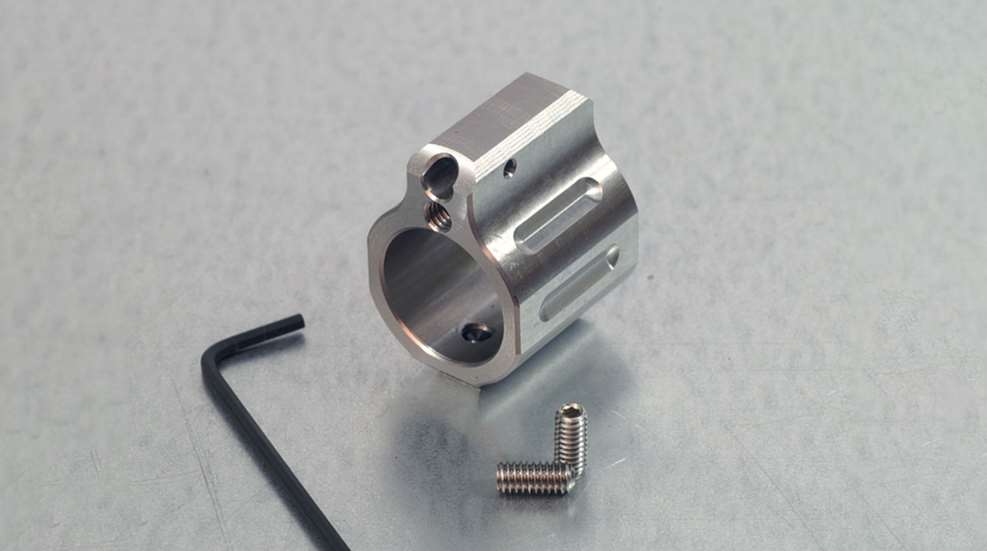
An adjustable gas block houses valving apparatus that’s user-adjustable. Some vent away or bleed off unwanted gas, others restrict or limit the flow of the gas into and through the system. Those that vent tend to hold up better longer.
Clearly, the idea is to install the adjustable gas block and then turn it “down.” Great idea! It’s easy, effective and it doesn’t last forever.
The valving in the block succumbs to the same heat- and pressure-induced erosion (flame cutting) as does a standard system (and as does the chamber throat and gas port) and will change, and it will get dirty, maybe corroded, and might lose its capacity for adjustment. Gas-induced erosion, by the way, increases space volume and that will effectively reduce pressure, so that means a tuned gun might not work after time unless the valve can be readjusted.
Adjustable gas blocks are best in the hands of competitive shooters, and are most wisely used only in rifle-length gas systems. One can work well to tune out percussion-induced rifle movement and will improve spent case condition. The farther ahead the block is from the rifle chamber, the less intense is the pressure and flame.
Complexities and Compensations
A recent article I wrote here discussed the importance and effectiveness of making essential “architectural” changes in the gas system to get closer to the original Stoner rifle spec combination of port location and barrel length (which works just fine, and dandy). However, I will quickly concede that valving might be the only reasonable solution. If we have to work within already-set specs that aren’t nearly ideal, then we may also have to work around that, and there’s the value of the valve.
A good example is something like a 22 Nosler or .224 Valkyrie, which have the same bore diameter as 5.56/.223 Rem. but a good deal additional propellant-generated gas pressure. Both these can stand a good stretch forward in gas port location, and a smaller gas port. However, most ready-to-go barrels have the same system specs as a rifle-standard 5.56/.223 Rem., and that means overt excess in function. Another is a 5.56/.223 Rem. with a 24-inch barrel. Once again, mail-order barrels are about certain to have a standard gas port location and size, same as for a milspec 20-inch rifle barrel. The extra post-gas-port barrel length means that the gas system is sealed under max pressure for a longer time, and common symptoms of excessive gas pressure result. Big-chassis rifles (AR-10s, SR-25s) can have overt x-pressure problems especially when chambered for smaller-diameter bullets (less volume to accept pressure); a valve might be the only post-purchase cure.
Adjustments
I turn one all the way down, all the way closed, and then open it up until the gun works, plus a little more to ensure full function. The “full-function” test, by the way, and this is important, is that the bolt carrier assembly will go to lock-back on the last round. It takes a little more carrier velocity to get it back far enough to trip and set the bolt stop than it does only to strip the next round from the magazine. Don’t cut it too close!
The preceding is a specially-adapted excerpt from Glen Zediker’s book America’s Gun: The Practical AR-15. Visit www.buyzedikerbooks.com or www.zediker.com for more information.
Read more articles by Glen Zediker:
- The AR-15: A Brief History
- Barrel Break-In: How To Do It Right
- 7.62 NATO vs. .308 Win.
- Semi-Automatic Tech: Understanding Chambers
- 4 Easy Mods To Improve Reloading-Die Performance
- Choosing An AR-15 Match Rifle Barrel
- Unboxing Your New Gun
- High-Performance High-Power Rifle Ammo: 6 Things That (Really) Matter