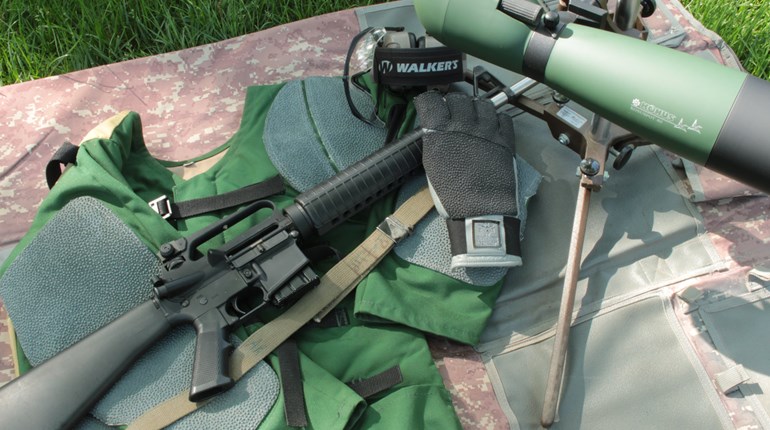
Back in the day, rifle shooters wore cloth shooting coats to protect themselves from abrasive contacts with the ground and to provide a non-slip surface for the shooting positions.
During that same period, match sponsors and organizations gave patches (officially: brassards) to recognize achievement, organizational membership or attendance at shooting events. Attaching these patches to the cloth coats became a common practice.
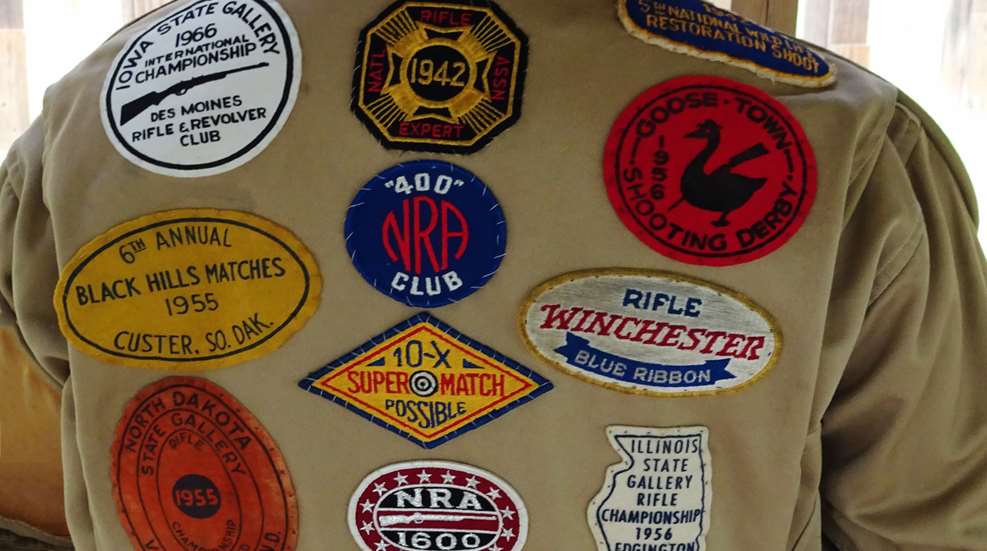
The first example of the well-patched shooting coat was owned by the late Robert Vangene of Minneapolis, MN. Bob was one of the pre-eminent smallbore shooters in the upper mid-west and at one time or another was state champion in all of them. He was CMP Distinguished, NRA Smallbore Position Distinguished, two-time Intermediate Senior Position Champion, and—for over half a century—one of my closest friends.
The earliest patches on Bob’s coat date from 1942: one commemorating Bob’s NRA Expert classification and another attesting to his attendance at the Fifth National Wildlife Restoration Shoot. Other patches on this coat commemorate Bob’s membership in the NRA’s 1600 Club and in the 400 Club. There are patches that arms companies awarded for shooting an outstanding score with the company’s products. Other patches were from matches fired in South Dakota, Wisconsin, Illinois and Iowa, the last one from 1966.
The second coat, now in the National Firearms Museum, was owned and worn by the late Marianne Jensen Driver. Ms. Driver, born in Transylvania, Romania, came to the U.S. at the age of 16, quickly mastering both the English language and smallbore shooting. A fine markswoman, she won two National Women’s Any Sight Championships and was closely associated with the Randle Team, the women’s international postal team that competes annually (since 1952) for the Randle Trophy, as an adviser, team member and team official. She was active in women’s affairs in the NRA and was a mentor to generations of women shooters, giving advice and encouragement to beginning competitors. Her coat documents many of these achievements.
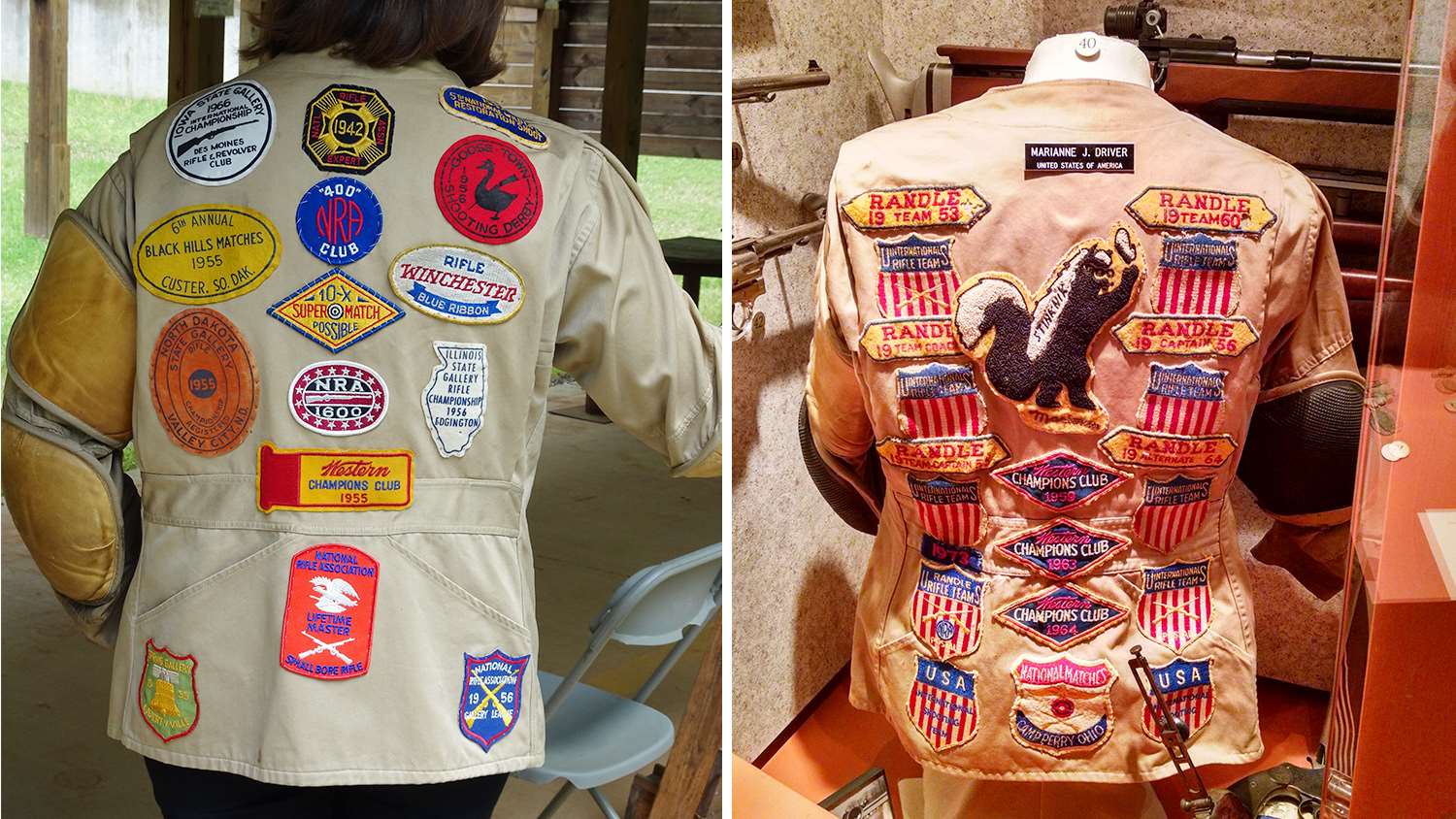
The many Randle Team brassards document her intense involvement in that organization and her regular presence at the National Matches. Prominent also is the “Stinknik” brassard―the honorary rifle club of which she was a proud (and founding) member. She had a remarkable career in the shooting sports.
Cloth shooting coats were stuffed into kit bags and car trunks and were subjected to rifle range suns and rain. Eventually they wore out posing a dilemma: What to do with the patches? Remove them of course and sew them on your new coat. Except that sewing on all those patches at one time was a daunting task; they were, after all, sewn on one-at-a-time. Most of us either started over on the new coat or started saving and collecting the patches while somehow never quite sewing them on anything. I located most of my collection in a couple of 9 x 12 envelopes, pretty well filled, which I recently inspected with pleasure.
Cloth shooting coats are still available today from most manufacturers but they no longer dominate the firing line. They started to become less common in the 1950s when the Russians appeared on the international shooting scene wearing heavy purpose-built leather shooting coats. Their nearly clean sweep of the 1954 World Championship matches gave the shooting world new ideas on clothing and much else. Evolution has produced generations of coats made of canvas, leather, cordura and heaven knows what-all else but one thing they all have in common is that they are very hard to sew patches on. So few do it anymore and match sponsors no longer routinely give them out to competitors with match entries.
The shooting coats illustrated here harken back to a simpler time in shooting―when your travels, affiliations and accomplishments could be summarized in a résumé wearable on your back. It may have been simpler, back then, but we are shooting a lot better today, and modern coats are part of the reason.
Editor's note: The author of this article, Paul Nordquist, who sadly passed away in August, wanted to acknowledge the help of Denise Loring (modeling), George Harris (camera work) and the National Firearms Museum (for the picture of Marianne Jensen Driver’s coat).
Most Popular