** When you buy products through the links on our site, we may earn a commission that supports NRA's mission to protect, preserve and defend the Second Amendment. **
From the June 2001 issue of Shooting Sports USA.
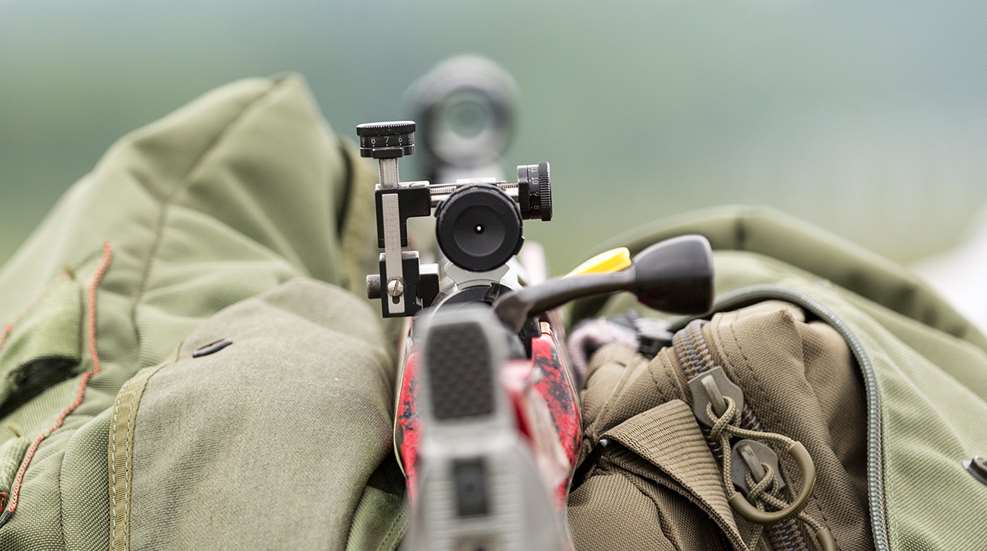
Remember that sight adjustment clicks will vary depending on the make and model of the rear sight and are usually expressed as "minute of angle" (MOA). MOA is a geometry term that works out to be about one inch of shift in the point of bullet impact on a target at 100 yards. Move the rear sight in the same direction you want the point of impact to change—for example, move the rear sight up to raise the bullet impact on the target.
Most U.S. sights will have an arrow and a letter designation like "L" for moving the bullet left or "UP" to raise the point of impact. Some European rear sights will have the letters "H" and "T" on the elevation knob. Rotating the knob toward "H" usually lowers the bullet impact, while "T" raises point of impact. Windage is often expressed as "R" and "L," along with the words "bei," which roughly translates as "if." Some sights so marked may move the point of impact opposite of what one would expect from U.S. sights. The only way to determine if this works with your sights is to fire a group of three to five shots from a stable position, find the center of the group, than add a specific and significant number of clicks on only one axis and fire an additional three- to five-shot group. Record the amount and direction of the group shift and make a note in your shooting diary for future reference.
Most American sights and scopes are calibrated in ½, ¼ or ⅛ MOA per click or graduation. Some foreign sights may have ⅕, ⅙, ¹/₁₂ or even ¹/₂₅ minute of adjustment per click. Be aware some sights may have different values of each click adjustment for windage than for elevation. As the gun-to-target distance changes, so also does the number of clicks required to move the point of impact a given distance. For example, when using sights with ¼-minute adjustments, moving the point of bullet impact two inches at 100 yards will require eight clicks, while moving the bullet impact two inches at 50 yards will require 16 clicks, but only four clicks at 200 yards.
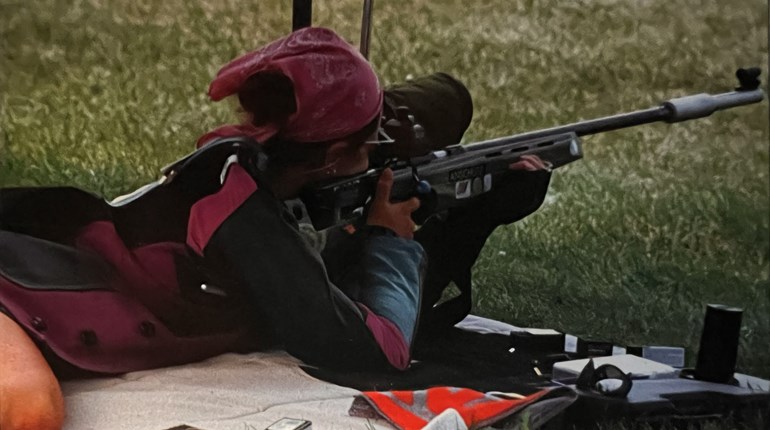
In addition, changing the gun's sight radius—the distance between the front and rear sights—will change the number of clicks required to move the point of impact a given distance on your target. For example, if you have a smallbore rifle with at 30-inch sight radius, and you add a 10-inch bloop tube and move the front sight out on the very end, you now have a 40-inch sight radius. You'll now need to add one-third more clicks than before you installed the tube. Thus, the 36 clicks of elevation on your ⅙-minute Anschutz sights you once used as your normal "come up" when moving from 50 yards back to 100 yards in the Dewar Smallbore Prone course will now require a full 48 clicks to achieve the same change in point of impact.
Some sights may run out of elevation adjustment before you can get a proper zero at longer ranges, and you may have to have a "riser block" installed between the sight and gun. These blocks are available in different heights and add a fixed amount of elevation, getting you back in the ballpark with your existing rear sight.
Read our tips for sighting-in your rifle and how bore cleaning can affect rifle accuracy
Remember that sight adjustment clicks will vary depending on the make and model of the rear sight and are usually expressed as "minute of angle" (MOA). MOA is a geometry term that works out to be about one inch of shift in the point of bullet impact on a target at 100 yards. Move the rear sight in the same direction you want the point of impact to change—for example, move the rear sight up to raise the bullet impact on the target.
Most U.S. sights will have an arrow and a letter designation like "L" for moving the bullet left or "UP" to raise the point of impact. Some European rear sights will have the letters "H" and "T" on the elevation knob. Rotating the knob toward "H" usually lowers the bullet impact, while "T" raises point of impact. Windage is often expressed as "R" and "L," along with the words "bei," which roughly translates as "if." Some sights so marked may move the point of impact opposite of what one would expect from U.S. sights. The only way to determine if this works with your sights is to fire a group of three to five shots from a stable position, find the center of the group, than add a specific and significant number of clicks on only one axis and fire an additional three- to five-shot group. Record the amount and direction of the group shift and make a note in your shooting diary for future reference.
Most American sights and scopes are calibrated in ½, ¼ or ⅛ MOA per click or graduation. Some foreign sights may have ⅕, ⅙, ¹/₁₂ or even ¹/₂₅ minute of adjustment per click. Be aware some sights may have different values of each click adjustment for windage than for elevation. As the gun-to-target distance changes, so also does the number of clicks required to move the point of impact a given distance. For example, when using sights with ¼-minute adjustments, moving the point of bullet impact two inches at 100 yards will require eight clicks, while moving the bullet impact two inches at 50 yards will require 16 clicks, but only four clicks at 200 yards.
In addition, changing the gun's sight radius—the distance between the front and rear sights—will change the number of clicks required to move the point of impact a given distance on your target. For example, if you have a smallbore rifle with at 30-inch sight radius, and you add a 10-inch bloop tube and move the front sight out on the very end, you now have a 40-inch sight radius. You'll now need to add one-third more clicks than before you installed the tube. Thus, the 36 clicks of elevation on your ⅙-minute Anschutz sights you once used as your normal "come up" when moving from 50 yards back to 100 yards in the Dewar Smallbore Prone course will now require a full 48 clicks to achieve the same change in point of impact.
Some sights may run out of elevation adjustment before you can get a proper zero at longer ranges, and you may have to have a "riser block" installed between the sight and gun. These blocks are available in different heights and add a fixed amount of elevation, getting you back in the ballpark with your existing rear sight.
Read our tips for sighting-in your rifle and how bore cleaning can affect rifle accuracy