WARNING: All technical data in this publication, especially for handloading, reflect the limited experience of individuals using specific tools, products, equipment and components under specific conditions and circumstances not necessarily reported in the article and over which the National Rifle Association (NRA) has no control. The data has not otherwise been tested or verified by the NRA. The NRA, its agents, officers and employees accept no responsibility for the results obtained by persons using such data and disclaim all liability for any consequential injuries or damages.
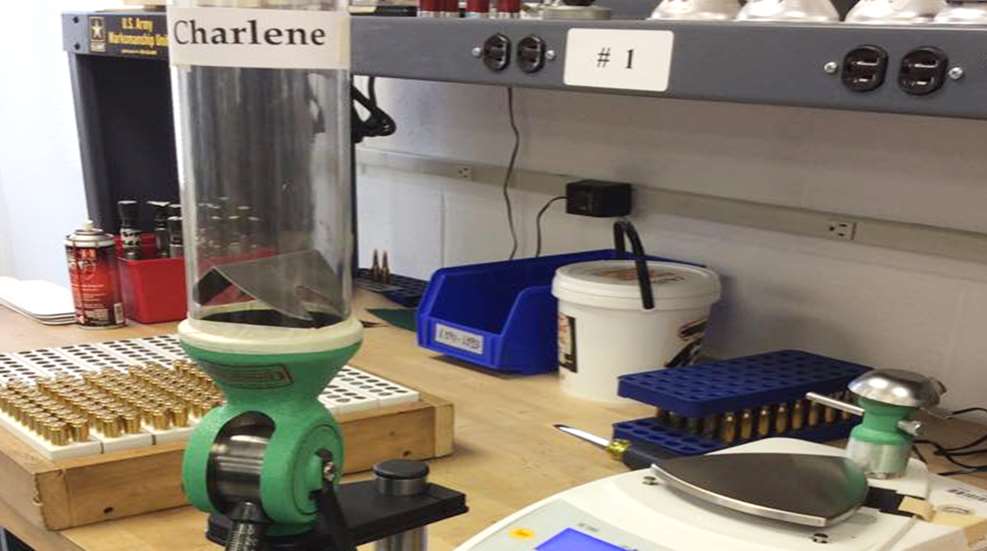
Above: All powder measures are not alike! Paying attention to feedback as you operate your measure can improve your handloads, efficiency, or both!
In the last article in our handloading series we discussed factors affecting uniformity of metered powder charges. In this article, we’ll continue by addressing specifics of optimum powder metering when loading progressively.
Powder measures have come a long way in recent decades. Chances are, if one is using a well-made, well-proven design from a respected maker, the measure will be perfectly adequate. Avoid bargains on very old powder measures at estate sales, etc., as some once-popular measures are actually quite inferior to the quality products of today.
Watch for buildup of powder residue that can cause binding in operation. When this occurs, the measure should be disassembled and cleaned to restore smooth operation. Installing a powder baffle (from your measure’s manufacturer) can help keep powder column pressure uniform.
Operator-induced powder charge variation generally stems from not having a smooth, standard technique for each measure cycle. Bumping the handle (or not) at the top or bottom of the measure stroke, speed of metering, and dwell time at the top of the stroke (when powder is flowing into the chamber) are all factors that can affect uniformity.
Checking charge weights on a scale is very useful in assessing one’s performance and charge uniformity. Small powder charge variations are unlikely to make a significant difference in all but the most demanding applications. However, it is not unheard-of to see a 0.7 gr. range of charge weights (or even more), especially when using some extruded powders.
Progressive presses add another layer to the variables above. Sometimes, the inherent uniformity of press operation can actually improve a new loader’s powder charges! The measures usually supplied, however, are not typically designed for extreme rifle-accuracy use. Polishing the internal and moving parts to reduce burrs and promote smooth powder flow and operation may help.
Some individual specimens from the same maker may well require more or less tuning than others, depending on the production run. Naturally, progressive press measures differ in design by maker, with some better than others. Moreover, throughout the years, some makers have refined their basic designs to improve operation, resulting in differences between “generations” of their measures.
To begin, observe the measure in operation and pay particular attention to smoothness of operation. Uneven “jolting” may occur, for example, if the measure bar “sticks” occasionally before returning. Sometimes adding an additional return spring can improve operation. Judicious use of graphite or other dry lube in friction areas may also help.
Finally, ensuring that the measure is set up properly for the particular cartridge in use is important. Inattention to this can especially cause problems if the measure is not fully cycled. If not carefully adjusted, measures may cycle only partially when loading for a short cartridge, vs. being fully cycled when moved to a toolhead used for a long (tall) cartridge. This should be checked as per the press instructions.
A different approach altogether is to use a “powder-through” die. This allows mounting a top-quality, manual measure as is found in single-stage loading. If the factory measure is unsatisfactory, one might consider this method. In use, one holds the press handle down, keeping the toolhead raised, and cycles the measure separately by hand. This should give results very similar to those obtained during single-stage loading.
Some makers offer kits to cycle the high-quality manual measure automatically when the ram is raised. The author has not used this method and cannot comment from experience on its accuracy. Readers with experience using this type setup are invited to share their results by emailing us at [email protected].
In summary, powder measures, whether used on progressive presses or separately, can be very individual in their behavior. Checking powder charges frequently during operation helps one learn what to expect from one’s measure, and whether tweaks might help. Some measures give near-flawless performance only when the reservoir is half-filled or less. Others from the same maker work very consistently, even when full. Learning the characteristics of your measure can make loading more efficient and precise.
In fact, one might almost be tempted to say, “This is my powder measure. There are many like it, but this one is mine … I will learn its’ habits, its’ preferences, and its’ quirks. Without me, my measure is useless …”
Next up is Match Winning Accuracy from Combat-Grade Brass: Part 1.
SSUSA thanks the U.S. Army Marksmanship Unit for allowing the reprint of this article.
Most Popular