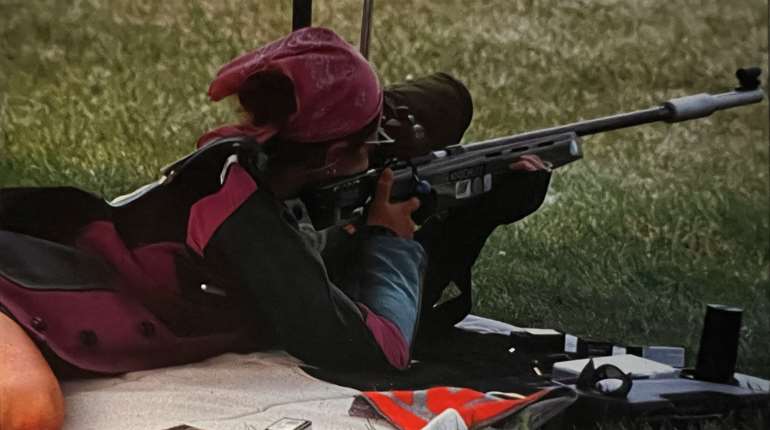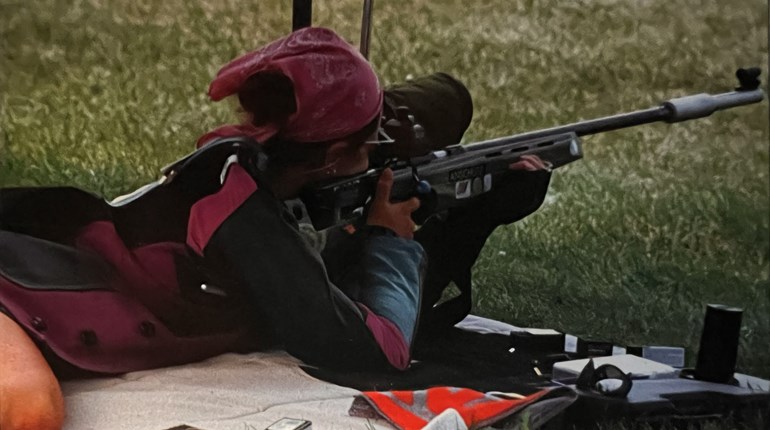
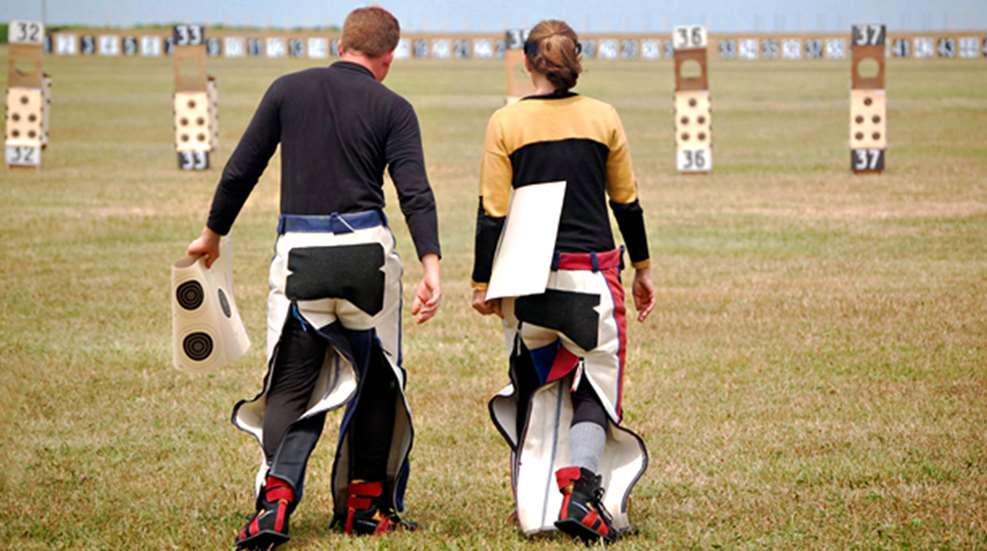
Above: The walk downrange to change targets is the perfect time to collaborate with your partner and prepare for the next stage. The author and her brother Tarl at Camp Perry, 2012. Photo by Lars Dalseide, NRA.
Some competitive shooters seem to have all the luck in terms of their location: a big local club, plenty of events in the area, and a community of fellow competitors at all levels to support one another. What about the rest of us? What happens when you’re one of only a few, or perhaps the only person in your area dedicated to a particular discipline? Or what if you’re the big fish in a little pond, consistently winning every competition with no one to challenge you? Unless you can find and/or afford a coach, your ability to progress will be hampered. You need to find yourself a training partner at an equal or higher skill level.
I have been extremely fortunate in my shooting career to have two such people: my brother Tarl and my boyfriend Justin. Any time we step up to the line, it’s a toss-up who might win. We also have a great relationship when it comes to helping one another and letting our competitive nature come out in a friendly, fun way. One the firing line, the competition is intense, but regardless of the outcome, heartfelt congratulations are always in order for the victor. This is crucial for a training partnership—neither party can be a sore loser.
During regular practice sessions, the benefits of having a partner are numerous. You can share techniques you’ve worked out, physical or mental. Asking your partner to watch you shoot or take video of you can be extremely useful as well. There are habits you may not realize you’re doing that your partner will notice, or you may notice upon seeing a video of yourself. You may think you’re following through after the shot, but a video may prove otherwise! Having another person with you also means you can easily swap a piece of equipment to see if it might work better for you than what you currently use. And anyone who’s tried to coach or teach knows that the act of trying to explain something forces you to clarify it in your own mind. It’s mutually beneficial.
In addition to coaching one another, one of the most useful things you can do is have competitions between yourselves. Add in a handicap for one of you if your skill levels aren’t very closely matched. Of course, you can run them just as your real competitions, but the fun lies in inventing something new to improve specific skills. Let’s say you’re a prone smallbore, long-range, or high power shooter and would like to improve on your wind reading. Challenge each other to short one- to five-shot matches with no sighters in different wind conditions. Your ability to see a condition and estimate a sight adjustment will improve, as will your confidence should the wind shift suddenly in a competition when you have no sighters or time to test the change.
Another idea is to shoot a normal course or stage for your event, but shorten the time to where it’s a little uncomfortable. Do this regularly and you’ll feel much calmer the next time you’re running short on time in a real competition. Interrupt or intentionally distract each other with random sounds, calling out names, time left, etc. Identify your weaknesses or areas you’d like to improve and invent a way to make it a game with your partner, putting some pressure on each of you but keeping it fun at the same time. Lastly, create consequences for the outcomes of these games or drills. You can bet money on the outcome to create real pressure, for instance. Or the loser must clean up the range or buy lunch. Choose something that matters but doesn’t feel like an undue burden. It’s still supposed to be fun!
A training partner’s benefits will extend to real competitions as well. You have an established relationship of mutual support and competition, so use it. During the match, keep up the communication by sharing what’s working and what’s not. Help each other with any problems that may arise. Keep the fun going by making your own personal bet or competition with each other along with a consequence, just as you’ve done in practice. This helps make the real thing feel less daunting and more comfortable, because it’s familiar and enjoyable. You’re still just shooting with your friend!
What if this all sounds like a great idea, but there is no one in your area who fits the bill? Use technology to work around the physical distance. Find someone in a similar situation as yourself. Perhaps you met at a competition, or an online forum. Arrange practice times and use Skype or FaceTime to simulate real-time training alongside your partner. Hold each other accountable. If possible, keep in touch during competitions if you aren’t both physically there. While this might be more difficult to maintain than a local partner, it’s more doable now than it’s ever been.
Whether you are lucky enough to have someone at your own club or not, remember to keep it fun, supportive, accountable, and challenging as you help each other improve!