** When you buy products through the links on our site, we may earn a commission that supports NRA's mission to protect, preserve and defend the Second Amendment. **
From the June 1957 issue of American Rifleman, "Inherent Pattern" by Leroy S. Foltz.
A multishot gun, even with perfect barrel and ammunition, has a natural property of dispersing its hits in a regular pattern. This is due to changes in its mass and center of gravity as the ammunition in the gun is fired.
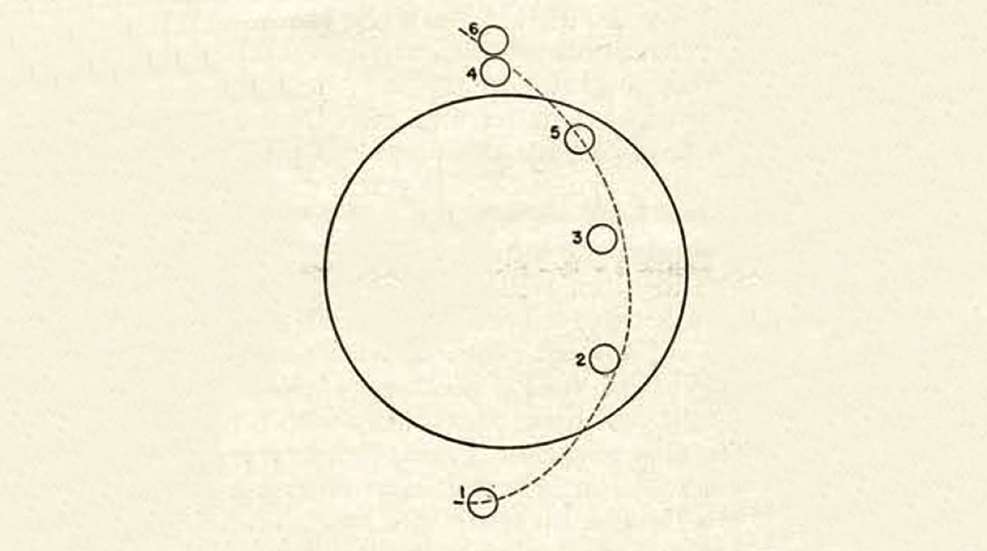
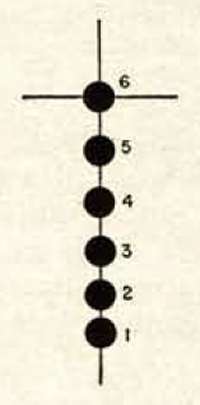
Below are the different patterns of a self-loading pistol and a revolver shown schematically. It will be evident that this 'inherent pattern' will be largest with those arms in which ammunition weight is greatest in proportion to gun weight. The effect would be very small in heavy target handguns firing the .22 long rifle cartridge.
It seems impossible to make a highly accurate determination of the inherent pattern, because of variables over which the shooter has unsatisfactory control. It should be possible, however, for a shooter to arrive at a good approximation to the inherent pattern by careful, patient and systematic shooting of shot groups, and plotting the group centers.
A method applicable to the revolver is as follows: Fire a string of shots at one target, using the same chamber and leaving the remaining chambers loaded. Identify this target and determine its group center. Then use chamber number two, with a fired cartridge in chamber number 2 and the remaining chambers loaded. Continue through all chambers of the cylinder. The group centers are then plotted on a common target. Or use six targets numbered one through six and fire the first shot of every cylinderful at the first target, the second shot at the second target, etc., then plot the group centers. The latter method was used for the third illustration in this article.
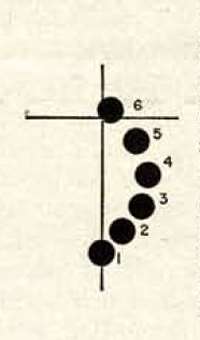
To examine this subject experimentally, I asked the help of two expert revolver shots, E.N. Foltz and R.D. Holmes. The former used a Colt Police Positive Special of .32-20 Winchester cal. having a 4-inch barrel. He fired five cylinderfuls or 30 shots at a range of 48 ft. Results are shown below. A second firing confirmed the results.
R.D. Holmes fired his Colt .38 Special with 6-inch barrel at 50 ft. Conditions did not permit a complete test, so two test targets were made. The first consisted of four shots from the same chamber, the other chambers being loaded. The second consisted of four shots from one chamber, the other chambers being empty. The centers of these two groups were on the same vertical line, with that of the second 1/2 inch higher than the first. These correspond with group centers number one and six from the .32-20 Police Positive, but the heavier .38 Special gun gave a smaller vertical spread as would be expected.
Both shooters used a rest at midforearm which assisted aiming without affecting the normal recoil movement of the gun and hand.
Obviously knowledge of the inherent pattern cannot be applied by a shooter whose skill allows variation comparable to the size of the inherent pattern itself. However, when the shooter's skill is of a sufficiently high order and he knows the inherent pattern for the existing circumstances, he can allow for it in his aiming. If his correction is right, the resulting group of shots should have a minimum size.
A multishot gun, even with perfect barrel and ammunition, has a natural property of dispersing its hits in a regular pattern. This is due to changes in its mass and center of gravity as the ammunition in the gun is fired.
Below are the different patterns of a self-loading pistol and a revolver shown schematically. It will be evident that this 'inherent pattern' will be largest with those arms in which ammunition weight is greatest in proportion to gun weight. The effect would be very small in heavy target handguns firing the .22 long rifle cartridge.
In a self-loading pistol with single-column magazine, the pistol is made heavier and its moment of inertia increased when the magazine is full. By each shot the pistol is lightened and therefore moves farther upward in recoil before the bullet leaves the muzzle. It can be expected therefore that the successive shots will print higher on the target, more or less as shown here. The impact spacings will widen since successive shots make a greater percentage change in the gun weight. In addition to angular reaction from imparting spin to the bullet will twist the gun and have some effect, not shown here.
It seems impossible to make a highly accurate determination of the inherent pattern, because of variables over which the shooter has unsatisfactory control. It should be possible, however, for a shooter to arrive at a good approximation to the inherent pattern by careful, patient and systematic shooting of shot groups, and plotting the group centers.
A method applicable to the revolver is as follows: Fire a string of shots at one target, using the same chamber and leaving the remaining chambers loaded. Identify this target and determine its group center. Then use chamber number two, with a fired cartridge in chamber number 2 and the remaining chambers loaded. Continue through all chambers of the cylinder. The group centers are then plotted on a common target. Or use six targets numbered one through six and fire the first shot of every cylinderful at the first target, the second shot at the second target, etc., then plot the group centers. The latter method was used for the third illustration in this article.
A fully loaded revolver has its center of gravity in the vertical plane through the barrel axis. Each shot raises the center of gravity, and as the cylinder is turned the center of gravity is moved to the side as well. When three or four shots have been fired this lateral displacement is a maximum. By the last shot the center of gravity has returned to the central plane. The successive bullet impacts are shown above for a 6-chambered revolver with cylinder turning to the right. An effort has been made to include the effect of the twist reaction from right-hand rifling.
To examine this subject experimentally, I asked the help of two expert revolver shots, E.N. Foltz and R.D. Holmes. The former used a Colt Police Positive Special of .32-20 Winchester cal. having a 4-inch barrel. He fired five cylinderfuls or 30 shots at a range of 48 ft. Results are shown below. A second firing confirmed the results.
R.D. Holmes fired his Colt .38 Special with 6-inch barrel at 50 ft. Conditions did not permit a complete test, so two test targets were made. The first consisted of four shots from the same chamber, the other chambers being loaded. The second consisted of four shots from one chamber, the other chambers being empty. The centers of these two groups were on the same vertical line, with that of the second 1/2 inch higher than the first. These correspond with group centers number one and six from the .32-20 Police Positive, but the heavier .38 Special gun gave a smaller vertical spread as would be expected.
Inherent pattern of .32-20 Colt Police Positive Special revolver at 48 feet range. The numbered small circles are the centers of impact given by the successive chambers of the cylinder, fired beginning with the gun fully loaded as described in the text. Here appeared a test of the perfection of the gun itself. The impact centers from chambers four and five are interchanged from their expected positions. No reason for this appears except irregularity of cylinder stop positioning or chambering.
Both shooters used a rest at midforearm which assisted aiming without affecting the normal recoil movement of the gun and hand.
Obviously knowledge of the inherent pattern cannot be applied by a shooter whose skill allows variation comparable to the size of the inherent pattern itself. However, when the shooter's skill is of a sufficiently high order and he knows the inherent pattern for the existing circumstances, he can allow for it in his aiming. If his correction is right, the resulting group of shots should have a minimum size.