From the vault: A reader submitted this question about meeting Major Power Factor (PF) while shooting a revolver with a 4-inch barrel. The principles outlined in the response still apply today. From the July 2006 issue of Shooting Sports USA.
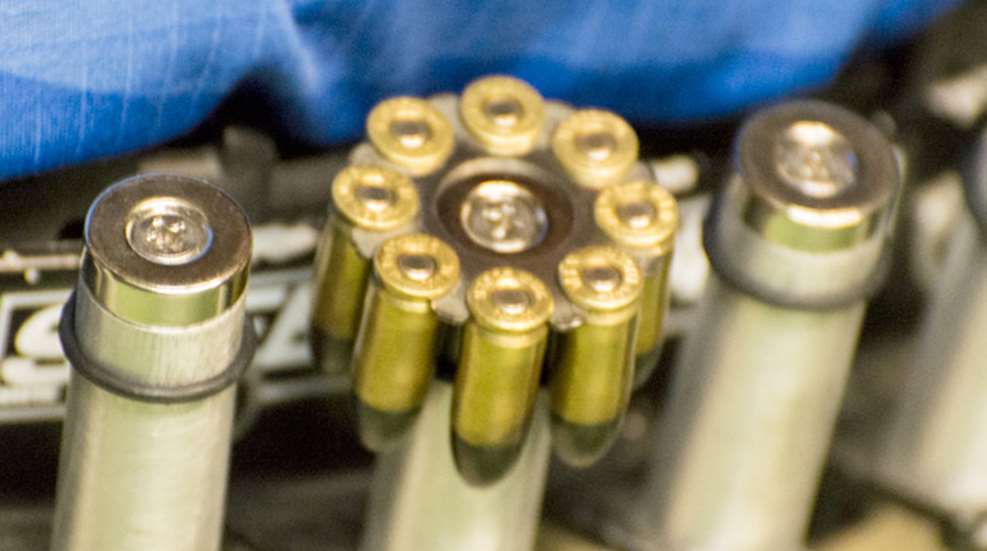
Q. My revolver is loaded with a moon clip and therefore requires a load with a Power Factor of 165. What loads do you suggest to reach 165+ in a 4-inch revolver? Can the round be loaded to longer length than what is specified for autoloaders?
A. While it is true that loads described in manuals were developed for autoloaders, it is not necessarily true that none of those same loads will make Major PF in a revolver.
As a reference, the Speer Reloading Manual #13, cites velocities that were obtained from a 4-inch pistol barrel. Some of these loads exceeded 185 Power Factor.
Through research and experience, it can be seen that there is a very small difference in velocities from the same loads fired in both types of pistols—revolvers and autoloaders. Even if there was some loss in velocity due to the barrel/cylinder gap, many loads would still make the Power Factor. Even though this may be true, it is still recommended that you chronograph your loads in the specific pistol you are using in order to get the exact velocity. The Speer manual offers plenty of options to start with.
The round loaded can certainly be in a longer overall length cartridge, however this may lead to a slightly lower velocity and an outcome that is the opposite of your goal.
Have a question about the shooting sports? Please email us at [email protected].
See more: Why Does Ballistic Coefficient Improve With Heavier Bullets?
Most Popular