
From the vault: the story of the Palma Trophy, the Western world’s oldest international team rifle match, and the priceless original that vanished without a trace. As published in the May 1991 issue of Shooting Sports USA.
The History of the Palma Trophy
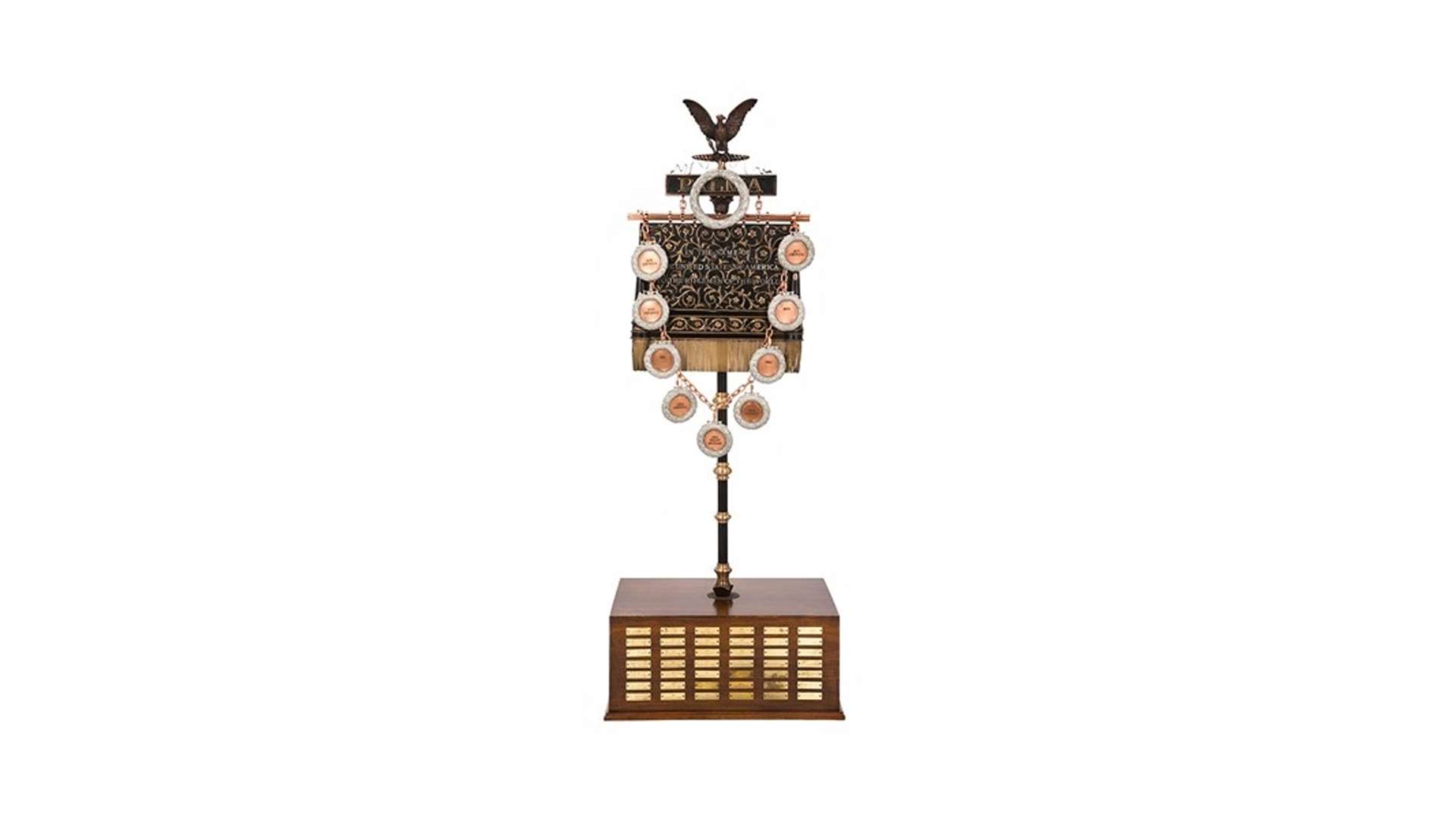
Deriving its name from the Latin word “palma,” meaning palm tree, which was used by the Romans to signify victory, the Palma Trophy continues its legacy as the Western world’s oldest international team match still fired.
Purchased in 1876, by American popular subscription, the Palma Trophy, originally named the Grand Centennial Trophy, was put up for international competition as a celebration of the United States Centennial. Followed by intense public interest, the first Palma Match was won by the United States in 1876. The 7½ foot high Palma Trophy was again won by the United States team in 1877. The initial Palma Matches were fired between teams of eight using any rifle of their choice. The competition was shot over a course of 30 shots per team member at 800, 900 and 1,000 yards.
Upon this victory the Palma Trophy went unchallenged for a period of 23 years, a break in activity which would prove to become a hallmark of the match itself. The 1880 NRA President’s Report explained the many years of idleness by stating that “the foreign teams had received so many defeats that it seemed almost impossible to induce them to send representatives to this country to compete for the Centennial Palma Trophy.”
In 1901, activity resumed with a Canadian team emerging victorious over the competition assembled in Sea Girt, New Jersey. In addition to being the first United States defeat, the match was notable because of two significant rule changes. These being the requirement that each nation use the official military arm of its service and that the course of fire consist of 15 shots per team member at each distance of 800, 900 and 1000 yards. These rules remained in effect until 1928.
After a second consecutive loss in 1902, the American team hoped for a change in fortune during the 1903 Palma Match held in Bisley Camp, Great Britain. However, this was not meant to be as the Americans found themselves engulfed in the most confusing and controversial Palma Match ever.
Controversy abounded when the American, British, Canadian and Australian teams all used privately made barrels in competition. This was a direct violation of the rule stating that competitors use only “the national arm of its country.” The result of these questions were that the match was declared void and the Americans returned the trophy to the 1902 defending champions, the British. For their part, the 1903 runner-up British team refused to declare victory and accepted custody of the trophy until a future match could be arranged.
After a four-year interruption competition was resumed on the neutral ground of Rockliffe Range near Ottawa. There the United States team emerged victorious while setting a Palma record with a score of 1712 points as compared to the 1671 point total posted by the second-place Canadian team. 1913 saw the first firing of the Palma Match at Camp Perry, Ohio, as the United States team posted a victory over the surprise second place Argentinean team.
The outbreak of World War I brought a stop to the Palma Trophy; competition was not formally resumed until 1928. That year’s contest saw only the United States and Cuba in the running with a win by the American team 1731 to 1696. In addition to the resumption of competition, 1928 also saw a rule change allowing the use of “any rifle of private manufacture.”
After the 1928 match, the Palma Trophy fell into a period of dormancy for 39 years. During this time the trophy itself was lost, its true whereabouts still remain a mystery.
Largely due to the efforts of NRA committee member James C. Whitney, official Palma competition resumed in 1967. This third revival brought about several rule changes. Teams were increased to include 20 firing members, two alternates and three officials. Competing nations were required to fire the same types of rifles, the service rifle of the host nation. And, the Palma Team Match was to be a competition between English-speaking nations. During this time, the Palma Match moved from an annual competition to one fired every third year.
The Palma Match was fired every year from 1967 to 1974, marking its longest period of activity. During 1975 no matches were fired so that the nations planning to attend could best prepare for the 1976 Palma Centennial Match held at Camp Perry. The American team claimed victory in 1976 as they did during the first official firing of the Palma Match 100 years earlier.
The Palma Match was then fired without interruption at the agreed upon three-year match interval. However, during the 1988 Palma Match the Palma governing council, instituted in 1985, declared that the match be held every four years.
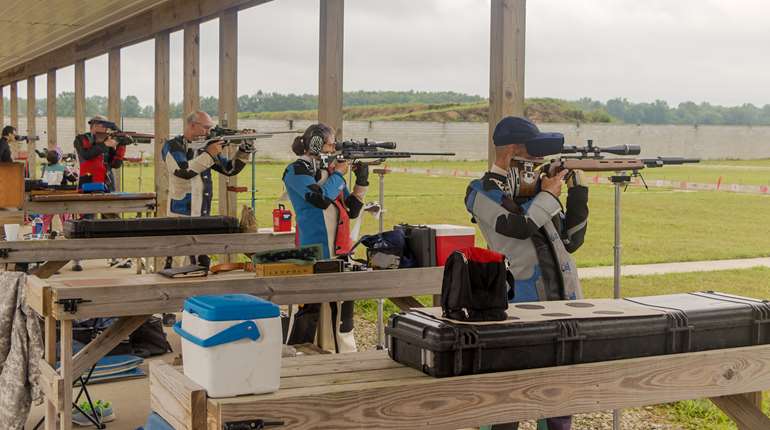
Under present rules, each competitor must bring his or her own rifle, chambered for the 7.62 mm NATO cartridge. The host country provides ammunition. The match is still fired at 800, 900 and 1,000 yards, 15 shots per team member using the standard targets of the host country. Team size may vary from year to year, being no fewer than 12, nor more than 20.
Palma Team positions are determined by a shooter’s performance during the Palma Match of the high-power phase at the National Matches. Using a .308-caliber rifle, the top 200 shooters will be invited to two additional days of final tryouts. The top 16 shooters from the finals will earn the right to represent the United States on the Palma Team.
Tryouts for the 1992 Palma Team will be held at Camp Perry on August 12-13, with preliminary qualification on August 11, 1991. The top 200 shooters in the 1991 Palma Match (match #98) and any prior Palma Team member will be eligible to compete in the tryouts on Monday, August 12, 1991.
The course of fire for the tryouts on August 12, 1991, will be two sighters and 20 shots for record at 300 yards. Each competitor will fire the same course of fire three times. The aggregate of the three strings will be used to rank the competitors.
The top 99 competitors on Monday will be eligible to compete the next day over the same course of fire. The aggregate of the six 20-shot strings will determine the order of rank from which the eighteen person team will be picked.
Most Popular