
This account first ran in the May 1991 Shooting Sports USA. Decades later, the original Palma Trophy is still missing and Ed Andrus’ paper trail is still the best map of where it went.
The Mystery of the Palma Trophy
By Ed Andrus
At a meeting of the Board of Directors of the National Rifle Association, held on November 9, 1875, Col. Henry A. Gildersleeve offered the following resolution:
RESOLVED, That in furtherance of the steps already taken for a Grand International Competition on the occasion of the Centennial Anniversary of American Independence, and for a proper observance of such Anniversary on the part of this Association, a series of Rifle Matches be inaugurated to take place during the Summer or Autumn of 1876, and a general invitation be and hereby is extended to riflemen of all Countries to participate.
There were other portions of this Resolution, which dealt mainly with trying to work with the Centennial Commission in order to have the Grand International Competition declared a Centennial event; to make certain that the funds and an appropriate firing schedule were maintained; and to issue invitations to “any country where a Rifle Association or Club was known to exist.”
The minutes of that meeting go on to say that “The prize will be a handsome Trophy presented by the citizens of the United States, but the design has not yet been determined upon.”
The prize, which was originally named the Grand Centennial Trophy, was also called the International Rifle Trophy and later was called the Palma Trophy. It disappeared sometime between 1930 and the early 1950s.
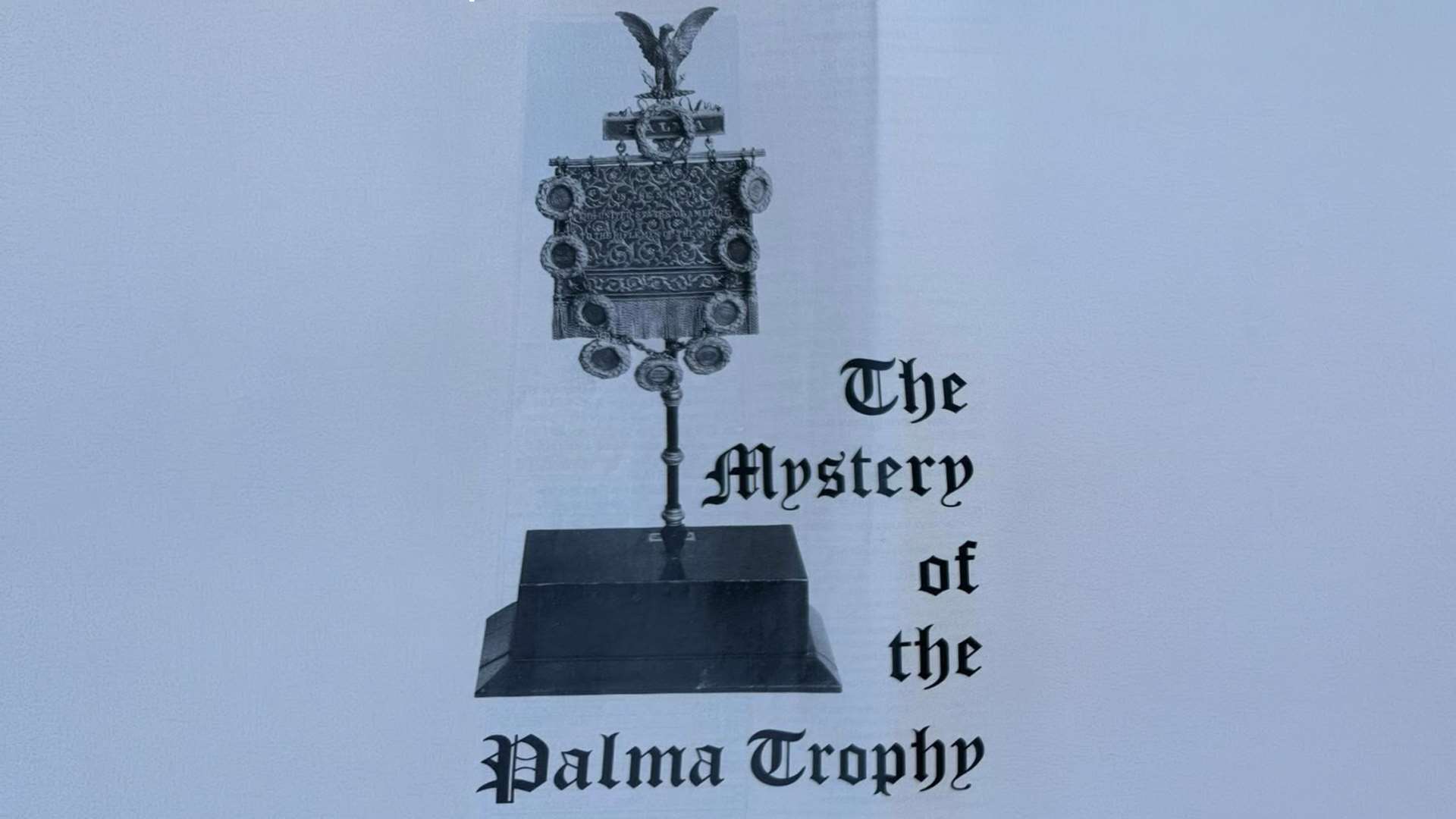
In the September 30, 1876, issue of Harper’s Weekly, on page 798, the Palma Trophy was described in the following manner:
The International Rifle Trophy, awarded as a prize by the United States National Rifle Association to the victorious marksmen, and illustrated on this page, is unique work, both in design and in the remarkable effects produced by a combination of the different metals. The general idea is of a Roman triumphal standard, but because wrought in metals, treated in a purely conventional manner. The trophy is about seven and a half feet high, and is formed of steel, inlaid with gold and silver, and otherwise enriched with elaborate mountings of copper. The staff is plain, smooth steel, with fillets of polished copper, and is surmounted by a foliated capital, above which is a paneled block, bearing in lieu of the S P Q R upon the Roman banners, the Latin word PALMA, signifying prominence, valor, and victory. Hanging across the face of this is a silver laurel wreath. A finely sculptured copper eagle with raised wings surmounts the whole, and in his claws is held the fulmen (indicative of power), from which shafts of lightning and branches of laurel are wrought in silver. A fasces of copper is attached by massive links to the paneled box, and from it hangs the field of the banner, which is enriched with a delicate scrollwork of gold superimposed upon the steel, and across the face is the legend, in highly ornate letters of incrusted silver, “In the Name of the United States of America to the Riflemen of the World.” An elaborate gold frieze, in high relief, extends across the lower edge, and from it hangs a massive gilded fringe. A copper chain, fastened at either end of the fasces, hangs in a semi-circle across the field, and attached to it at intervals are nine laurel wreaths of silver, inclosing each a plate of copper in which the dates from 1876 to 1884 are inlaid, and having each a space on which to engrave the name of the nation that shall each year send forth the victorious team. This trophy, from its originality, will attract attention in whatever country it may be held, and can not fail to excite admiration for the marvellous [sic] manipulation of metals which is presents. Many of the methods of decoration employed in its construction are new to us in this country, and it illustrates in a marked manner the taste and skills of Messrs. Tiffany & Co., the makers, as well as the vast resources of their workshops.
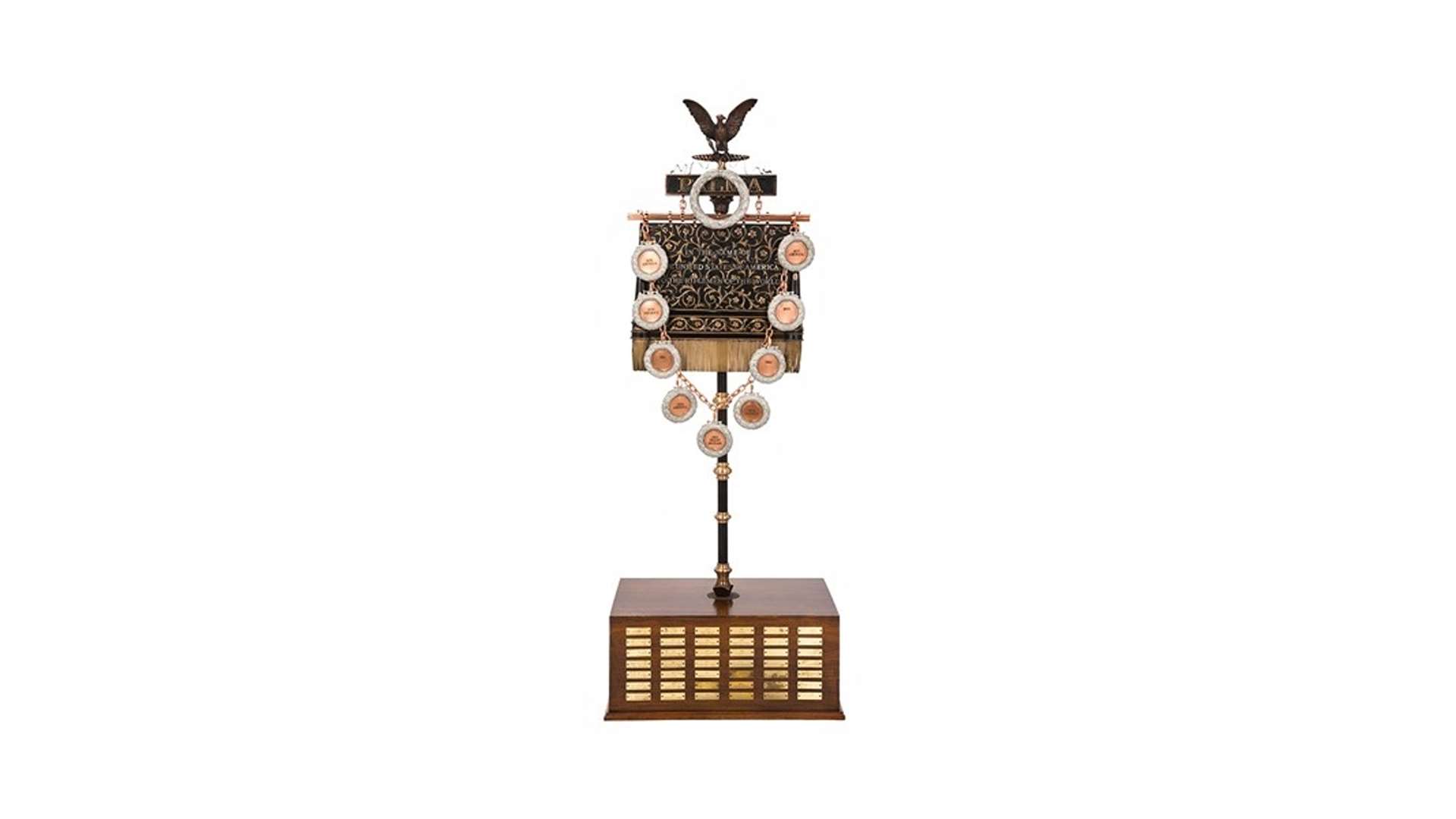
The original Palma Trophy (a reproduction of which has been produced by the Architectural Bronze and Aluminum Co. of Skokie, Illinois, and paid for by a donation from Dr. Herbert M. Aitken of Eau Claire, Wisconsin) was listed by Tiffany’s as Ledger Entry #4612, 0.483 as the International Rifle Trophy. James H. Whittenhouse designed the trophy, which contained 280 ounces of silver and according to Tiffany’s cost $1,500 in 1876. Tiffany’s was paid by a fund which was collected in a public subscription drive.
The Palma Trophy (to call it by the name by which it is known at present) did not really fulfill the intent of the NRA Board of Directors. The Palma Team Match was only fired in 1876 and 1877, and not again until 1901. Competition continued in 1902 and 1903, then skipped until 1907 to 1912, and then 1913. Before the modern era beginning in 1966, competition for the Palma Trophy took place again only in 1928 at Camp Perry, during the National Matches. For a match which was intended to be fired every year, it certainly did not live up to the grand expectations projected for it when the trophy was commissioned.
The last photograph of the trophy in NRA files was taken in 1903. Only engravings and replicas of the trophy are known to exist today. In January and February of 1930, a curious series of letters was transmitted between the War Department and NRA. Those letters positively identified the Palma Trophy as being, “hung in the corridor of the State, War, and Navy building, near the office of the Secretary of War. It is not in especially good condition and the record discs attached are far from complete.” The State, War, and Navy Building is now known as the Old Executive Office Building and is on 17th St. right next door to the White House.
General Reckord, at that time the NRA Executive Vice President, noted in a letter to Secretary of War Patrick J. Hurley on January 22, 1930, that “I have noticed the Palma Trophy hanging on the wall near your door. I have no idea how the Palma Trophy came to be in the War Department, as it is the property of this Association …”
On February 10 of 1930, Mr. Hurley replied that “records do not show that the Palma Trophy, now in the corridor of the State, War and Navy building, is the property of the United States … it was probably placed on display in the War Department because of its character as a trophy for international competition. There is no objection to delivering the Palma Trophy into the custody of the National Rifle Association.”
And on February 13, 1930, Gen Reckord replied to Secretary Hurley’s letter, closing with the words, “At an early date I will call to arrange for the transfer of the trophy.” The trophy was never picked up.
There is no further correspondence in the files of the NRA on the subject of the Palma Trophy until 1954, when Lt. Col. Harold B. Riley, the Assistant Executive Officer of the National Board for the Promotion of Rifle Practice wrote to Col. E.H. Harrison of the American Rifleman staff to transmit copies of the 1930 letters to him. Obviously, someone was still concerned about the trophy, but the question remains: why wasn’t it recovered from the War Department in 1930?
In 1957, George J. Kuch of the Competitions Section wrote to the Richmond (Va.) Quartermaster Depot concerning the whereabouts of the Palma Trophy, only to have a rather curt reply sent back only two days later, saying that “A thorough search of records at this Depot revealed that there is no such trophy on hand. This Depot is a trophy storage point for Army units only … If further action is desired, it is suggested that the Office of the Chief of Military History be contacted.”
It is perfectly obvious to even a casual observer that if George Kuch’s letter was written on the 14th of January; and that a reply to it was written on the 16th of January, it is very unlikely that “thorough search” of anything at the Richmond Depot was, or even could have been, made. It is also perfectly obvious that Major Frank X. Nause, the Chief of the Storage Division, did not want to be bothered, and indeed, could not have cared less about any assistance which could have rendered.
In the time that the Pentagon was completed during the late 1940s, offices of the various military Departments were moved to the new building, and the office of the Secretary of the Army (formerly the Secretary of War) was also moved. All sorts of items were moved directly to the Pentagon, but much was also moved into storage at the Richmond Depot, and perhaps elsewhere. It does not seem unlikely that Palma Trophy might have found its way to the Richmond Quartermaster Depot. This is reinforced by a note to C. Richard Rogers, then Director of Program Division (of which Competitions was a part) from George Kuch on January 18, 1957, the day after he received the letter from Major Nause, shows that Mr. Kuch called a Major Higgins in the Pentagon who investigated the trophy display area and informed Mr. Kuch that the trophy was not at the Pentagon. He went on to say that “some such material is stored in the Richmond Quartermaster Depot.”
On February 27, 1957, Mr. Kuch wrote a letter to the Chief of Military History requesting any information available on the Palma Trophy. That letter was referred to the National Archives. On April 9, 1957, Victor Gondos, Jr., Archivist in charge of the Old Army Branch, replied in a manner which shows considerably more time and effort in research than that of Major Nause; but the result was the same: “The records of the War Department in the National Archives do not give any indication as to the present location of the Palma Trophy.”
Eight years later, September 17, 1965, Frank L. Wyman, then Director of the Program Division, wrote a letter in reply to a communication from a Col. Robert M. Calland, USMC (Ret.), who was then working in the Smithsonian Institution, in which it is indicated directly that Col. Calland had actually seen the trophy in the Richmond Quartermaster Depot! The pertinent comment in Mr. Wyman’s letter was, “… and if you have found it [the Palma Trophy] in the warehouse in Richmond, our hats are off to you.”
No further correspondence can be located between Col. Calland and Mr. Wyman concerning the Palma Trophy, nor is there any evidence that Mr. Wyman pursued the matter further, even though the Palma Trophy Team Match was about to be revived through agreement between Canada and the United States. Frank Wyman retired from the Program Division in the following year, 1966, and left NRA and the Washington, D.C., area in 1967.
As late as January 1982, John J. Grubar, Director of the Competitions Division, wrote the Director of Civilian Marksmanship asking that help be provided to search for the original Palma Trophy. At the same time, Tiffany and Co. was contacted, which resulted not only in the information listed earlier, but in gaining possession of the original Palma Trophy plans. These plans were then in turn used to produce the reproduction Palma Trophy. However, nothing further learned from the Army concerning the disposition or location of the original Palma Trophy.
There are three distinct and independent pieces of information which point at the Richmond Quartermaster Depot as being the possible resting place of the original Palma Trophy: first, the fact that Major Higgins of the Pentagon indicated that some pieces from what is now the Old Executive Office Building were transported to Richmond for storage; second, that the reply of Major Nause of the Richmond Depot is hardly believable; and third, that Col. Calland apparently actually sighted the trophy at the Richmond Depot in 1965.
This last sighting indicates that the trophy was not cased. As it contains, among other valuable metals, 280 ounces of silver, it is entirely possible that the trophy was vandalized at the least, with portions of it stolen. Or, it could still be in dead storage in Richmond, requiring only that someone be allowed to explore the proper warehouse to be discovered and returned to NRA.
Whatever happened to the original Palma Trophy may never be known. However, the situation of the Palma Trophy is certainly reminiscent of the last scene in a recent film about the lost Ark of the Covenant.