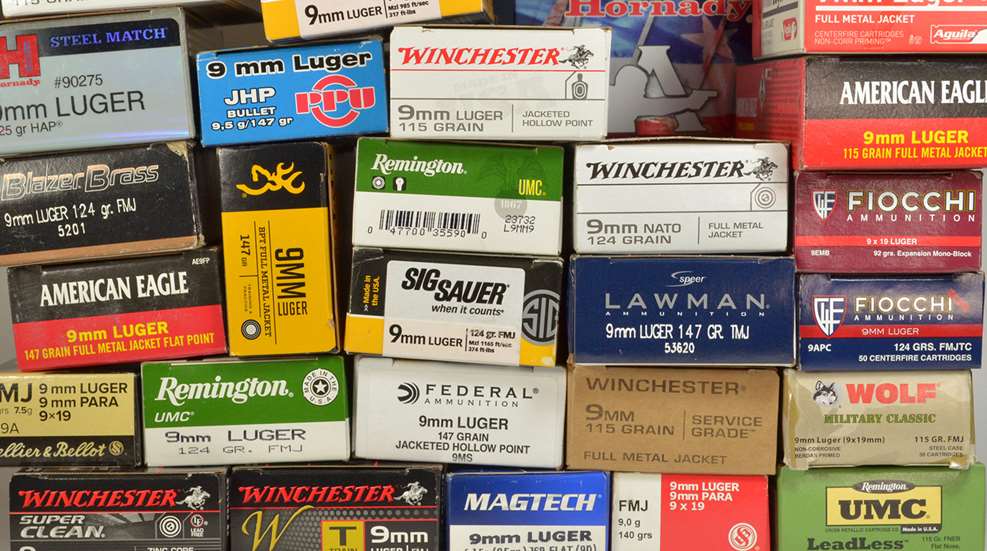
Not all ammunition is equally accurate in a given gun. But just how much of a difference can there be? For example can one kind of ammo be twice as accurate as another―or possibly even more?
This article examines accuracy in one pistol. Savvy shooters know that it’s only one of millions of pistols, and the results only apply to the test gun. But this article is not saying that Brand X is the most accurate ammo for all guns, it only looks at how one gun shoots different ammunition.
Here we compared some inexpensive 9mm Luger ammo commonly used for casual shooting. Match-grade 9mm ammunition is a different subject we will address in a future article. A few loads that would be used for self-defense were included, though they were a minority.
Thirty-eight factory loads were tested, ranging from 90 to 147 grains. These are only a fraction of 9mm loads available. A quick look at the 9mm ammunition available on a popular vendor website showed a list of 151 products. Some of these are repeats, but there are many more brands and loads that are not included in their inventory. So much ammo to try, so little time and money!
Extreme testing
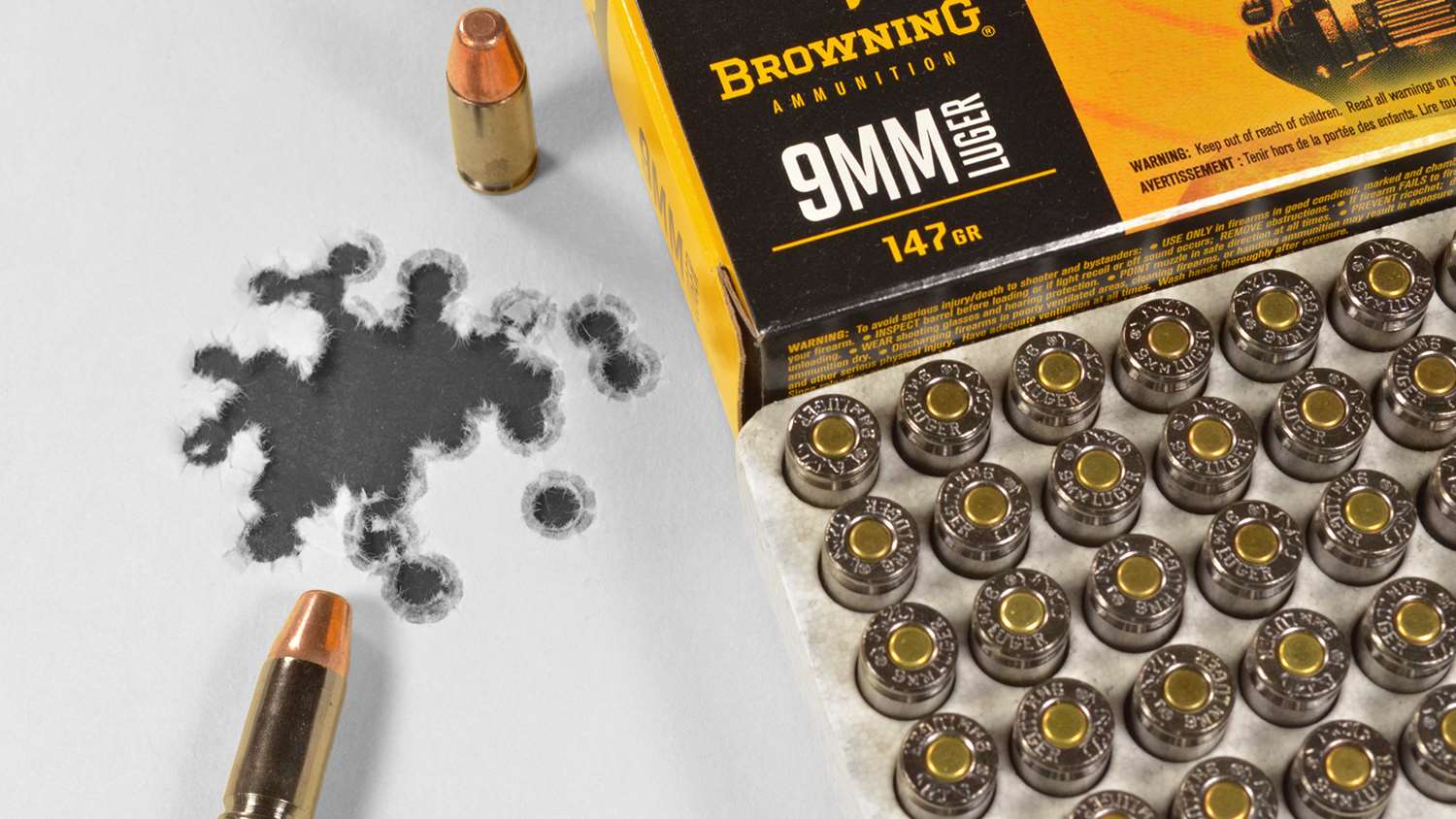
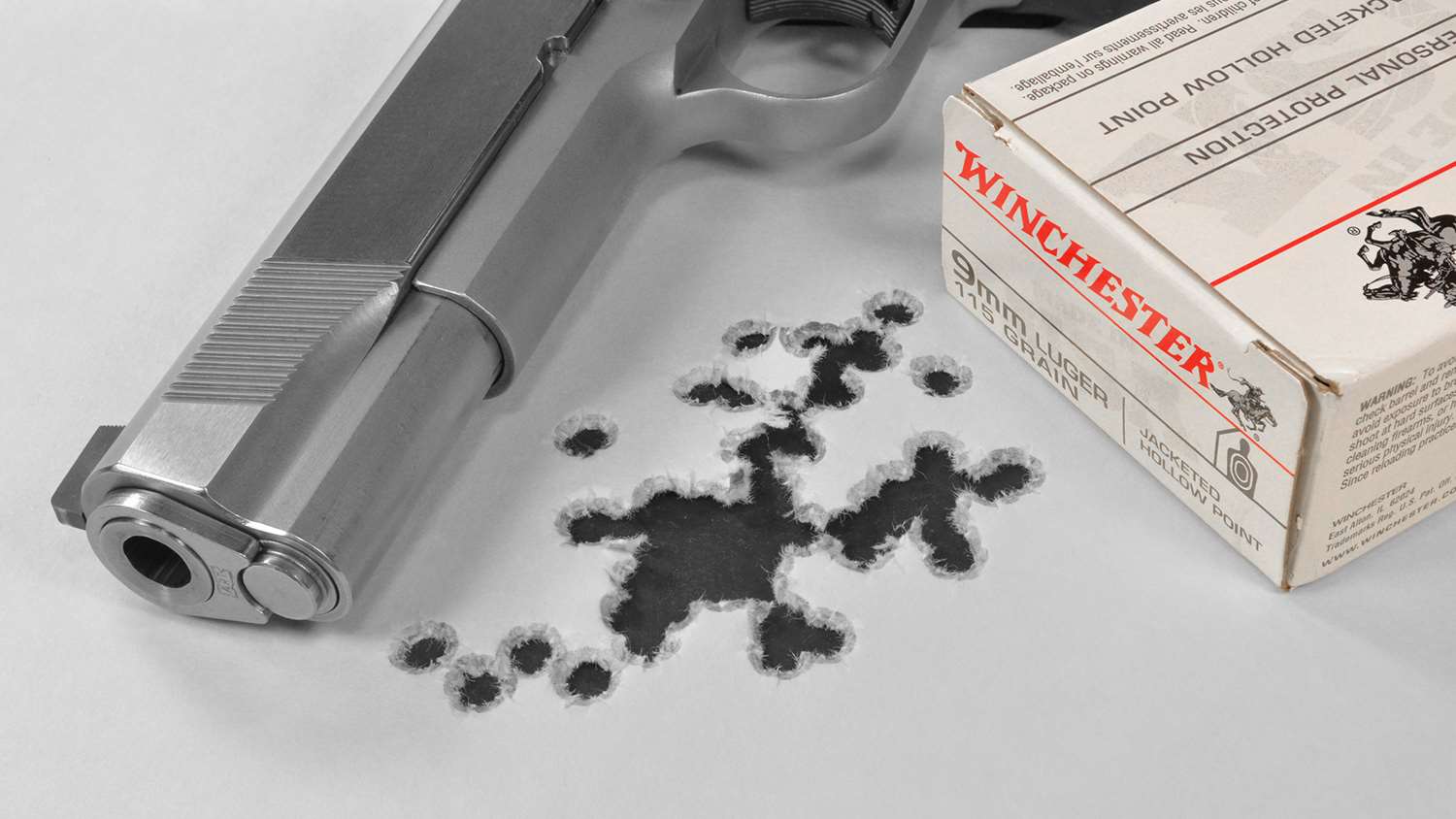
An extreme method was used to assess accuracy. A full box of 50 rounds was fired into a single group. This method is, in the author’s opinion, more informative than shooting multiple groups. Seeing all the hits on one target reveals the full distribution of hits that might not be obvious when shooting at multiple targets.
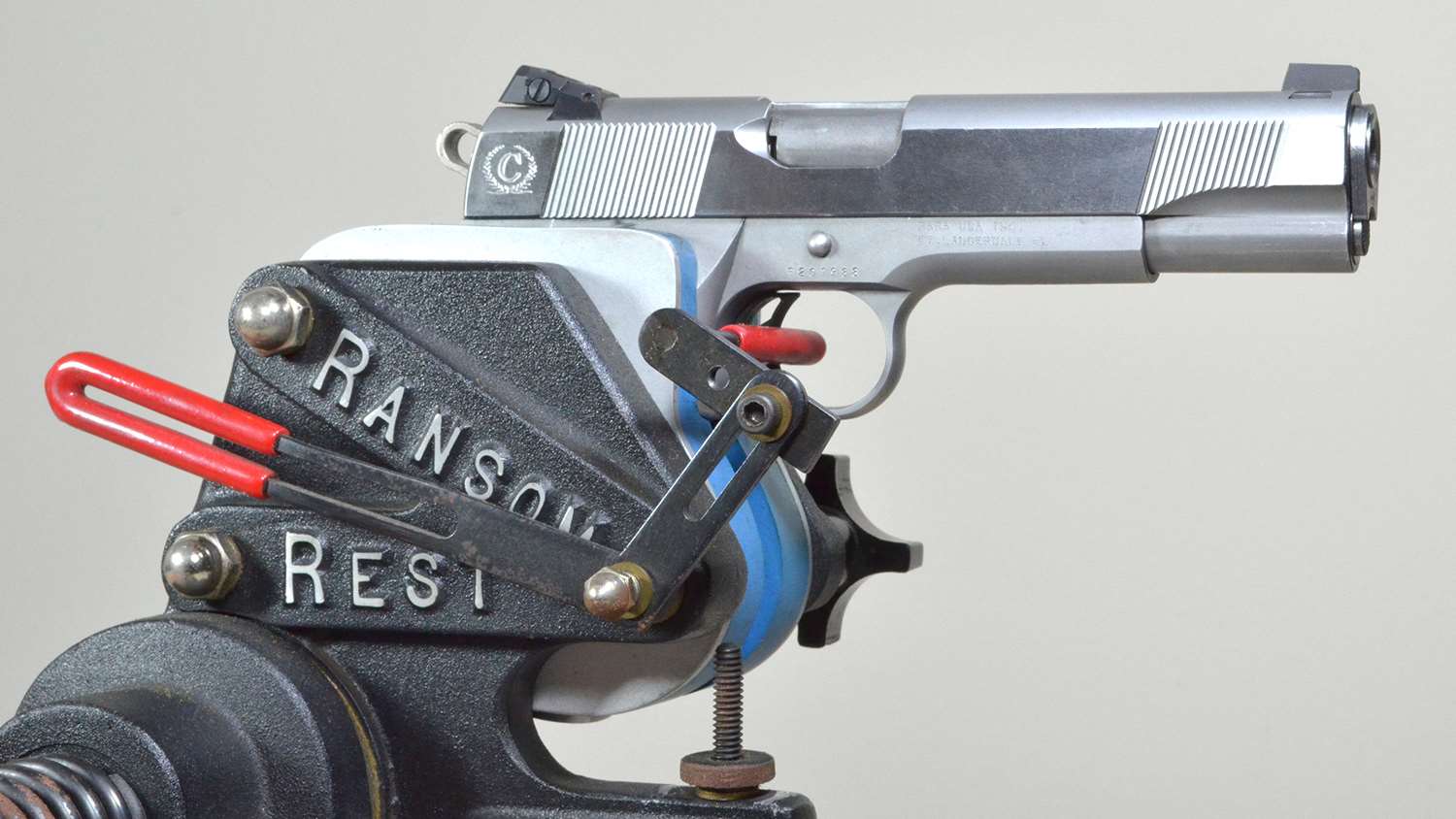
The test gun is a hybrid 1911 with a Para Ordnance frame, Caspian slide and 5″ Kart barrel. It’s a custom gun because it’s purposely assembled with specific parts, but it’s not a bullseye-quality or match grade gun. The Kart barrel fits the slide well, but there is slop in the slide to frame fit. The barrel has traditional land and groove riflings and a 1:16″ twist.
The test was conducted with the gun mounted in a Ransom Rest to eliminate shooter-induced errors that can degrade accuracy. After each 50-shot group, the barrel was cleaned before moving on to the next brand of ammunition.
The Browning 147-grain FMJ load produced the smallest 50-shot group, which measured 1.91″. The next smallest group was with the Fiocchi 92-grain Expansion Mono Block, at 2.25″. The ammo it liked the least was the Blazer 115-grain FMJ, with a group of 5.92″. The next largest group was the Fiocchi 115-grain FMJ, at 5.45″.
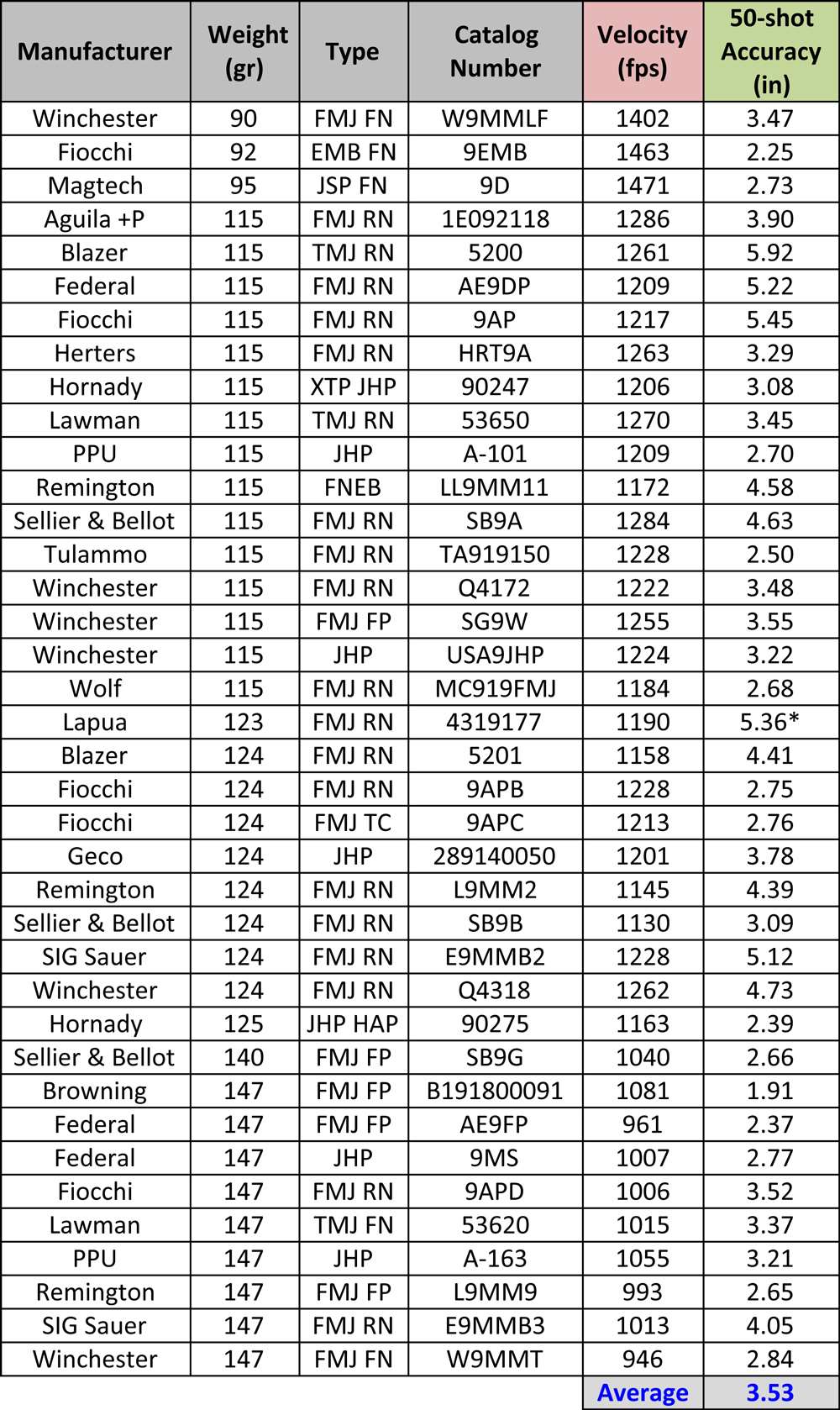
There was a 3.1-fold difference between the smallest and largest groups, meaning that one was just over three times more/less accurate than the other. That’s a fairly big difference but not unexpected, because there can be a significant difference in how well a gun will shoot one load compared to another.
One trend observed with many handguns is that flat nose bullets, which includes any bullet with a flat nose, whether it is a flat-nosed soft point, FMJ or JHP bullet, tend to shoot more accurately than round nose bullets. Naturally, there are exceptions to this, but all else being equal (equal construction type, same quality etc.), there is some merit to this observation.
Half of the loads (N=19) had round nose bullets, and the other half (N=19) were flat nosed. The average group size of the round nose bullets was 4.10″ and the average group size of the flat nose bullets was 2.96″. A statistical student’s t-test assesses if the two samples are from the same population. In simple terms, the t-test asks if the two types of bullet shapes have the same average accuracy. The t-test result indicated that the average accuracy of the round nose bullets and flat nose bullets was statistically not the same (t = 4.13, probability = 0.0002, 2-tailed, 36 degrees of freedom). The conclusion is that this gun shoots flat nose bullets statistically significantly more accurately than round nose bullets. The test result applies to the specific ammunition used in this comparison. Different ammo, or a different gun, could produce different results.
This does not mean that flat nose bullets always outshoot round nose bullets. Some loads with round nose bullets produced smaller groups than those with flat nose bullets. For example, the Tulammo 115 FMJ, Wolf 115 FMJ and Fiocchi 124 FMJ round nose bullets produced 50-shot groups at or below 2.75″, which was less than the average of the flat nose bullets. And the largest group with a flat nose bullet was Remington’s 115-grain FNEB round at 4.58″, which is larger than the average of the round nose bullets. That said, it was the only flat nose bullet that produced a 50-shot group larger than the average of the round nose bullets.
This 1,900 round test shows that a gun can have a threefold difference in accuracy between different types of ammunition. One can imagine that the gun would show an even greater difference if other ammunition was included since some loads might shoot better than the Browning load or worse than the Blazer load. A different gun might have a larger, or smaller, difference in accuracy.
The gun also preferred loads with flat nose bullets over those with round nose bullets, producing 50-shot groups that were, on average, 1.14″ smaller with flat nose bullets.
The bottom line
Accuracy is elusive, and requires testing different loads in your gun to see what it likes. As shown here, a gun’s preference for one type of ammunition over another can be significant, and can be the difference between hitting or missing your target.
More ammo articles:
Most Popular