
In the valleys of northern Italy, certain species of craftsman have evolved to do one thing extraordinarily well. Around Gardone Val Trompia, where the Beretta family has been in the gun business for 15 generations, they shape steel into actions that lock up like bank vaults. A couple of hours to the west, near the shores of Lake Como, a much smaller colony spends its days coaxing wheels no bigger than a lentil into keeping perfect time. The two populations rarely mingle. This fall they did, and the encounter produced a shotgun you can see into.
Beretta and La Vallée, an independent Italian watchmaker with a staff of less than 15, unveiled Oct. 12 the SO10 Kronos as a one-off sidelock over-and-under built for Beretta’s 500th anniversary. Its big idea, years in the making, is a sapphire crystal window in each sideplate, opening a view onto lockwork normally sealed away beneath engraved steel.
Watch collectors have spent decades turning their watches over to admire the movement through an exhibition caseback, the glass back that puts a wristwatch’s engine room on view like a tiny aquarium. Beretta and La Vallée have, in effect, given a shotgun two of them.
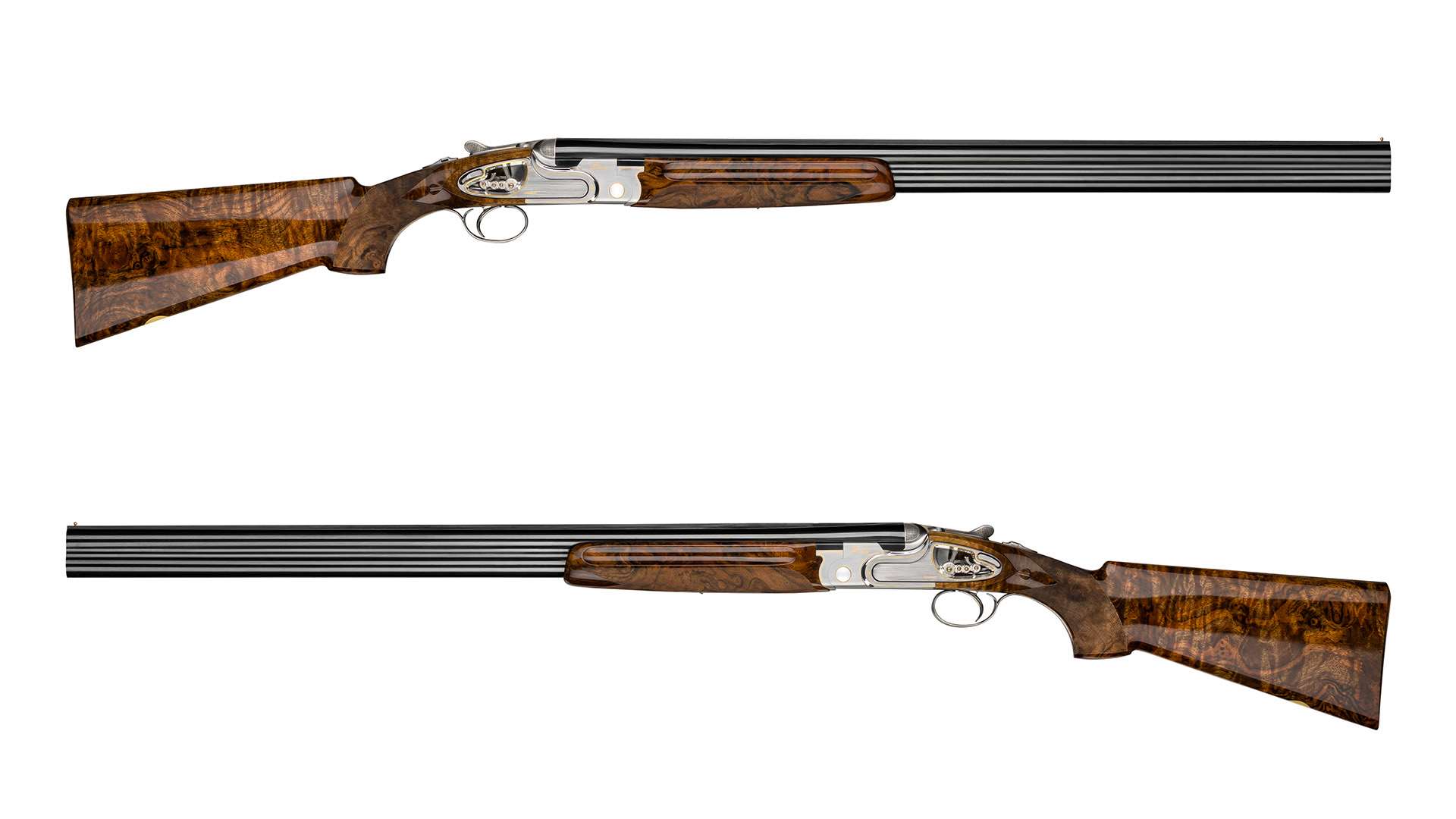
Beretta’s anniversary year has produced a run of one-of-a-kind guns, and Carlo Gussalli Beretta, PB Selection business development manager for Fabbrica d’Armi Pietro Beretta, isn’t shy about ranking them.
“Among the one-off creations celebrating Beretta’s 500th anniversary, SO10 Kronos stands as the most emblematic piece,” he said. “Not only for its rarity, but for its meaning: time—the true protagonist of this milestone.”
As partners go, La Vallée is an intriguing pick. Founded in 1938, the company builds bespoke watches in tiny numbers, each one designed around its owner. Its patented M30TP Aero and Cosmo models can even be set up so the Aero’s tourbillon or the Cosmo’s escapement beats in time with the owner’s resting heart rate.
Massimiliano Quintavalle, La Vallée’s CEO, saw the shotgun as a chance to take a watchmaker’s habits of mind somewhere new.
“Horology is an art of mechanical thinking,” he said. “It is an ongoing discovery of how components interact, how structures can be conceived differently, and how engineering and craftsmanship can transform the experience of an object.”
Cutting a window into a sideplate sounds simple enough until you consider what an SO10 sideplate does for a living. On a true sidelock, the firing mechanism is mounted on the plates themselves, and on the SO10 those plates detach, so any opening has to be carved into a part that is already carrying a load. Roberto Savassi, Beretta’s over-and-under design manager, summed up the challenge.
“If you want to open a glass window on a shotgun, the SO10 is the one: it is an engineering masterpiece itself,” he said. “But the SO10 mechanism is also the most complex to approach, realize and revise from both an engineering and a manufacturing standpoint.”
The fix began with the plates. Each was reconceived as a single monobloc piece machined from solid high-strength alloy steel, so the window wouldn’t cost it any strength. Screws that would normally hold the mechanism’s pins in place gave way to a gold trilobe spring, a three-lobed elastic retainer borrowed from precision watchmaking. A watch needs parts that stay put through the knocks of daily wear. A shotgun’s recoil is a considerably bigger knock, and the spring is built to ride out even severe shocks.
With a newly designed opening system, both sideplates open at a twist of a curved catch set into the crystal, and the lockwork can at last be observed in its natural habitat. Savassi said the team went so far as to introduce entirely new lever geometries for disassembly, and by his account the finished gun passed every one of Beretta’s toughest tests.
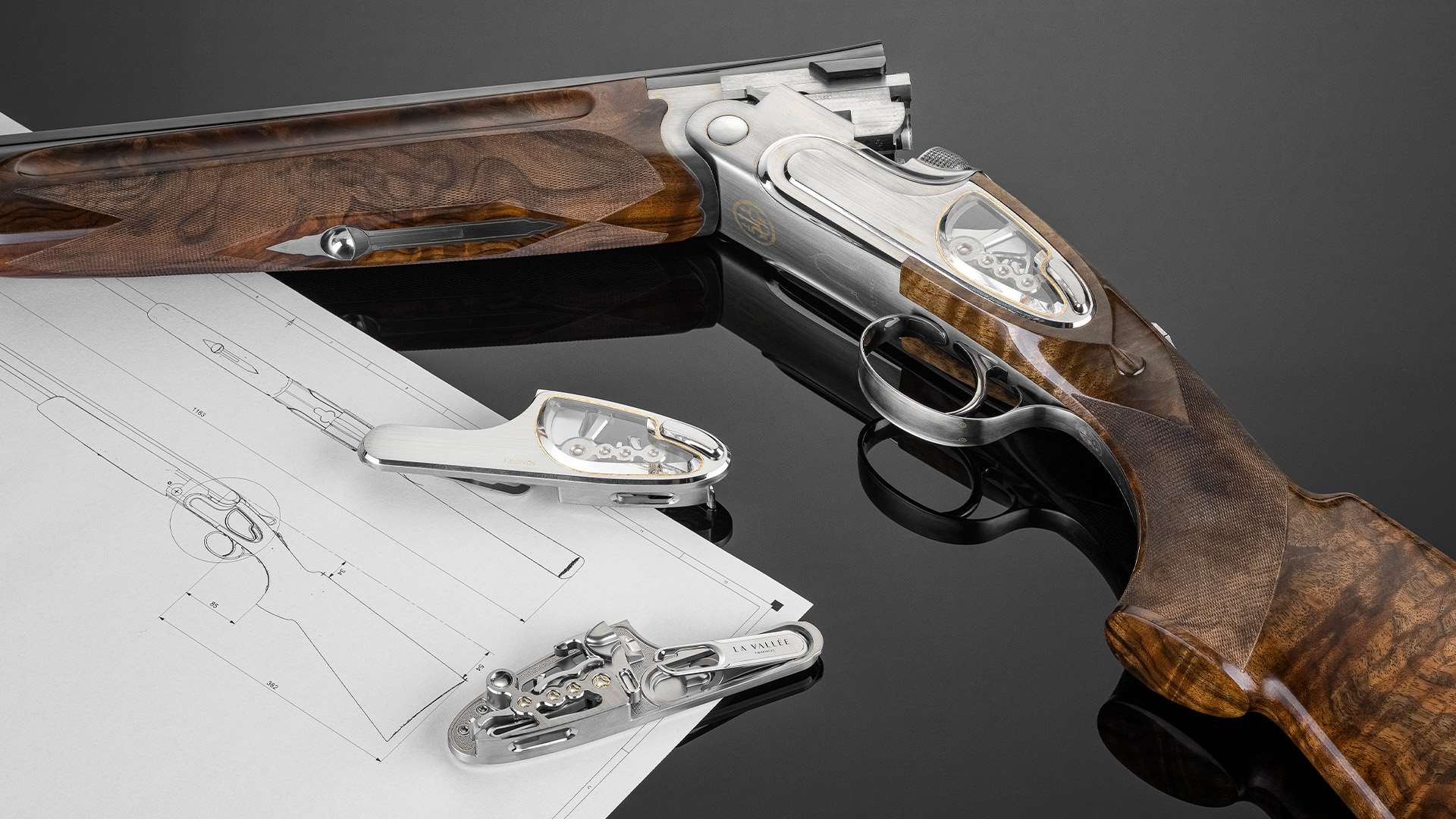
That left the glass. Sapphire crystal shrugs off almost anything that tries to scratch it, but like most very hard materials it has little patience for being clamped rigidly inside something that recoils. For a solution, the team turned to gold inlay. A groove was machined around each shaped recess, and gold was hand-hammered into it much the way gunmakers have laid gold into engraved steel for centuries. Here the gold has a job beyond decoration, gripping the crystal securely while yielding just enough to let the assembly absorb the stresses of firing.
Luciano Sasso, La Vallée’s head of research and development, said the visible components were finished to the same standard the company applies to its own movements, right down to hand-shaped edges and carefully managed boundaries where one finish gives way to the next. Peer through the sapphire and you’ll find Geneva stripes, the rippling parallel bands that decorate the bridges of fine watches, along with polished bevels, gold-plated sleeve bearings and graining laid down in both straight and radial patterns.
Look past the watchmaking, though, and it is still an SO10, a gun meant to outlast its first owner. Its receiver is machined, with no castings or welds. At the rear, a longitudinal locking bolt sits in line with the hinge pins, two more locking lugs are set into the lower receiver and the SO10’s trapezoidal barrel-locking shoulders complete the lockup.
Windows like these tend to draw every eye in the room, so the engraving elsewhere stays restrained. An English-style border inlaid with gold frames the receiver. Fine scrollwork covers the locking shoulders, top lever and safety, and a gold-inlaid 500 Years emblem sits on the bottom of the receiver, where its most frequent admirer will likely be whoever cleans the gun.
In keeping with SO10 tradition, the stock is Grade 5 walnut, and it wears 80 hand-applied coats of Tru-Oil. Built up layer upon patient layer, like sediment settling on a slow riverbed, the finish gives the figure in the wood a depth that seems to rise from somewhere well beneath the surface.
Even the case gets in on the act. Its black leather shell carries a glass panel at the center, so the gun stays on view even when the case is closed. Inside, black microfiber is French-fitted around the shotgun and its accessories, with the layout arranged so the sideplates are the first thing anyone notices.
There is a tidy symmetry to all of it. The 1526 document Beretta counts as its founding record logs payment for 185 arquebus barrels delivered to the Arsenal of Venice. La Vallée got its start in a Venice workshop a little over four centuries later. Now the two have met over a gun whose true subject is time, and whoever ends up owning it faces a pleasant dilemma. A safe would keep it secure. Judging by that glass-paneled case, Beretta would rather it lived somewhere people can watch.
Learn more at pietroberetta.com.
Most Popular