
Most of us know stories of the differences between smallbore and high power shooters; here is a true story that illustrates one of those differences.
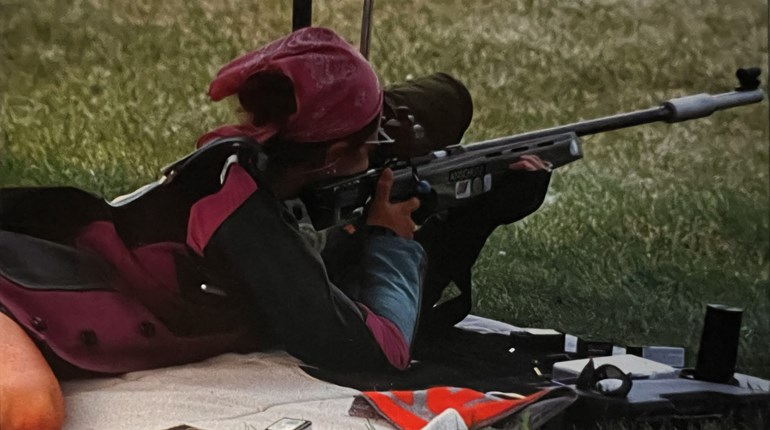
It was the early fall of 1962 at a high power match on the 1000-yard range at Camp Ripley, located in the exact center of the state of Minnesota. I had a Springfield ‘03-A3 with the original two-groove barrel in a Herter’s stock (remember Herter’s?) which I had shot exclusively at 200 yards with with 180 grain Sierra hand loads that I had assembled with the help of a friend.
When my relay was called I got into a good prone position and came up a hopeful amount on the rear sight. I sent a round down range. Nothing. “Mark five!” my scorer called. My scorer was Bob Sloan, Professor of Geology at the University of Minnesota and one of the many really fine marksmen (of both sexes) to have come out of Minnesota over the years. I was in the graduate chemistry program at that same university and I figured I’d better play it cool with Professor Sloan because you could never be sure who might be on your oral exam committee. A geologist at a chemistry oral could cause untold misery. My target came up with Maggie’s drawers signaling a miss.
Another shot. Nothing. Mark Five! Another Maggie’s. And so it continued for several shots. Finally, the good Professor Sloan, ever the teacher, bless his heart, said, “Let me see if I can help you get on paper.”
“Thank you, sir,” I said over my shoulder in the strangled voice inevitable in the prone position.
“OK, what’s your 200-yard zero?” asked the professor. Hesitation. Uncertainty. “Zero?” I finally squeaked. The professor’s jaw clenched and his mouth became a thin line. Patiently, although through closed teeth, he said, ”You’re a smallbore shooter, aren’t you?”
“How can you tell?”
Professor Sloan phoned the pits: “We have a problem on target five. We’ve got a smallbore shooter who doesn’t know his zero!” I fired a few more misses as the absurdity of the situation slowly dawned on me. It is hard to shoot when you are laughing.
And there you have it: Smallbore shooters don’t know their zeroes, high power shooters do—indeed, must. The high power shooter knows, for example, “At 200 yards, nine minutes up and half a minute left from mechanical zero.” I’ve never clicked any of my smallbore sights down to mechanical zero to record my sight settings. And I’ll bet the rest of you smallbore shooters haven’t either.
Should the good Professor Sloan ever read this: Thank you again for your generous (and unforgettable) help that day at Ripley. I do now know my 200-yard zero now; along with my 300-, 600-, 800-, 900- and 1000-yard zeroes. I did learn, for high power, anyway.
Most Popular