** When you buy products through the links on our site, we may earn a commission that supports NRA's mission to protect, preserve and defend the Second Amendment. **
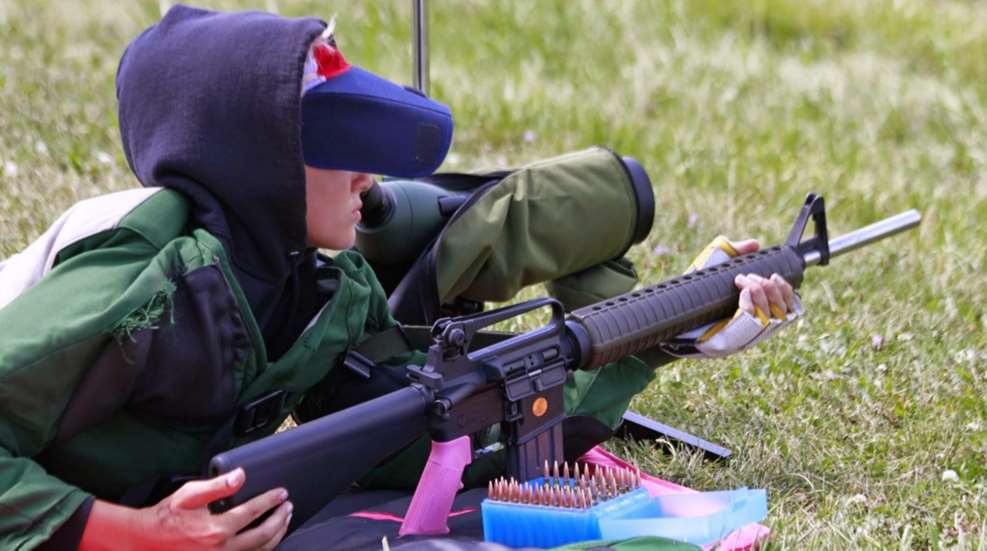
What MOA is Not: We measure groups with a ruler and should include the range to the target. But we measure MOA as an angle that applies to all distances. A gun that shoots 1-inch groups at 100 yards may shoot a 6-inch group at 600 and a 10-inch group at 1,000 yards. However, by definition, one minute of angle is the same measurement regardless of distance. It’s incorrect to mix the two with a phrase such as “the gun shoots 3 inches of MOA.”
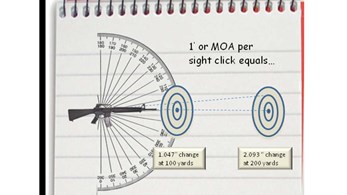
Get Out Your Protractor: Each of the 360 degrees in a circle can be further divided into 60 minutes, which turns out to be a practical unit of measure for target shooting. We’ve been taught that one MOA from the 100-yard line equals one inch on the target (actually 1.047 inch), about 2 inches at 200 yards and so on. And we know that sights with finer threads can produce smaller adjustment increments so that ¼ MOA, for example, mathematically moves the point of impact ¼ inch at 100 yards, ½ inch at 200 yards, etc.
By turning the formula around, we can divide inches of desired movement on the target by the MOA increment to figure out how many clicks are required for that correction. So, in order to move the point of impact 4 inches at 200 yards with a ¼ MOA sight, we would calculate: ¼ MOA sight x 200 yards = ½ inch per click. Divide 4 inches of movement by ½ inch per click to learn it would take 8 clicks to achieve our goal. (Hang in there, the fun part is coming.) Armed with this knowledge, we can make some notes for the firing line.
From the online NRA Rule Book we learn:
4.3 200 Yard Targets
(a) No. SR - Military “Target, Rifle, Competition, Short Range.
Aiming Black (inches)
X ring . . . . . . . .3.00
10 ring . . . . . . .7.00
9 ring . . . . . . . .13.00
Rings in White (inches)
8 ring . . . . . . . . 19.00
7 ring . . . . . . . . 25.00
6 ring . . . . . . . . 31.00
5 ring . . . . . . . . 37.00
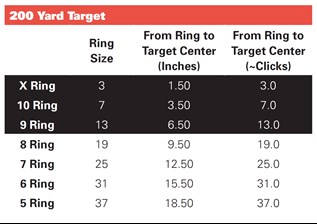
Using the above data, a sample reference card for ¼ MOA sights at the 200-yard line might look something like the table below. To avoid the mental calisthenics of translating the table into sight clicks, some shooters prefer to use a graphic that displays clicks only.
Sight Radius: Given the triangle formed by rear sight height, sight radius along the barrel and line-of-sight to the target, if you move the front sight forward, as when adding a “bloop tube,” the point of aim will rise and the MOA adjustment value will diminish, ever so slightly.
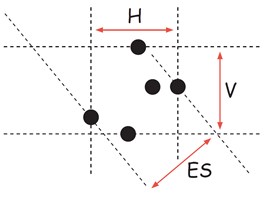
Measuring Groups: Using the USAMU protocol, measure the center-to-center distance on the vertical axis of the group (V in the diagram), another for the horizontal center-to-center distance (H) and the extreme spread (ES), then average them (divide by three) for the resulting group size (not MOA).
If you have access to a scanner or digital photography, try Jeffrey Block’s free software program. His OnTarget software allows you to import a scanned or photographed target into the software for measurement. If photographed, you’ll have to enter the distance between the camera lens and the target to keep everything straight. Scanning requires no such data and is therefore somewhat simpler to use. The user is then required to enter the caliber and distance to the target. The user then positions the proportionately correct graphic circles on top of each bullet hole to precisely mark the center of each shot. Zooming in makes it easier for exact placement of the circles. Once marked, the program quickly calculates several measurements such as MOA, group center and maximum group spread. View OnTarget and a tutorial video at www.ontargetshooting.com.
The Math: If you sat in the front row of math class, you already know this.
1. 360 degrees x 60 minutes per degree equals 21,600 minutes in a circle. Next, we need to know how many inches are in a particular circle, based on the distance to the target.
2. The circumference of a circle calculates as: Pi (3.14) x circle’s diameter.
3. We get the diameter from 2 x radius (distance to the target) … so, from 100-yards (radius), the diameter is 2 x (100 yards x 36 inches) or 7,200 inches.
4. (From step 2) 3.14 x 7,200 = 22,608 inches in the circumference of this circle.
5. A circumference of 22,608 inches divided by 21,600 minutes = 1.047 inches on the circumference (target) for each MOA, in this case, at a radius (shooting distance) of 100 yards.
Continuing on we see that:
One Minute of Angle =
1.047 inch at 100 yards.
2.093 inches at 200 yards.
3.140 inches at 300 yards.
6.280 inches at 600 yards.
10.467 inches at 1,000 yards.
And for my bullseye pistol friends:
.262 inch at 25 yards.
.523 inch at 50 yards.
Get Out Your Protractor: Each of the 360 degrees in a circle can be further divided into 60 minutes, which turns out to be a practical unit of measure for target shooting. We’ve been taught that one MOA from the 100-yard line equals one inch on the target (actually 1.047 inch), about 2 inches at 200 yards and so on. And we know that sights with finer threads can produce smaller adjustment increments so that ¼ MOA, for example, mathematically moves the point of impact ¼ inch at 100 yards, ½ inch at 200 yards, etc.
By turning the formula around, we can divide inches of desired movement on the target by the MOA increment to figure out how many clicks are required for that correction. So, in order to move the point of impact 4 inches at 200 yards with a ¼ MOA sight, we would calculate: ¼ MOA sight x 200 yards = ½ inch per click. Divide 4 inches of movement by ½ inch per click to learn it would take 8 clicks to achieve our goal. (Hang in there, the fun part is coming.) Armed with this knowledge, we can make some notes for the firing line.
From the online NRA Rule Book we learn:
4.3 200 Yard Targets
(a) No. SR - Military “Target, Rifle, Competition, Short Range.
Aiming Black (inches)
X ring . . . . . . . .3.00
10 ring . . . . . . .7.00
9 ring . . . . . . . .13.00
Rings in White (inches)
8 ring . . . . . . . . 19.00
7 ring . . . . . . . . 25.00
6 ring . . . . . . . . 31.00
5 ring . . . . . . . . 37.00
Using the above data, a sample reference card for ¼ MOA sights at the 200-yard line might look something like the table below. To avoid the mental calisthenics of translating the table into sight clicks, some shooters prefer to use a graphic that displays clicks only.
Sight Radius: Given the triangle formed by rear sight height, sight radius along the barrel and line-of-sight to the target, if you move the front sight forward, as when adding a “bloop tube,” the point of aim will rise and the MOA adjustment value will diminish, ever so slightly.
Measuring Groups: Using the USAMU protocol, measure the center-to-center distance on the vertical axis of the group (V in the diagram), another for the horizontal center-to-center distance (H) and the extreme spread (ES), then average them (divide by three) for the resulting group size (not MOA).
If you have access to a scanner or digital photography, try Jeffrey Block’s free software program. His OnTarget software allows you to import a scanned or photographed target into the software for measurement. If photographed, you’ll have to enter the distance between the camera lens and the target to keep everything straight. Scanning requires no such data and is therefore somewhat simpler to use. The user is then required to enter the caliber and distance to the target. The user then positions the proportionately correct graphic circles on top of each bullet hole to precisely mark the center of each shot. Zooming in makes it easier for exact placement of the circles. Once marked, the program quickly calculates several measurements such as MOA, group center and maximum group spread. View OnTarget and a tutorial video at www.ontargetshooting.com.
The Math: If you sat in the front row of math class, you already know this.
1. 360 degrees x 60 minutes per degree equals 21,600 minutes in a circle. Next, we need to know how many inches are in a particular circle, based on the distance to the target.
2. The circumference of a circle calculates as: Pi (3.14) x circle’s diameter.
3. We get the diameter from 2 x radius (distance to the target) … so, from 100-yards (radius), the diameter is 2 x (100 yards x 36 inches) or 7,200 inches.
4. (From step 2) 3.14 x 7,200 = 22,608 inches in the circumference of this circle.
5. A circumference of 22,608 inches divided by 21,600 minutes = 1.047 inches on the circumference (target) for each MOA, in this case, at a radius (shooting distance) of 100 yards.
Continuing on we see that:
One Minute of Angle =
1.047 inch at 100 yards.
2.093 inches at 200 yards.
3.140 inches at 300 yards.
6.280 inches at 600 yards.
10.467 inches at 1,000 yards.
And for my bullseye pistol friends:
.262 inch at 25 yards.
.523 inch at 50 yards.