In 1875 the NRA, as part of the Centennial celebration of the founding of the nation, issued a challenge to the riflemen of the world for a long-range rifle match to be fired at 800, 900 and 1,000 yards at the Creedmoor range on Long Island in 1876. Australia, Ireland, Scotland and Canada accepted the challenge.
The USA was on a roll in long-range rifle shooting. We had eked out a three point win over the Irish in 1874 and won again against them (by a more comfortable 39 points) in 1875 at the Dollymount range in Ireland. We would also win in 1876 and in 1877. When we challenged the world again in 1878, no one answered.
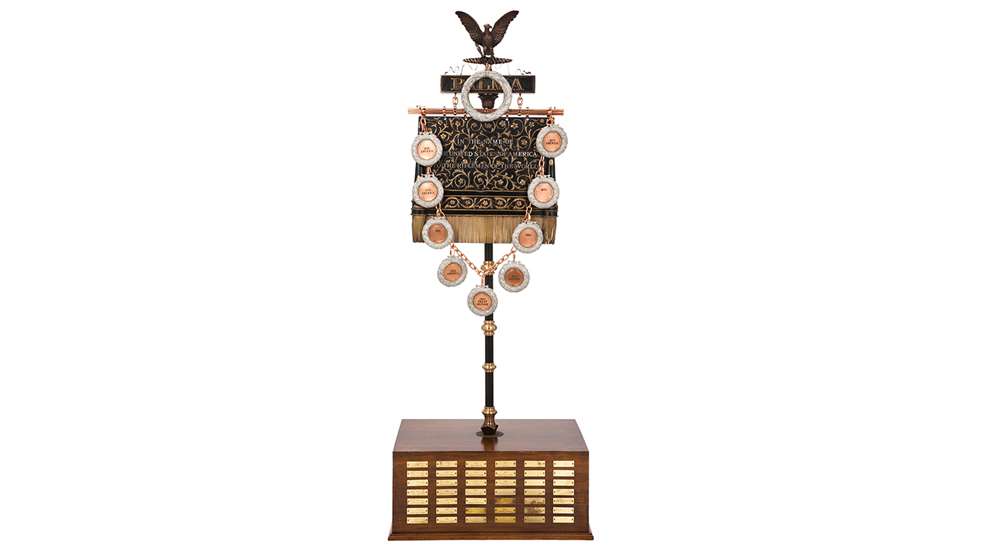
A trophy, constructed by Tiffanys (the cost was $1,500, including 280 ounces of silver) and paid for by private contributions, was to be awarded to the winning team. The trophy stood seven and a half feet tall and was in the form of a Roman triumphal standard. Instead of the Roman SPQR, the trophy bore the word Palma (Latin: victory, honor, glory) and the words “In the name of The United States of America to the Riflemen of the World”. Officially, it was the Centennial Trophy but it quickly became known as the Palma Trophy. Although the intention was to contest the trophy annually, it didn’t work out that way. Competition repeated in 1877, but then occurred only intermittently and irregularly through 1928. In 1966, formal competition was resumed (at varying intervals) at venues around the world: Australia, New Zealand, Great Britain, Canada, South Africa and the USA.
Sometime after 1930, the Palma Trophy vanished. It was last seen in a corridor in the State, War, and Navy building (now the Old Executive Office building—next door to the White House). Correspondence between Gen. Milton A. Reckord (then NRA Executive Vice President) and the Secretary of War confirmed the trophy’s presence and acknowledged that it was NRA property. But apparently nothing was done.
When the Pentagon was completed in the 1940s, much of the material from the several services was transferred to the new building; the balance was sent to the Richmond, VA, Quartermaster Depot and perhaps to other locations. A 1965 report that the trophy had been sighted in the Richmond Depot evidently was not pursued.
Upon learning that all trophies in the U.S. Army inventory were transferred to a Smithsonian Storage facility in Pueblo, CO, John Grubar (of the NRA) and Smithsonian personnel searched this facility and were unable to find any trace of the trophy.
Ed Andrus concludes his article on the Palma Trophy (SSUSA, May, 1991) with “Whatever happened to the original Palma Trophy may never be known. However, the situation of the Palma Trophy is certainly reminiscent of the last scene in a film about the lost Ark of the Covenant.” [I. e. Raiders of the Lost Ark.]
And there the matter rests.
One good thing that did turn up in these searches was the original Tiffany plans for the Palma Trophy; these were used by Dr. Herbert M. Aitkin M. D. from Eau Claire, WI, to construct a two-thirds size replica of the Palma Trophy which Dr. Aitkin (a member of the High Power Rifle Committee) donated to the NRA in 1988.
Today the Palma Trophy is awarded to the winner of the Long-Range Team match (800, 900 and 1,000 yards) fired at the World Long-Range Championships, most recently in 2015 at Camp Perry where the winning team was from Great Britain for the fourth consecutive time.
The Palma Trophy is the oldest international trophy contested by the United States.
Readers interested in learning more about the Palma Trophy and its history should read Ed Andrus’s article (The Mystery of the Palma Trophy, cited above) in SSUSA and also The History and Records of the Palma Match (The Long-Range Rifle Team Championships) by Colin C. C. Cheshire.
Most Popular