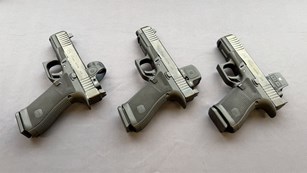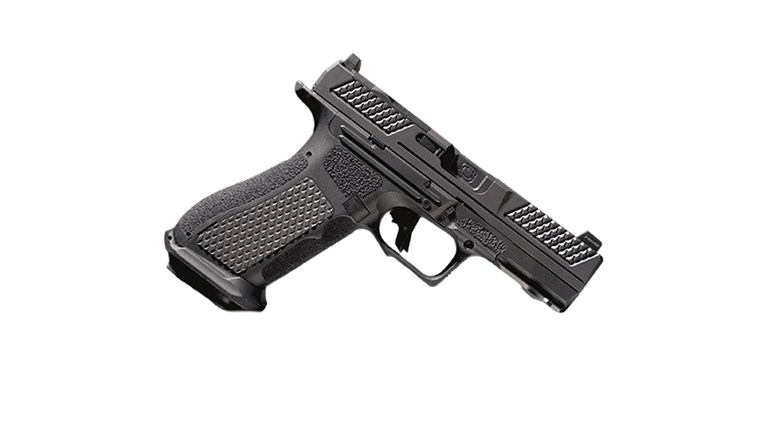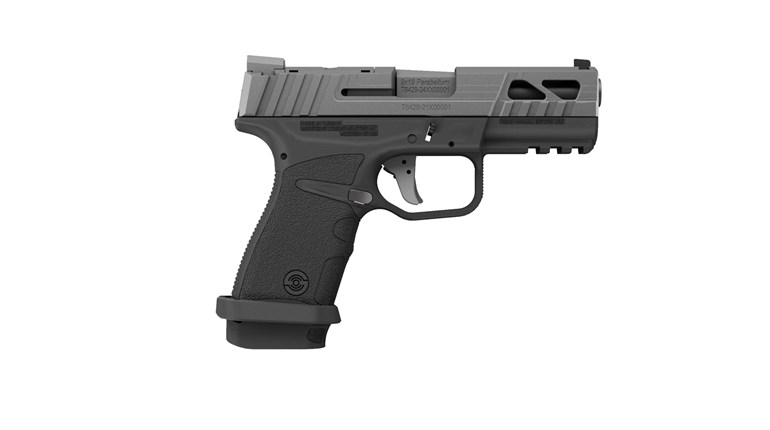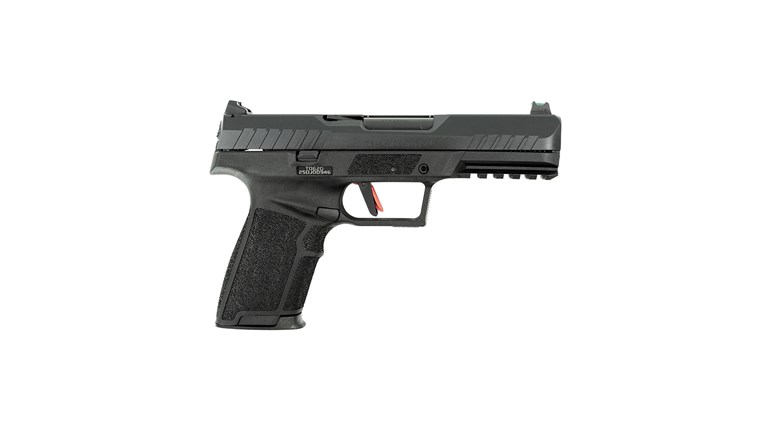
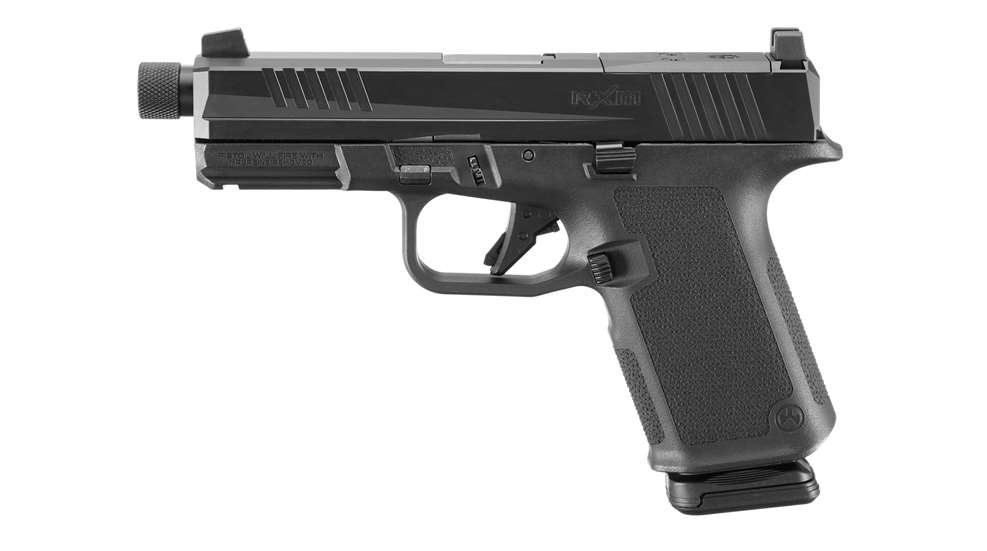
If Ruger’s newest addition to their handgun line bears a surprising resemblance to a Glock, it’s not accidental. The RXM is the result of a collaborative effort between Ruger and Magpul that results in a modest price and a wide range of custom options due to compatibility with Glock Gen3 components and Magpul frames.
Ruger RXM
Built on a polymer frame, the RXM weighs in at a petite 23.6 ounces. It features a removable fire control group that allows switching between the supplied Magpul full-sized grip and aftermarket compact and sub-compact frames, as well as accepting many Glock Gen3 components, including aftermarket competition triggers.
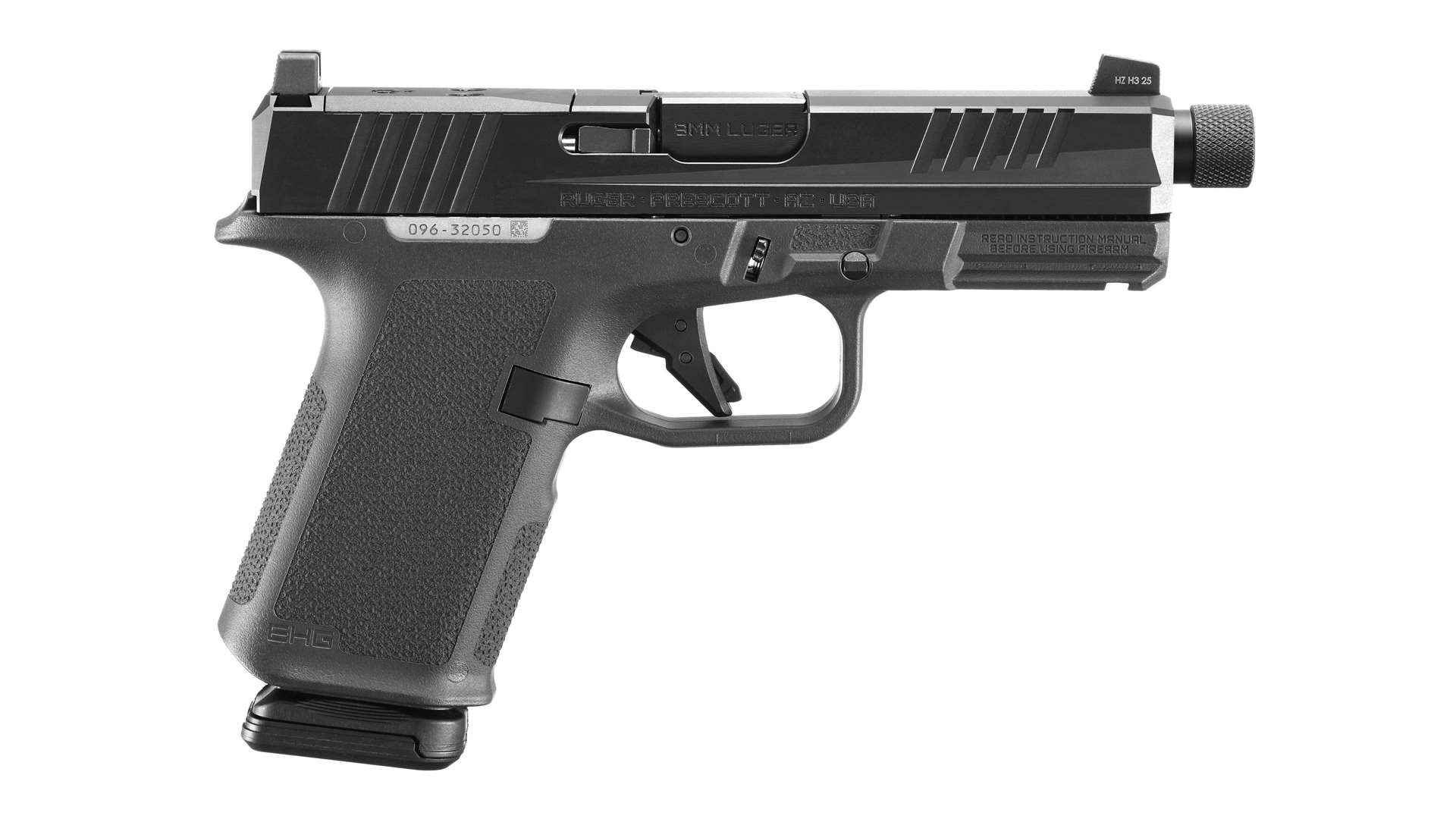
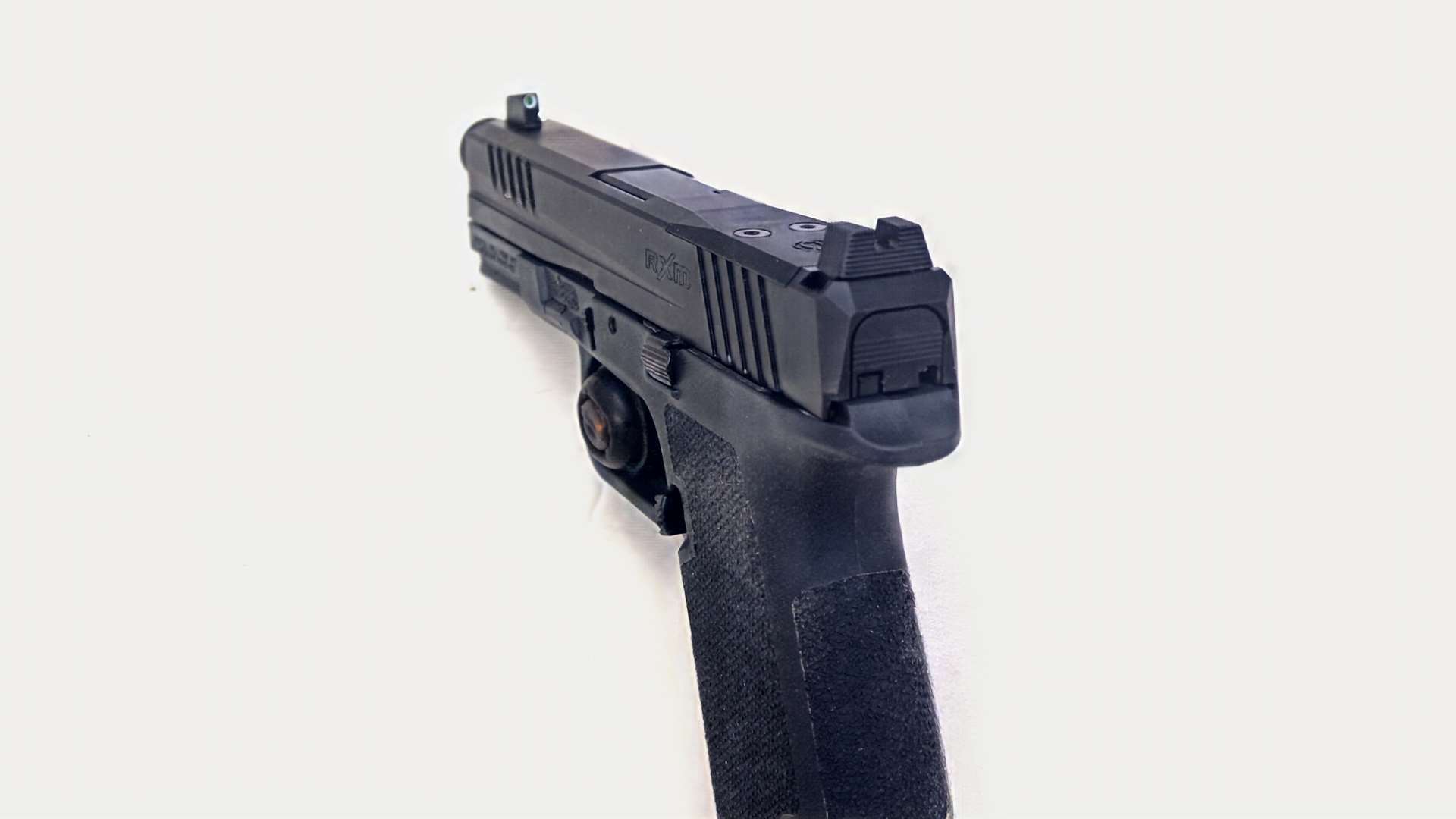
Iron sights are fixed, co-witness height and consist of a tritium front blade and a black drift adjustable rear. It’s cut for optic sight mounting in the RMR, RMSc and DeltaPoint Pro footprints that cover a wide variety of popular reflex sights.
The RXM is available in nine variations ranging in price from $499 to $599. Five of the models have 4-inch barrels, while the other four have 4½-inch threaded barrels for attaching muzzle accessories. The 4-inch models range in price from $499 to $599, while the 4½-inch threaded models run from $569 to $599. Beyond that the only differences between the nine models are cosmetic—differing color schemes. Operating characteristics and components (other than the barrel difference) are the same for all. The test model sent to me was Model No. 19446: plain black with the 4½-inch threaded barrel ($599).
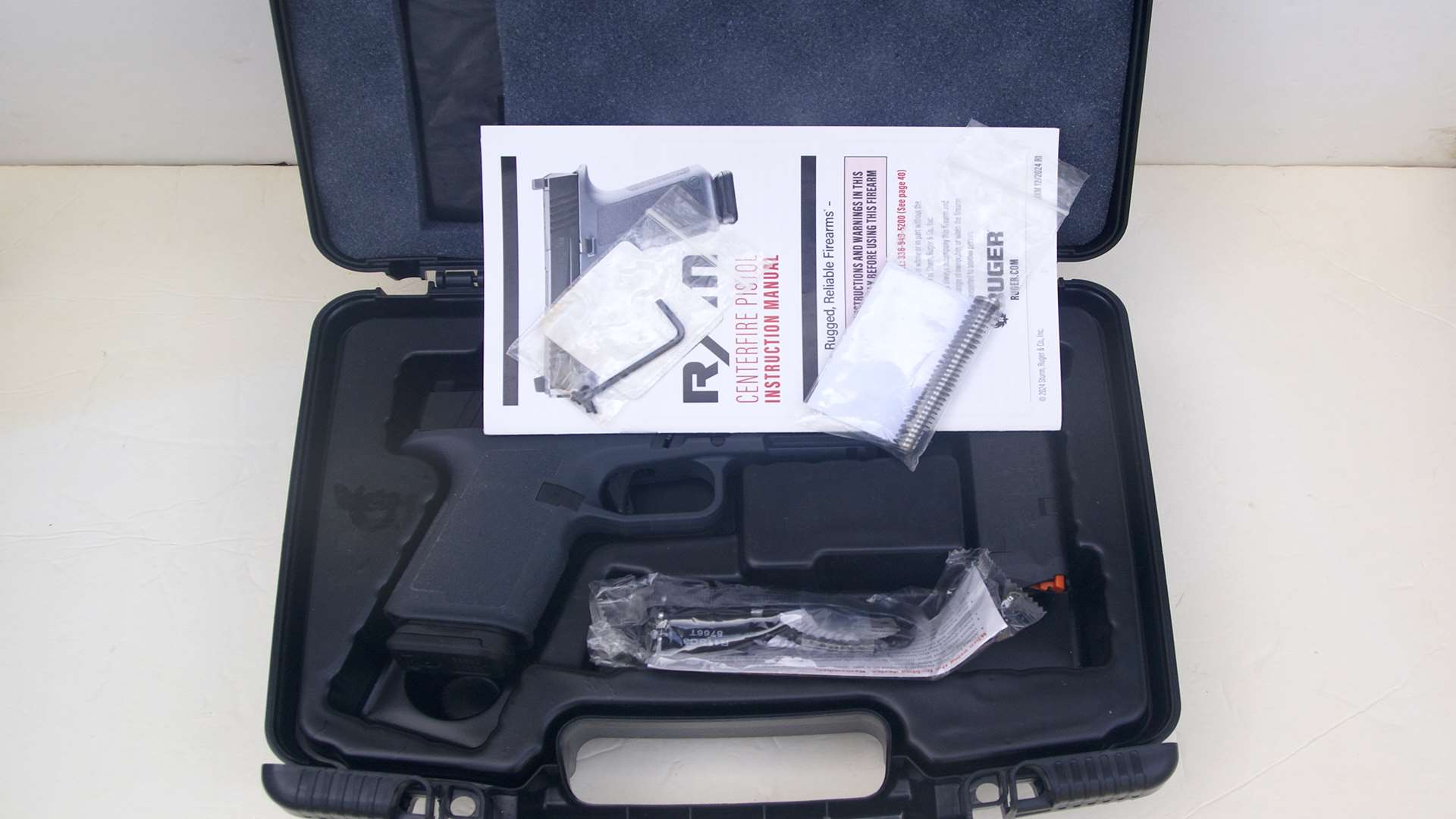
It ships in a lockable padded hard-plastic case with the full-sized grip and two 15-round magazines, a cable lock, plus the wrench and dowels required for optic sight installation.
On The Range
My first step with any test gun is a strip/clean/lube. The RXM field strips like a Glock, but there’s a catch. As with the Glock you clear the gun, pull the trigger and move the slide rearward to align a notch on the upper slide with the frame-mounted slide release levers. Then press down on the slide lock release levers to release the lock and allow the upper unit to be slide forward and off the frame. I’ve done this many times with my Glock G29 and it’s easy. The procedure with the RXM is the same, but there is no alignment notch on the slide, and the rearward slide movement is very slight. The manual says no more than 1/16-inch or the trigger will reset and stop the process.
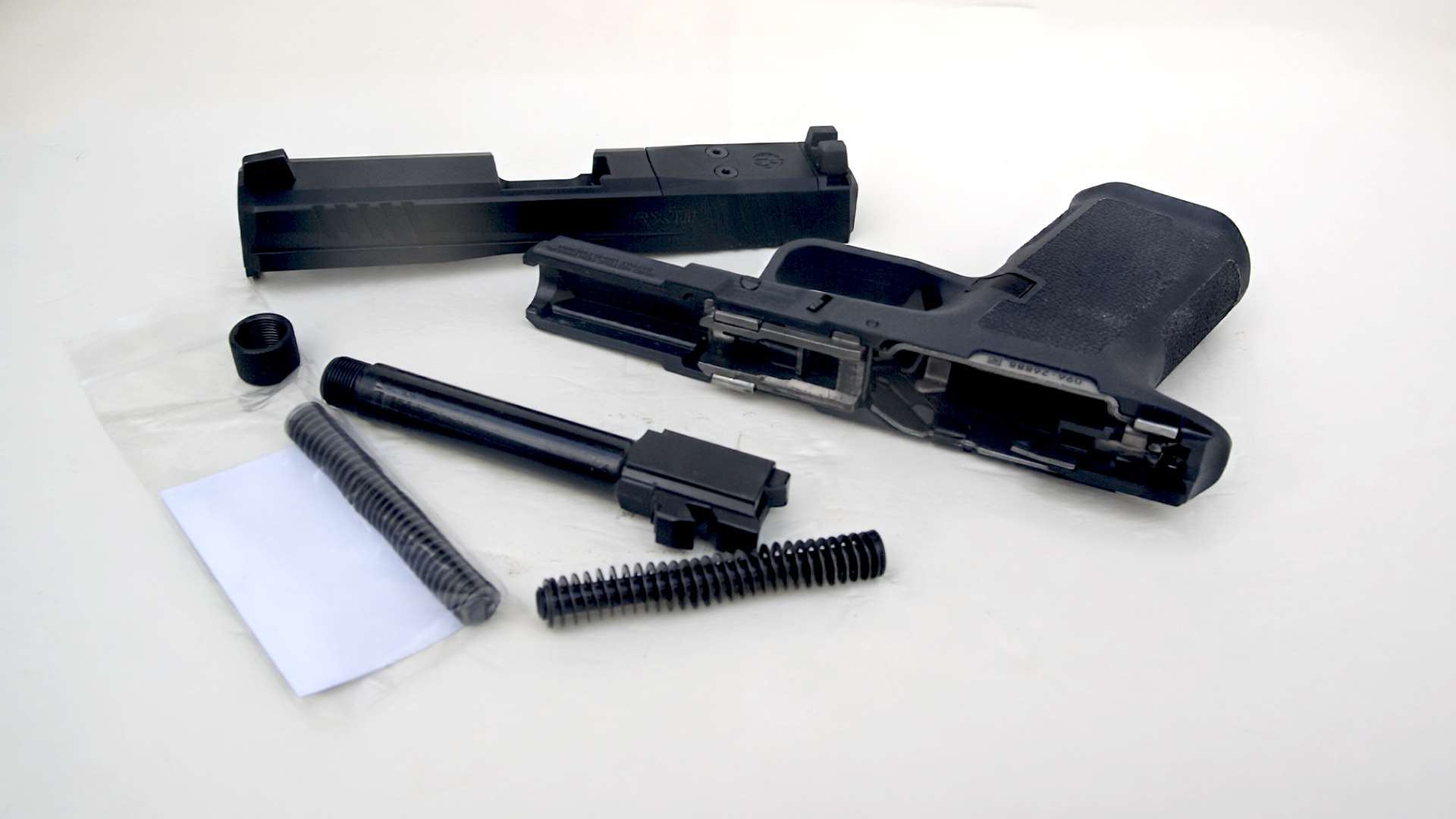
I didn’t seem to have that 1/16-inch figured out and was constantly resetting the trigger. I finally figured out that if I start pressing down on the release levers before moving the slide, and then just eased the slide rearward until the levers drop, it will work. After mastering the slide release, everything worked just like my Glock and re-assembly was simple.
With that done I played with the trigger. Like most out-of-the-box Glocks it was rough, gritty and heavy. I had not yet replaced my dead digital trigger pull gauge, so I could only estimate about seven pounds. But my previous Glock experience had shown me that they smooth and lighten after break-in, so I ran 40 dry fires and then grabbed a box of Remington 115-gr. UMC loads and headed to my range.
I set up three white cut-out targets about 10 feet apart and ran transition drills from 15 yards with the 50 rounds. The iron sights presented a bold and quickly acquired sight picture. As one would expect from a 23-ounce gun the recoil was brisk, but the EHG full-size grip frame that comes on the gun was well-shaped for my hands and very comfortable. By the time I was done the trigger had smoothed up well, and felt no different than my well-worn G29, which I had previously measured at five pounds.
My next step was to a sandbagged rest at 25 yards to check the iron sights with my test loads. In order to test a variety of bullet weights I selected the 115-gr. Remington UMC FMJ, 123-gr. Lapua FMJ, Federal Syntech 130-gr. TSJ and 150-gr. TSJ, and Remington 147-gr. UMC FMJ. On clean targets I fired a five-round group with each to check the point of impact.
Windage and elevation was dead on. As one would expect there was a difference in vertical impact between the different bullet weights with the 125/130 being centered, the 115 a couple inches low and the two heavier slugs a couple inches high.
My next step was to try a comp on the threaded barrel. I wouldn’t be using it in USPSA Open, since Minor is not competitive and a 23-ounce gun has no business shooting 9 mm Major loads. But Steel Challenge has no Power Factor and it could be very useful in Open there with light loads. The only 9 mm comp I had on hand was a Tandemkross. This is a four-port compensator; two to a side with the hole extending from the upper side to mid-point down the side.
I have used it successfully on several other pistols, but the RXM would not eject cases with any of the factory test loads. With some loads the slide didn’t even move. There is a second recoil spring assembly included that states it is for use with comps. I changed the springs and tried each load again with the same results. I then tried a Federal 147-gr. +P load and it did eject, but not very vigorously.
I queried Ruger on that and the product manager responded by stating, “This is actually a common issue with aftermarket third-party compensators being fitted to threaded barrels. The aftermarket compensators add weight to the barrel and also modify the recoil energy that can result in malfunctions being experienced. This situation does not indicate a fault with the pistol.”
Maybe a lighter comp, or a single-port comp, would work, but had had none on hand to try.
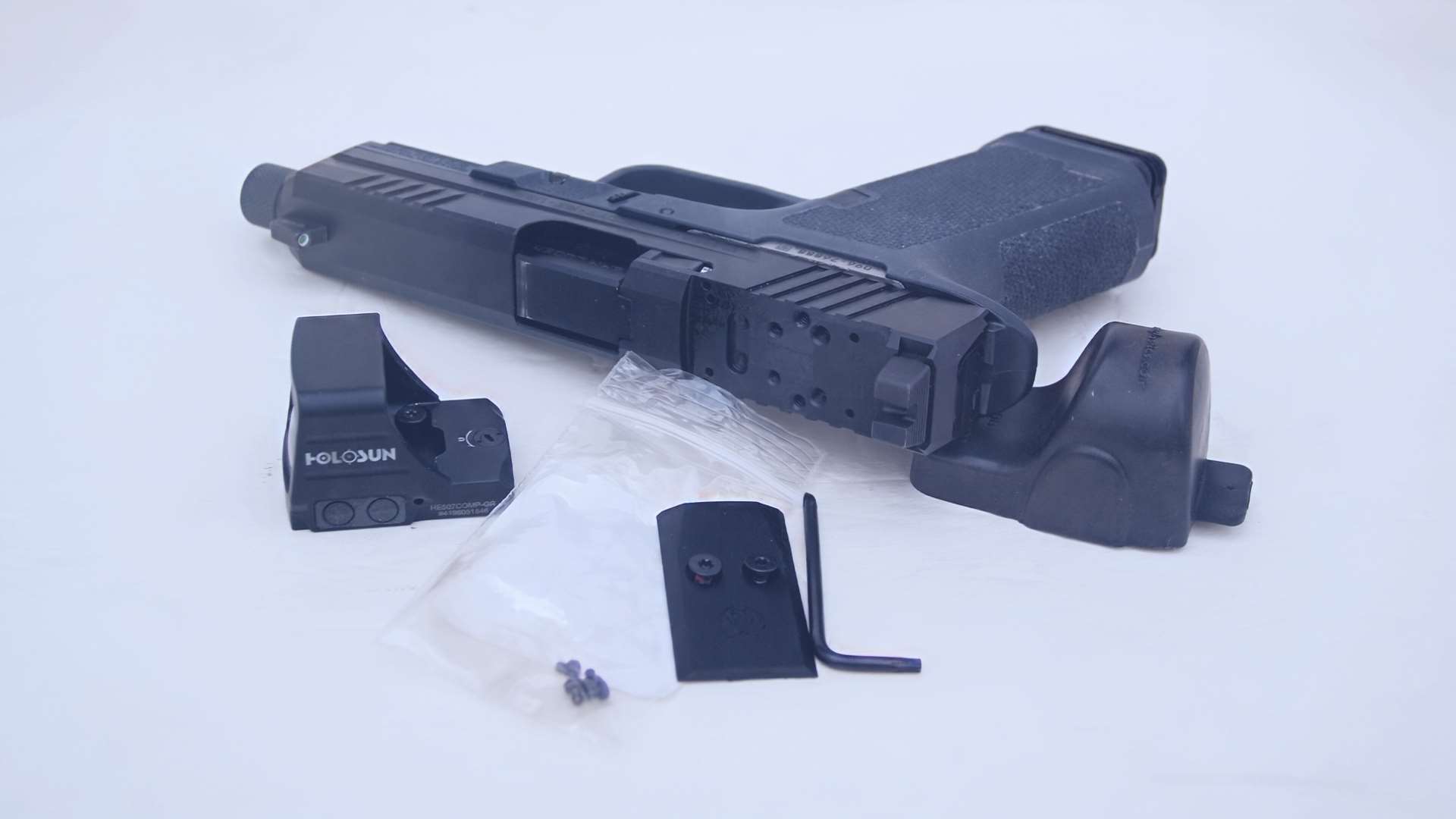
My next step was to install a Holosun 507C for the accuracy tests. It was quick and easy. Using the supplied wrench, you remove the cover plate located forward of the rear sight. This reveals the mounting holes and four holes for the included dowels that mate with the underside holes on the reflex sights. DeltaPoint Pro and RMSc sights require four dowels and the RMR used by the Holosun take just two. The dowels were too small for my clumsy fingers to manipulate, but tweezers installed them easily.
Once installed the Holosun laid flat to the slide and the co-witness iron sights were clearly visible. This is a solid and well-designed mounting system.
Accuracy testing was done from my 25-yard bench with a sandbag rest. In addition to the five factory test loads, I included my 125-gr. 128 PF coated lead bullet load. The table below shows the accuracy of each.
Accuracy Table
Accuracy tests conducted outdoors from a 25-yard bench rest with a Holosun 507C reflex sight mounted. Temperature was 76°F with virtually no wind. Groups, reported in inches, are the average of two five-round groups measured center to center.
| Load | Avg. Group Size (inches) |
|---|---|
| Lapua 123-gr. copper jacket | 2.76 |
| Federal 130-gr. TSJ | 3.02 |
| Federal 150-gr. TSJ | 3.26 |
| Remington 147-gr. copper jacket subsonic | 3.72 |
| Remington 115-gr. UMC copper jacket | 3.97 |
| Handloaded 125-gr. coated lead 128 PF | 4.10 |
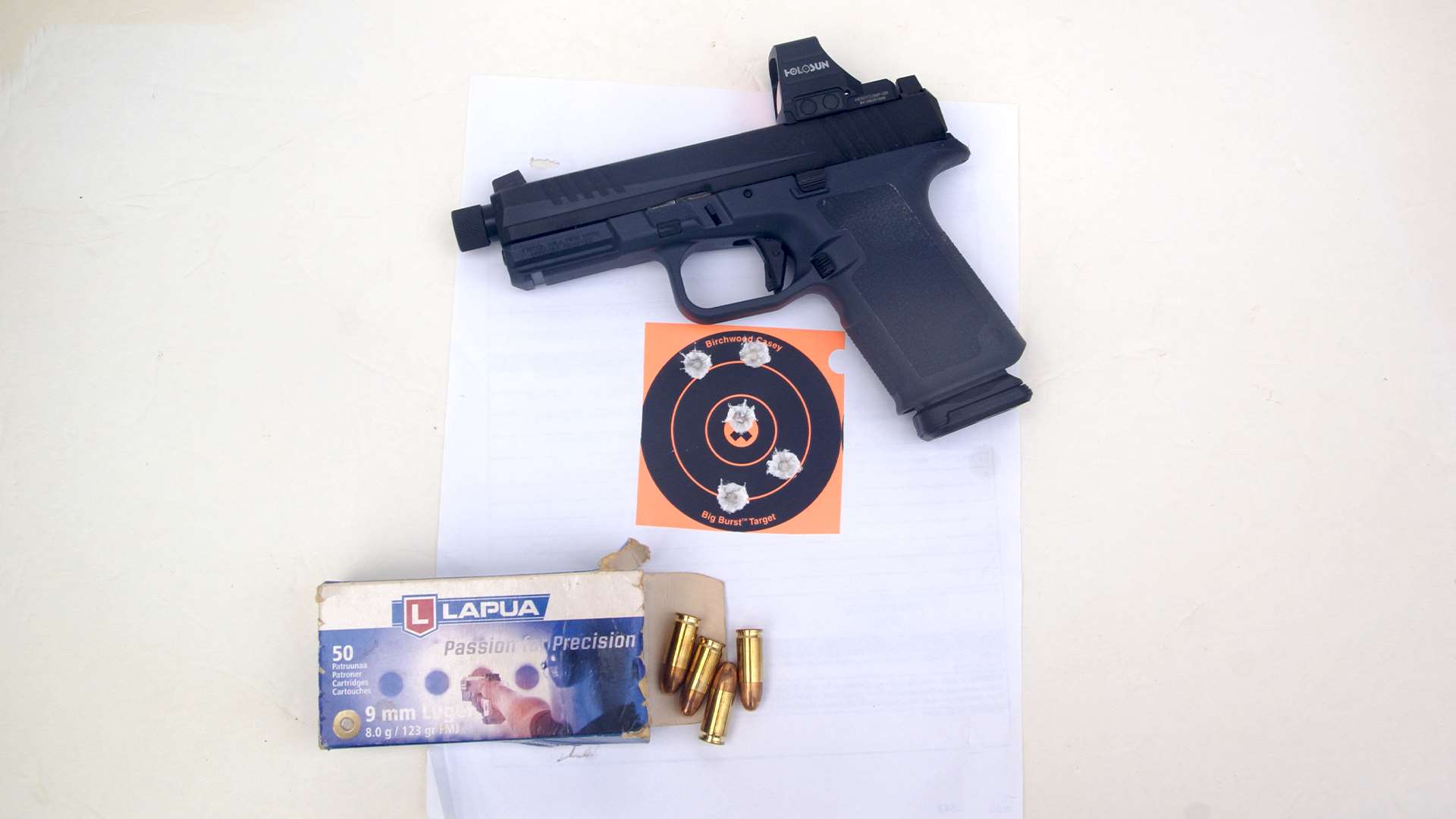
A Steel Challenge match was last and I shot it in Limited Optics. I cobbled together enough of the Lapua and Federal 130-gr. loads that had shown the best accuracy to get me through the 150-round match. The gun functioned perfectly without malfunction.
The modest price, along with its being a legal gun in IDPA Stock Service Pistol and Carry Optics (and Compact Carry Pistol with a different interchangeable frame) as well as Production, Limited Optics and Carry Optics in USPSA make the Ruger RXM worth a look. Go to ruger.com.
Specifications
- Model: Ruger RXM, No. 19446
- Caliber: 9 mm Luger
- Capacity: 15+1
- Grip frame: Stealth gray Magpul Enhanced handgun grip
- Front sight: Tritium co-witness height
- Rear sight: Steel, fixed drift adjustable
- Barrel length: 4½ inches, threaded 1/2-28
- Manual safety: No
- Magazines: PMAG 15 GLP, two included
- Optic ready: Yes
- Barrel: Alloy steel 1/10 RH twist, six-groove, black FNC Nitride
- Overall length: 7.65 inches
- Empty weight: 23.6 ounces
- Height: 5.31 inches
- Slide width: 1 inch
- Slide material: Through-ardened alloy steel, black FNC Nitride finish
- MSRP: $599 (Not available in Calif. and Mass.)