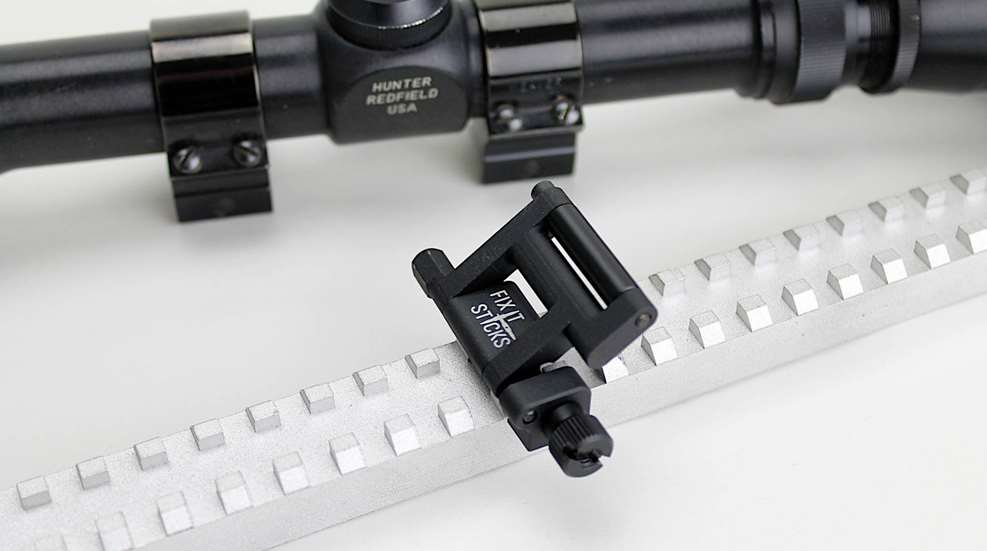
Leveling a scope when mounting to a firearm is an absolute must for precision shooters. Errors introduced by canting a rifle to an off-kilter scope increase with distance, and adjustments to elevation affect windage and vice-versa.
Those who rarely or only occasionally mount scopes are perhaps best served in taking their rigs to a gunsmith for proper mounting. For DIYers possessed of patience and attention to detail, levelling a scope can be accomplished with a set of gunsmith’s bubble levels made for the purpose. However, Fix-It-Sticks, the company that brought us those great torque limiters, has another option—the Scope Jack (MSRP: $44).
Simple, easy
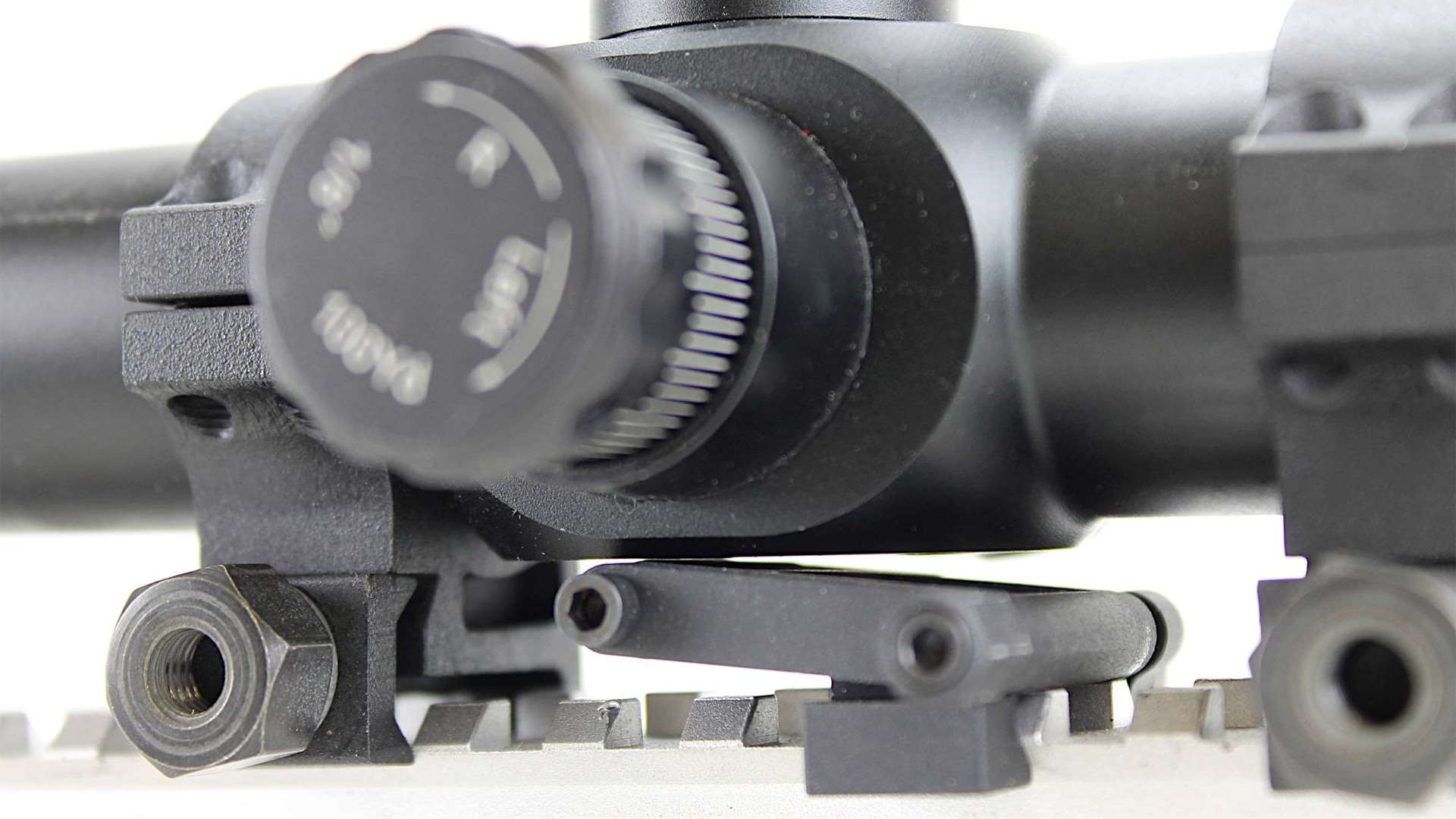
If you’ve ever used a floor jack to raise your vehicle, you’ve got the idea behind Scope Jack. But whereas the floor jack rolls slightly on its wheels as it raises or lowers your vehicle, Scope Jack attaches firmly to a Picatinny rail while a roller on top of the Scope Jack rolls against the flat on the scope bottom. That flat on the bottom of the scope adjustment turret housing—not found on all scopes—is a requirement for Scope Jack; it won’t work with a rounded surface or on the scope tube.
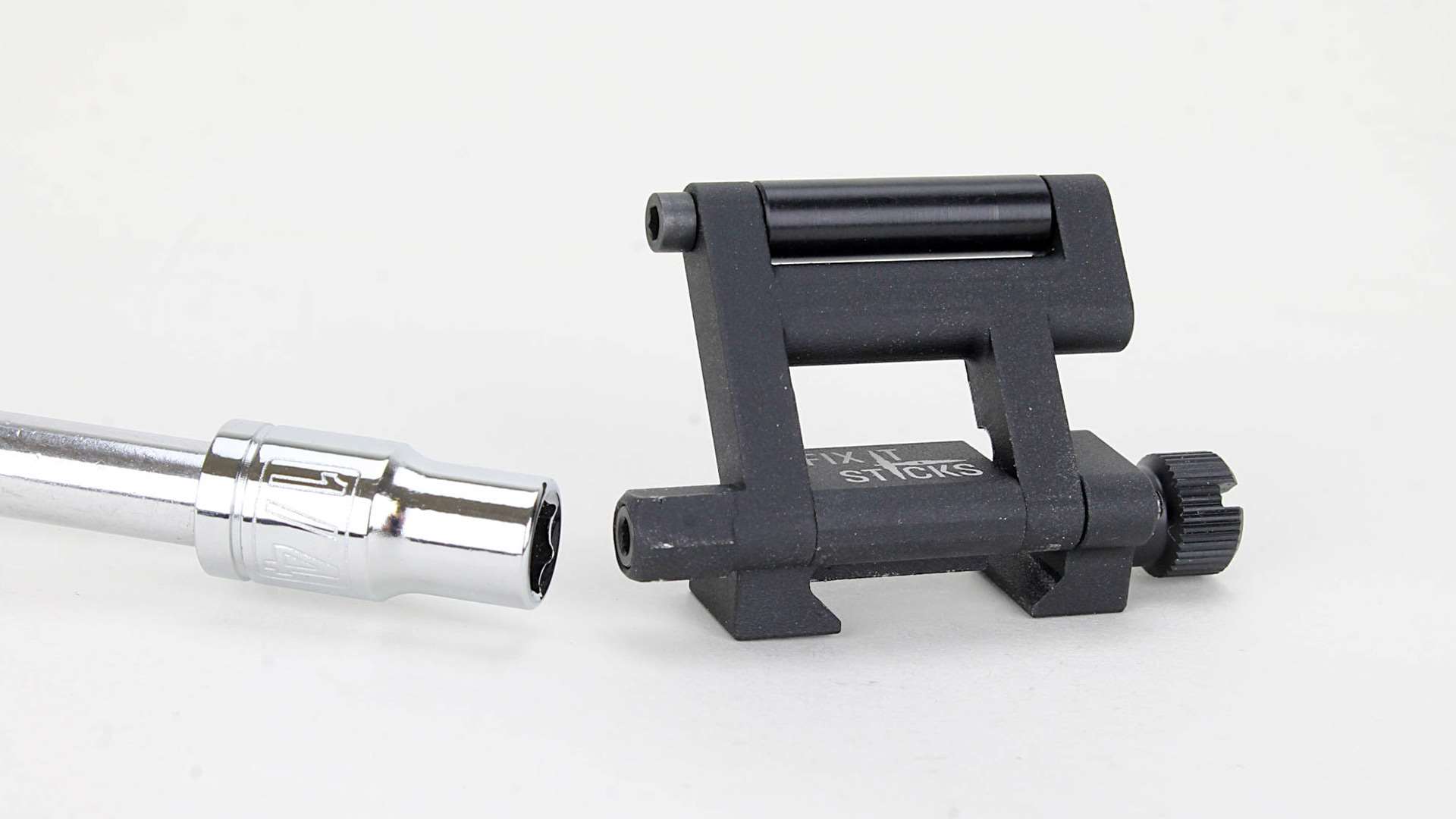
Using the Scope Jack is refreshingly simple. Once you’ve got your scope rings properly mounted to the Picatinny rail, install the scope and leave the scope ring screws loose while adjusting eye relief for placement of your cheek on the stock. When satisfied, install the Scope Jack on the Picatinny rail so that the lifting arm with roller is directly below the flat on the scope bottom, then tighten the thumb screw that clamps the Scope Jack to the Picatinny rail. With a ¼-inch nut driver, rotate the Scope Jack lifting arm so that the roller puts upward pressure against the scope bottom and settles the scope to a level position. Maintain light upward pressure on the lifting arm while tightening the scope ring screws.
Here are a couple lessons learned with the Scope Jack. First, tightening the clamp thumb screw also somewhat “tightens” the lifting arm, so to aid the lifting arm in maintaining upward pressure on the scope bottom, tighten the thumb screw. The thumb screw is slotted for a screwdriver, but hand-tight is tight enough and permits the lifting arm to move downward while still maintaining upward pressure when tightening the ring screws. For low-mounted scopes, it may be necessary to remove the thumb screw and clamp, then slide the Scope Jack into position before installing and tightening the clamp.
Works as intended
As with every tool or device, the Scope Jack works properly only within specific parameters. Again, the scope or optic must have a flat on the bottom of its adjustment turrets housing, and mounting must be to a Picatinny rail. There must be enough spacing between the scope rings to allow the Scope Jack to fit. Since the Scope Jack is only about 1¼ inches wide—the distance of four Picatinny rail slots—it will fit all but the narrowest of mountings. The Scope Jack takes up about ½-inch of vertical space, from the bottom of the clamp to the top of the roller, and scope rings must be high enough to allow the Scope Jack to do its thing. Though the maker says Scope Jack needs a ¼-inch gap to work, it really needs a smidgeon more, even if removing the clamp and sliding Scope Jack into place under a scope. Only my lowest scope mounting, low rings on a Hi-Lux XTC scope mounted to a High Power AR-15, failed to give the Scope Jack enough clearance to work.
Scope Jack is not a do-all replacement for the scope mounting tools we’ve been using for many years, but it’s a clever device that does work within its parameters, and its diminutive size means we can readily carry it to the range or field for unexpected immediate repairs. Retail price is in the $40–$45 range and is available from Creedmoor Sports, Brownells and Midway USA. Learn more at the Fix It Sticks website.
Read more: 5 Great New Competition Rifles And Accessories
Most Popular