** When you buy products through the links on our site, we may earn a commission that supports NRA's mission to protect, preserve and defend the Second Amendment. **
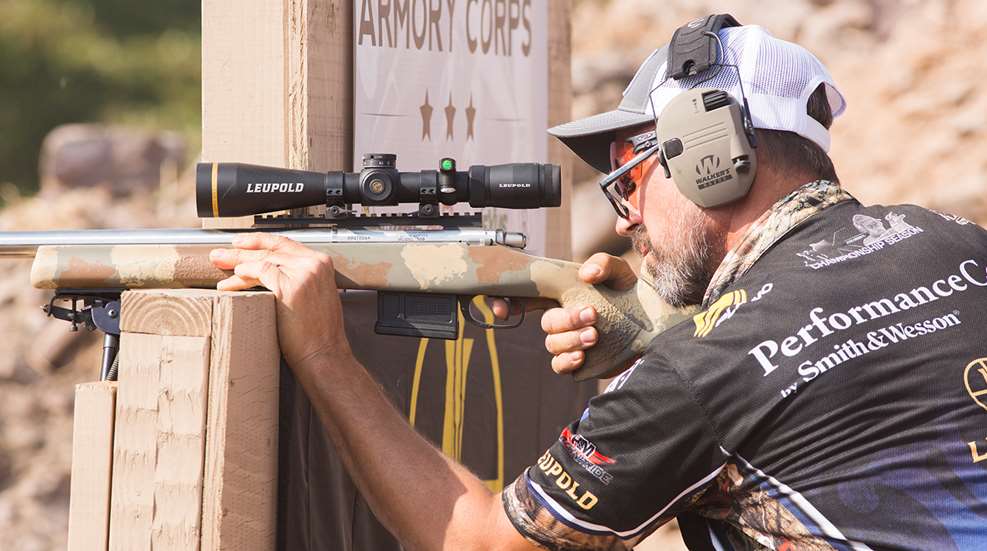
One day I was shooting groups under fairly bad conditions when suddenly a really terrific group began to come together. As I looked through the scope at the three shots through one hole, internal voices began to pester me: “Don’t blow it! You know it only takes one bad shot to ruin a great group like this.” Listening to these messages, my breathing became shallower and more rapid. My heart rate accelerated. I could feel myself “blowing up” inside. I knew this was not going to help me shoot more accurately.
I mentioned the experience to a friend, and he suggested I write an article on dealing with pressure while shooting. I approached a number of past and present champions with the following:
The focus of this article will be to find out how champion shooters in various NRA disciplines manage the pressure of competitive shooting. This could be the pressure of “Hey, I’m doing really great, I hope I don’t blow it,” or the pressure of, “I’m doing really badly, I need to fix it now,” or simply the pressure of, “This is the biggest, most important match of the year. I need to shoot my best.” What I want to know is how you, personally, deal with pressure in competition or how you prepare to minimize pressure when you are shooting competitively.
What follows is what those champions had to say about the fine art of not cracking under pressure.
Dr. Judy Tant, Precision Pistol
The fundamentals of handling match pressure are not very exotic. In fact they are mundane approaching boring, having to do with being well prepared for the match in terms of equipment, physical health and positive outlook. No apt phrase is going to help you with your fears of shooting badly if you haven’t cleaned your gun, checked your ammo, arrived at the match comfortably ahead of time and not started an argument with your spouse the night before! If you haven’t prepared, you deserve to be anxious, because it is in some sense a rational response.
The other basic that is mundane is that the more matches you shoot, the more desensitized you are likely to be to the pressures of competition. Again, this is not a glamorous solution, but the feelings of match pressure can recede as the process of competing becomes routine. Here are some things I do and don’t do.
I try to stay positive no matter what. I am aware that telling myself to NOT blow it, for instance, is the same as instructing myself to fall apart, because the brain deals with the assertion “blow up” and ignores the “not.” So if I catch myself in a negative, I reframe it to direct myself towards something I want to do. This usually has to do with focusing on the shot at hand, no matter how awful the shot or target before turned out. “One shot at a time” is a favorite of mine, or “Finish!” when I get close to the end of a competition.
Some shooters seem to have success when they get mad at themselves for failure and then pull up their socks, and I’ve used this occasionally, too. The problem with it is that you have to do badly before you do well when you take this approach, so I try to stay away from it. I figure that the shooters who use it could be a lot better if they shifted their approach to the positive. Likewise, some shooters (very few at the upper skill levels) try to intimidate others or get under their skin. That’s a waste of energy that could be directed at their own game, so I think they put themselves at a disadvantage when they do it.
Phil Hemphill, PPC, Precision Pistol
Pressure is something that we actually create ourselves—it’s that little anxious feeling: I don’t want to blow it; I might set a new national record. John Pride out in California does a lot of mental imaging. I thought he was off his rocker, but you can sit there in a quiet place and imagine shooting the match very well. If you sit there in your recliner or in your bed before you go to sleep, you can get as realistic as you want. Imagine the squeak of the targets when they turn, imagine drawing your pistol, aligning the sights, and so forth. The more that you do it, the more routine it becomes.
I’m one of two people who have shot a perfect score in Police Pistol Competition. There are five matches in a 1,500 course. I knew I wasn’t down any points at the end of match four. I just went back to my routine: Identify my target, go to the aiming point and shoot the shots. I try to put pressure on myself when I’m practicing, so I am accustomed to it in the actual match. Train as realistically as possible. That’s the good thing about training: If you make a mistake, you can go back and correct it. What separates the good shooters from the average shooters is that we have a set game plan, and we go back to our game plan/checklist, and that helps me to feel that I am back in control.
Also, you can have good fundamentals and poor execution, such as jumping on the trigger when we should be pressing the trigger. Lastly: Confidence in your equipment is key. Check everything. You want to know that everything is running at optimum level.
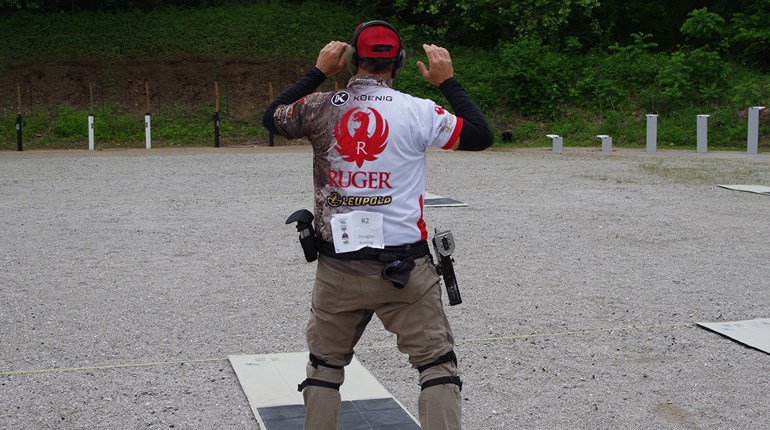
Doug Koenig, Action Pistol
Everybody suffers from pressure, but the more you are in a particular situation, the better the chance you have of dealing with it. Being in many high-level competitions helps reduce the amount of pressure you feel. If you want to go to a national level, you have to shoot a lot of lower level matches and get comfortable with being in competition. I’ve shot a lot of big matches, so I’d like to think I have them figured out a little bit. Preparation is the key to making sure I don’t crack under pressure. Making sure I am prepared, that is first and foremost, which includes making sure my equipment is ready, and that I have trained well.
I’ve been a full-time professional for over 20 years. I generally practice every other day, two to three times a week, depending upon what’s coming up. When it comes to my training, I don’t focus too much on the basic stuff anymore. I’ll pick one of the stages and fine tune on that. I absolutely try to duplicate competition conditions when I practice. I shoot on the exact same target, and so forth. I try to replicate things in the competitive environment as best I can, within reason.
When I am in competition, I try to focus on what I have trained to do—just pick one thing and focus on it. As an example, for the Bianchi competition, I try to focus on the middle of the target and put all my attention there. I try to maintain a laser focus on the exact center of the target. If I have a bad shot, I don’t pay attention to it, but learn from it so that I can make any necessary adjustments, and move forward. One year before shooting the mover at Bianchi, I spent several minutes just relaxing so that I could maintain that focus when I was shooting.
I mentioned the experience to a friend, and he suggested I write an article on dealing with pressure while shooting. I approached a number of past and present champions with the following:
The focus of this article will be to find out how champion shooters in various NRA disciplines manage the pressure of competitive shooting. This could be the pressure of “Hey, I’m doing really great, I hope I don’t blow it,” or the pressure of, “I’m doing really badly, I need to fix it now,” or simply the pressure of, “This is the biggest, most important match of the year. I need to shoot my best.” What I want to know is how you, personally, deal with pressure in competition or how you prepare to minimize pressure when you are shooting competitively.
What follows is what those champions had to say about the fine art of not cracking under pressure.
Dr. Judy Tant, Precision Pistol
The fundamentals of handling match pressure are not very exotic. In fact they are mundane approaching boring, having to do with being well prepared for the match in terms of equipment, physical health and positive outlook. No apt phrase is going to help you with your fears of shooting badly if you haven’t cleaned your gun, checked your ammo, arrived at the match comfortably ahead of time and not started an argument with your spouse the night before! If you haven’t prepared, you deserve to be anxious, because it is in some sense a rational response.
The other basic that is mundane is that the more matches you shoot, the more desensitized you are likely to be to the pressures of competition. Again, this is not a glamorous solution, but the feelings of match pressure can recede as the process of competing becomes routine. Here are some things I do and don’t do.
I try to stay positive no matter what. I am aware that telling myself to NOT blow it, for instance, is the same as instructing myself to fall apart, because the brain deals with the assertion “blow up” and ignores the “not.” So if I catch myself in a negative, I reframe it to direct myself towards something I want to do. This usually has to do with focusing on the shot at hand, no matter how awful the shot or target before turned out. “One shot at a time” is a favorite of mine, or “Finish!” when I get close to the end of a competition.
Some shooters seem to have success when they get mad at themselves for failure and then pull up their socks, and I’ve used this occasionally, too. The problem with it is that you have to do badly before you do well when you take this approach, so I try to stay away from it. I figure that the shooters who use it could be a lot better if they shifted their approach to the positive. Likewise, some shooters (very few at the upper skill levels) try to intimidate others or get under their skin. That’s a waste of energy that could be directed at their own game, so I think they put themselves at a disadvantage when they do it.
Phil Hemphill, PPC, Precision Pistol
Pressure is something that we actually create ourselves—it’s that little anxious feeling: I don’t want to blow it; I might set a new national record. John Pride out in California does a lot of mental imaging. I thought he was off his rocker, but you can sit there in a quiet place and imagine shooting the match very well. If you sit there in your recliner or in your bed before you go to sleep, you can get as realistic as you want. Imagine the squeak of the targets when they turn, imagine drawing your pistol, aligning the sights, and so forth. The more that you do it, the more routine it becomes.
I’m one of two people who have shot a perfect score in Police Pistol Competition. There are five matches in a 1,500 course. I knew I wasn’t down any points at the end of match four. I just went back to my routine: Identify my target, go to the aiming point and shoot the shots. I try to put pressure on myself when I’m practicing, so I am accustomed to it in the actual match. Train as realistically as possible. That’s the good thing about training: If you make a mistake, you can go back and correct it. What separates the good shooters from the average shooters is that we have a set game plan, and we go back to our game plan/checklist, and that helps me to feel that I am back in control.
Also, you can have good fundamentals and poor execution, such as jumping on the trigger when we should be pressing the trigger. Lastly: Confidence in your equipment is key. Check everything. You want to know that everything is running at optimum level.
Doug Koenig, Action Pistol
Everybody suffers from pressure, but the more you are in a particular situation, the better the chance you have of dealing with it. Being in many high-level competitions helps reduce the amount of pressure you feel. If you want to go to a national level, you have to shoot a lot of lower level matches and get comfortable with being in competition. I’ve shot a lot of big matches, so I’d like to think I have them figured out a little bit. Preparation is the key to making sure I don’t crack under pressure. Making sure I am prepared, that is first and foremost, which includes making sure my equipment is ready, and that I have trained well.
I’ve been a full-time professional for over 20 years. I generally practice every other day, two to three times a week, depending upon what’s coming up. When it comes to my training, I don’t focus too much on the basic stuff anymore. I’ll pick one of the stages and fine tune on that. I absolutely try to duplicate competition conditions when I practice. I shoot on the exact same target, and so forth. I try to replicate things in the competitive environment as best I can, within reason.
When I am in competition, I try to focus on what I have trained to do—just pick one thing and focus on it. As an example, for the Bianchi competition, I try to focus on the middle of the target and put all my attention there. I try to maintain a laser focus on the exact center of the target. If I have a bad shot, I don’t pay attention to it, but learn from it so that I can make any necessary adjustments, and move forward. One year before shooting the mover at Bianchi, I spent several minutes just relaxing so that I could maintain that focus when I was shooting.