WARNING: All technical data in this publication, especially for handloading, reflect the limited experience of individuals using specific tools, products, equipment and components under specific conditions and circumstances not necessarily reported in the article and over which the National Rifle Association (NRA) has no control. The data has not otherwise been tested or verified by the NRA. The NRA, its agents, officers and employees accept no responsibility for the results obtained by persons using such data and disclaim all liability for any consequential injuries or damages.
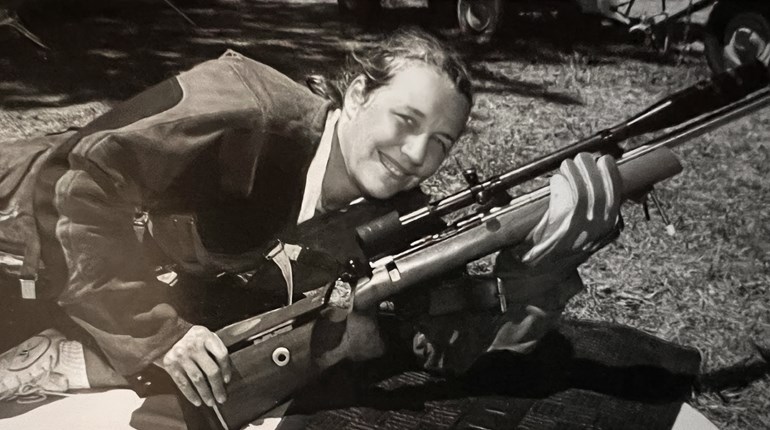
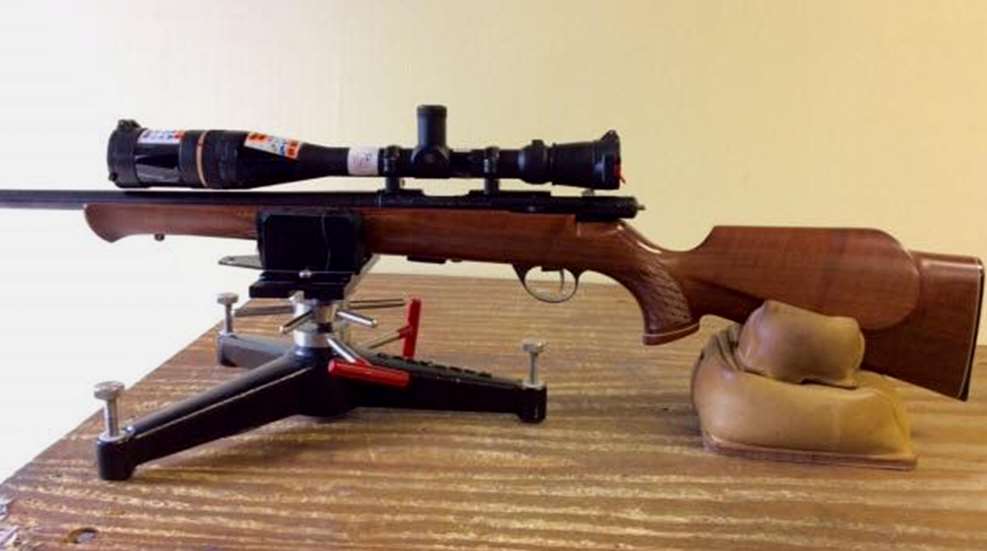
Above: This Silhouette rifle shows the complex interplay of stock angles that one may encounter when determining the best places to rest your rifle!
In this article, we will discuss ways to efficiently “tune out” vertical dispersion in our rifle/ammunition system, saving wasted time and component cost/barrel wear. Is your rifle giving vertical stringing during benchrest testing? If so, it *could* be your ammo, or it could be something else altogether.
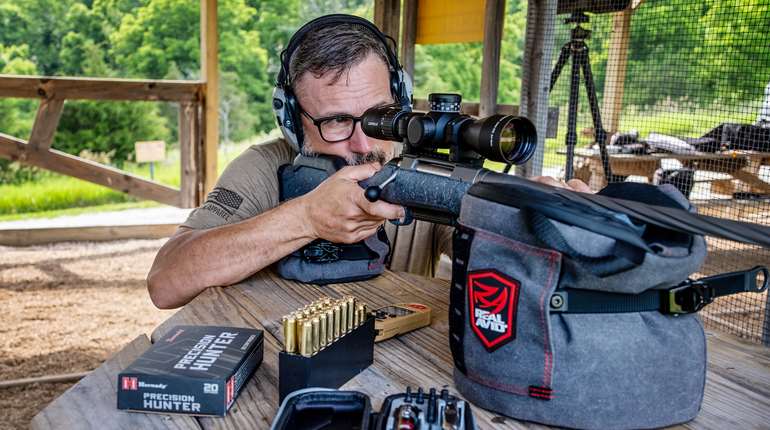
How your rifle sits on the benchrest pedestal/sandbags can definitely impact its’ grouping. Unfortunately, there is no “one-size-fits-all” formula for success, as rifle stocks vary greatly in configuration. Moreover, the total weight, weight distribution and balance of each rifle also affect results. Thus, when you find the optimum combination for testing, say, your AR15 NM Service Rifle, what you’ve learned may help streamline tuning your bolt action, but it’d be sheer luck if the identical prescription worked ideally for both.
Before you begin load development (or ASAP, if you’re already testing), evaluate the rifle you’re working with. Is it heavy, light, or in-between? How is it balanced? Is it very muzzle-heavy, with a long barrel, a light sporter, or something in-between? Is the stock very rigid vs. flexible, rounded vs. flat on the forend bottom, and what is the angle and contour of the stock toe behind the pistol grip? Each of these factors contributes to the rifle’s performance on the bench. By optimizing how you set up your rifle on the bags, you can make life much easier during load testing.
Earlier in this series, the author described the phenomenon of “Rifle Hop.” Briefly, this occurs when a rifle with significant recoil and a relatively light barrel is fired from a benchrest without any shooter contact with the forearm. The example given was an 8-lb. (complete) sporter with a featherweight barrel in 7x57. Although noted for mild recoil, the caliber produced enough energy that the forend would lift up off the sandbags a few inches during firing!
This spoiled otherwise-excellent groups with vertical fliers. They were eliminated when the author reached around the front rest and grasped the rifle’s forend for each shot. This was not an effort to hold the rifle rigidly down to the front rest, but merely to slow its’ movement enough to let the bullet make a clean getaway. This worked well, and the fliers disappeared immediately.
However, there are other methods to optimize each rifles’ position on the sandbags which can greatly improve its’ tracking straight to the rear during recoil. First, don’t be afraid to experiment with different forend positions on the front rest. With any given rifle, moving the forend fore and aft on the bags in, say, one- to two-inch increments can significantly improve its’ performance in testing. That is done in conjunction with experimenting with the height and placement of the rear bag.
Some rifles, such as F-Class, tactical or benchrest types, have a horizontal toe line built into their stocks. This helps them track smoothly and straight to the rear under recoil. Others, particularly sporters, will have the underside of the buttstock running at a downward angle to the buttplate, which complicates matters a bit. For quickly shooting from the bags, this feature allows leaving the rear bag in place. One rapidly adjusts elevation by moving the angled stock toe line fore and aft until the crosshairs are on target. Note, this simultaneously affects the forends’ placement on the bags. This technique can be useful for some hasty shooting, but isn’t the best method for pure accuracy work.
Not all rear bags are created equal, and nowhere is that more evident than in the height of the platform section that supports the “ears” the toe rides in. Rarely are they ideal for any given rifle, so adding vertical spacers under the rear bag can help you obtain an optimal height for your particular bench, rest and target setup. This facilitates leaving the rear bag in one place, shot after shot, and also allows doing the same with the rifle’s forend relative to the front rest. Consistency is a key to accuracy, and this is a good place to start.
After some experimentation, you will likely find a preferred position for your forend on the front rest. There may be a visible stock feature that serves as a reference point to return your forend consistently after every shot, or you may add a strip of masking tape for reference. The latter approach has the advantage of being a visible reminder to consciously return the rifle to the exact, correct position after each shot, until you’ve done it enough so that it becomes routine. The combination of forend and rear bag placement helps to balance the rifle on the rests, and can make fine shooting much easier.
Many competitive shooters keep a log book to record their sight data, conditions, scores, etc. as they attend matches. This is a good place to record the optimum locations for your forend and buttstock, plus spacer height for any given rifle. If you have several that you shoot regularly, or even semi-regularly, this can be help you start off at your best if a quick zero check or accuracy test session is in order.
In Part 2, we review mechanical issues and ignition irregularities.
Read the previous article in the AMU handloading series: "Handloading: Estimating Actual Cost per Round by Caliber"
SSUSA thanks the U.S. Army Marksmanship Unit for allowing the reprint of this article.
Most Popular