WARNING: All technical data in this publication, especially for handloading, reflect the limited experience of individuals using specific tools, products, equipment and components under specific conditions and circumstances not necessarily reported in the article and over which the National Rifle Association (NRA) has no control. The data has not otherwise been tested or verified by the NRA. The NRA, its agents, officers and employees accept no responsibility for the results obtained by persons using such data and disclaim all liability for any consequential injuries or damages.
Readers who are new here may wish to review the previous two columns in this series, which address basic handloading strategies for NRA High Power Service Rifle competition and International competition.
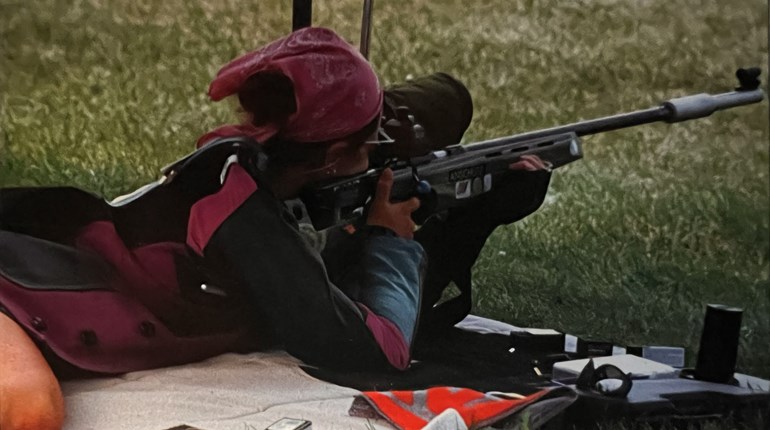
We now return to our Olympian with his optimized 7x57 at the 300m World Championships in Switzerland. The range featured elevated targets and elevated firing points … plus an overcast sky and 35 degree temperatures. The lack of wind indicators made “calling” the wind essentially impossible.
He was shooting next to a teammate of equal ability who fired his USAMU-issue .308. Winds were largely steady at 15-20 mph, but with sudden, sharp let-offs that couldn’t be predicted. He and his teammate had to shoot essentially “blind” to the wind.
They were shooting equally-accurate rifles at an identical cadence, firing literally within seconds of each other. Nice strings of “10’s” were interrupted periodically by random, wind-induced 9’s or worse. In the first 20 rounds, whenever the 7x57 target came up with a “line 10” at 4:00, his teammate’s target unfailingly showed a corresponding “9” at 4:00. The 7 mm’s “wide 9’s” signaled the .308’s “8’s.” It was exactly as his slide-rule had predicted! Every round fired with the 7 mm showed less wind effect than the .308.
Being nobody’s fool, his teammate took the virtually unheard-of step of retiring his .308 after 20 shots. Clearly, more firepower was called-for. He broke out his .30-06, but it still couldn’t match the 7x57.
We’ve brought you this account from long, long ago and far, far away to describe a real-world instance in which SIGNIFICANT ballistic superiority with fine accuracy was consequential. No questions arose from confounding variables such as shooter skill, sight changes, failed wind doping, etc. Thus, external ballistics helped.
Now, flash forward about 40 years. We currently enjoy a dizzying array of great new developments. Huge advances have been made in cartridge accuracy, bullet designs and B.C’s, powders, brass and other areas. An overwhelming parade of wonderful, new “wildcats” abound, each promising to be better than the last.
However, if considering a change, one must choose wisely, for in such pursuits may lie madness.
In shooting, as in most other areas, logistics matter. Given a very capable rifle—a known, Champion-level performer which one already owns and can feed, ponder carefully whether changing to the “latest-greatest X-caliber darling” is truly wise. If one may gain, say, a mere 0.6” per 10 mph full-value change at 300, (real-world numbers for two highly popular calibers), balance that carefully with ammo/component cost and availability, mechanical accuracy, recoil, barrel life, etc.
Will the desired magic really arrive on schedule as desired? Although one may be a very fine shooter indeed, there are several at every match. At the end of the day, one must still steer the rifle and read the wind.
The moral of the story is that when spending one’s hard-earned money and precious free time, it’s wise to very carefully consider the likely return on investment. Will one gain more points by spending all that time and energy training vs. enjoying setting up a cool, new cartridge? Cost/benefit analysis is important in the delicate interplay between target dimensions, rifle accuracy, external ballistics, recoil, barrel life and logistics, et. al.
Consider one’s skill level; is a SIGNIFICANT ballistic advantage with little/no accuracy loss in the offing? If not, one’s time might be better spent training and becoming (even more) outstanding with Old Faithful.
As a famous American cultural icon once [almost] said, “Now, I know what you’re thinkin’. Is that a 0.6 BC, or only 0.5? Well, to tell you the truth, in over-thinking all the possibilities, I kinda forgot, myself. You just gotta ask yourself one question … ‘Can I exploit the difference?’ Well, can ya?”
In closing, train hard, think hard, and hold hard. It’s the path to victory!
Thanks to the U.S. Army Marksmanship Unit for allowing the reprint of their handloading series.