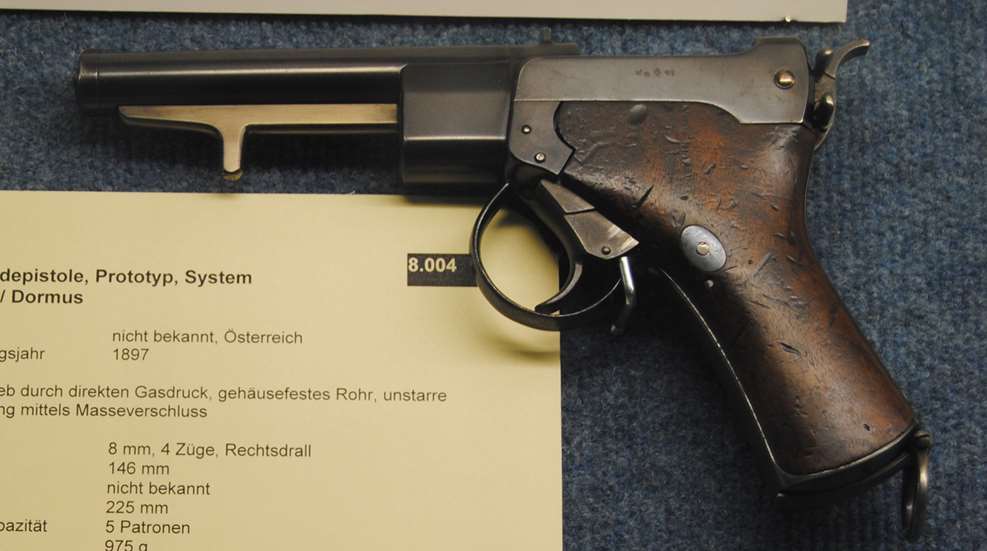
Following the unveiling of Hiram Maxim’s machine gun in 1883, the first semi-automatic pistols soon followed. In 1891, Austrian Archduke Karl Salvator and Count Georg Von Dormus patented the Salvator-Dormus pistol (photo above), of which few examples have survived. Next came the Schonberger-Laumann 1892, which was an upgrade of a previous design by Austrian designer Josef Laumann. With the financial aid of the Schonberger brothers, Laumann’s design was produced by Steyr in 1892.
The first semi-automatic pistol to gain commercial success was in 1894, when Hugo Borchardt produced his C-93 that resembled the human knee with a toggle-lock mechanism. Paul Mauser introduced his famous Mauser “Broomhandle” in 1896.
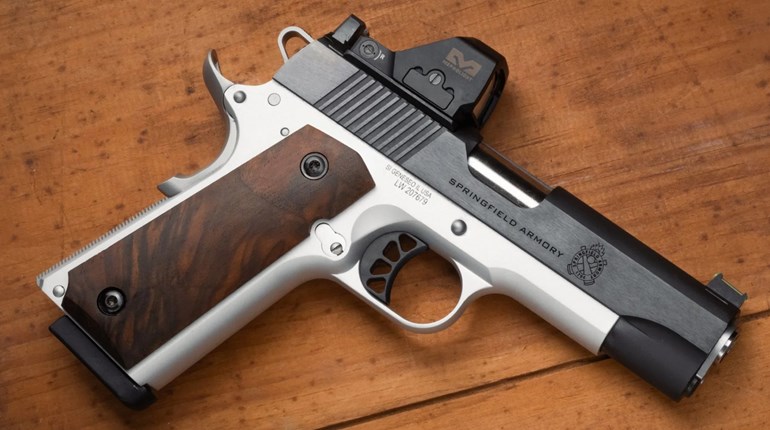
Any history of the semi-automatic pistol is incomplete without including the legendary American gun designer John Browning. His models were initially manufactured by Colt in the U.S. and by the Belgian firm of Fabrique Nationale (FN) in Europe. A testament to his skills is the fact that Browning’s locked-breech action is still used by many modern, large caliber semi-automatic pistols to this day. The Colt M1911 was the U.S. military’s service pistol until the 1980s, and modernized versions remain in use by some military units as their preferred sidearm. For four years prior to his untimely passing in 1926, Browning co-designed the Browning Hi-Power, a 9mm handgun with a 13+1 capacity.
By World War II, Germany had adopted the Walther P38 as its military sidearm. A locked-breech, 9mm double-action pistol, the P38 could be carried ready to fire with enhanced safety features, many of which are found in modern day pistols used today.
Source: Ian Hogg Pistols of the World and Wikipedia.
Lead photo: Salvator-Dormus self-loading pistol, prototype manufactured in 1897, at display at Wehrtechnische Studiensammlung Koblenz. Attribution: Torana/Wikicommons.
Read more history articles:
- Origin Story: The Word “Pistol”
- Golden Age, Part 1: National Smallbore Outdoor Rifle Championship History
- The Interesting History Of Vitarbo Custom Target Grips
- A Page From History: World’s First Recorded Pistol Match
- The 7.5 Swiss: A Reputation For Precision
- A Page From History: First Autoloading Sporter?
Most Popular