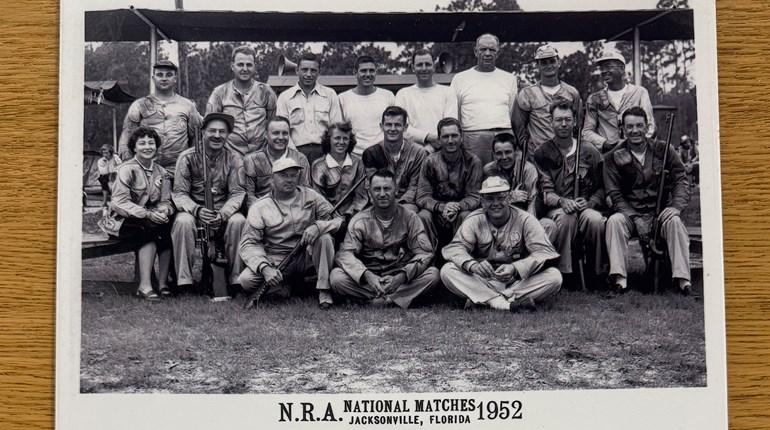
From the November 1955 issue of American Rifleman.
Question: I am confused by the term ‘wind bucking ability’ as well as by the practical effect of it. Possibly can you help me by advising whether there is any generally agreed acceptance of the terms ‘wind bucking’ and ‘wind drift.’ For example, in Gen. Hatcher’s interesting reply to Mr. Snap, on page 104 of the September Rifleman, he uses the term wind drift and states that the higher speed .22 has approximately 37 percent more wind drift than the slower bullet of the same shape and weight. Likewise, some of the more recent ads for bullets are stressing lower velocities for more accuracy. This of course ties in with Gen. Hatcher’s comments.
I can understand what is said about the difference in the delay in flight between the two bullets, but I cannot figure out why greater accuracy or shot uniformity should result. Assuming still air, would not the effect of increased air resistance be a constant and could it not be calibrated for in the sighting of the arm?―D.G.
Answer: I can sympathize with your feeling of confusion about the various terms used to describe the displacement of a bullet from its line of aim by a cross wind. I think the best term to use would be wind deflection and that the term drift should be used for the tendency of a bullet to deviate to the right for bullets having a right-hand spin, or to the left for bullets having a left-hand spin, without regard to any cross wind. However, wind drift implies the existence of wind so perhaps we can accept that term without too much strain. Of course, wind bucking indicates the ability of a bullet to withstand wind deflection or wind drift or whatever you want to call that effect.
Your question about the reason for the greater accuracy of certain lower velocity .22’s is a good one. This increase in accuracy does not come because the velocity is lower, but simply because the velocity is selected so as to take the bullet out of that range of velocity which coincides with the speed of sound in air.
When a bullet moves through the air it sets up shock waves due to the compression of the air by the moving bullet. These shock waves move at the speed of sound under the conditions of temperature, humidity, and density of the air. When the bullet has a speed lower than the velocity of sound, the shock waves move faster than the bullet does, and they move away from it without causing any disturbance in its flight. Again, when the bullet has a speed considerably above that of sound, the bullet runs away from the shock waves it generates. However, when the bullet has a speed just about equal to sound the shock waves ride right along with it for a time, and they exert a buffeting effect that can be disturbing to accuracy.
Another thing, when a bullet has a speed that is almost the same as that of sound, the unavoidable variations in velocity from one bullet to the next will cause some bullets to encounter this buffeting action and other bullets not to encounter it. That can again cause a considerable disturbance to accuracy. For ammunition of a rather uniform velocity, either above or below the critical velocity of sound, it is possible to calibrate for the effect in the sighting of the arm as you suggest, but at that critical velocity the effect is too variable to be taken care of satisfactorily in this way.―J.S.H.