** When you buy products through the links on our site, we may earn a commission that supports NRA's mission to protect, preserve and defend the Second Amendment. **
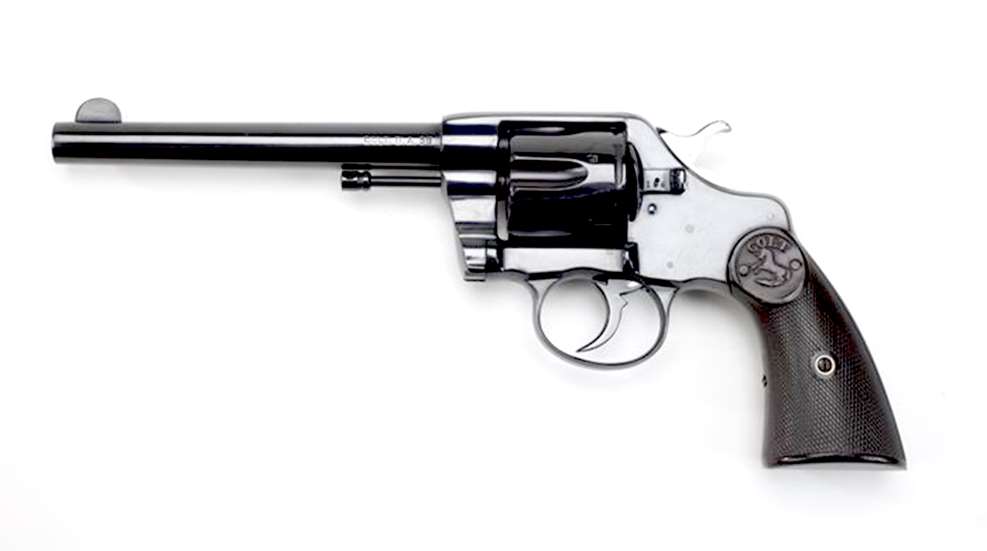
Above: Colt Model 1892 New Army Revolver. Photo by NRA Museums.
Pistols used in the National Matches started out in a pretty straightforward manner. Until 1911—actually until supplies of M1911 pistols became available—competitors in the National Individual Pistol Match used either of the two revolvers prescribed for U.S. Military service. Those were the several variations of Colt "New Army" and "New Navy" revolvers of 1892 (including the follow-on models of 1894, 1895, 1896, 1901, and 1903) and Smith & Wesson's .38 Hand Ejector, Model of 1899—known from the outset of production as the "Military & Police" (M&P).
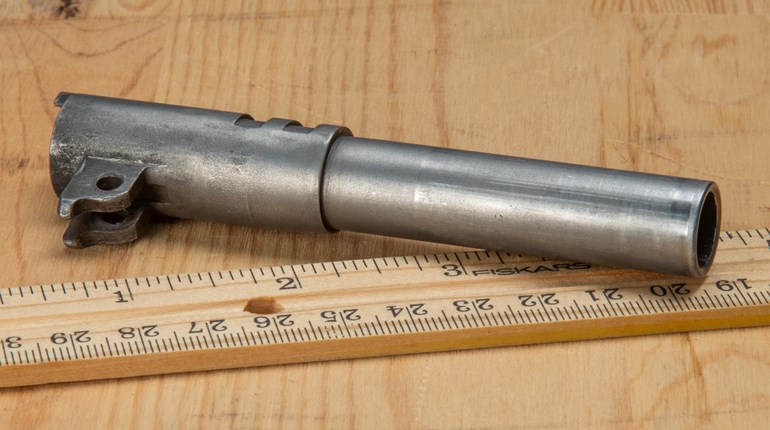
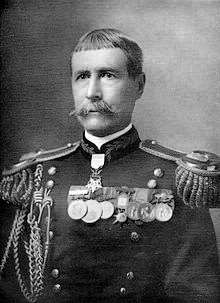 The only controversy came about in 1905, when Army Brig. Gen. William P. Hall declared that, "No Pistol with a barrel over six-inches in length will be allowed to used in the National Pistol Match ..." Hall was the Military Secretary of the United States Army and the officer detailed to take charge of the 1905 Matches. The decision was his to make, and he made it in response to a request from a National Guard State Adjutant General concerning the eligibility of revolvers of military pattern that had barrels over six-inches long. The gun in question was the M&P (a variant known to collectors as the Second Model, First Change, made from 1903-06) that was offered in 4-, 5-, and 6 1/2-inch barrel lengths. Thus, states' National Guards that purchased service pattern revolvers from Smith & Wesson in those years bought revolvers with 6 1/2-inch barrels. So too did members of both the regular and militia establishments who purchased Smith & Wesson revolvers for personal use.
Hall's decision was reported in the appropriate journals—among them Shooting and Fishing magazine. Editor John Taylor Humphreys, who happened to have been the only civilian to compete in the 1904 National Pistol Match, pointed out that Gen. Halls decision did not take into account that 6 1/2-inch barrel revolvers had been permitted in 1904. But Humphreys noted that, "The ruling of General Hall is in accordance with Government regulations, and being promulgated at this early date [Shooting and Fishing for June 22, 1905], should prevent any misunderstanding at the time of this year's match."
The early promulgation of Gen. Hall's decision probably did not prevent misunderstanding, but it did not prevent the wails of potential competitors who wanted whatever advantage and extra one-half inch of barrel offered (presumably the familiarity with a particular revolver). In the August 10 edition of Shooting and Fishing there appeared the text of three sets of correspondence—two between Gen. Hall and procurers of military equipment and a letter to Humphreys.
Brig. Gen. William Crozier, Army Chief of Ordnance, responded to Hall's query to the effect that barrels of revolvers issued to troops were of six-inch length. N.E. Mason of the Navy's Bureau of Ordnance informed Hall that the Navy had purchased S&W revolvers, then in storage at the New York Navy Yard, and that those revolvers had six-inch barrels. Finally, Hall responded to a letter from Humphreys dated July 26, 1905, citing correspondence with Crozier and Mason, and stating unequivocally that, "... only the model [revolver] as described in the Firing Regulations for Small Arms—1904, and issued to troops will be admissible." To make his point clear, Hall noted that the newly introduced Colt small-frame .38 caliber revolver (the Police Positive) would not e allowed and neither would S&W revolvers with 6 1/2-inch barrels. And that was that, except ...
Perhaps to pour oil on troubled waters, NRA Secretary Albert Jones ruled that in matches sponsored by the NRA and the New Jersey Rifle Association, revolvers with 6 1/2-inch barrels would be allowed. Smith & Wesson helped too, with a long run solution to the problem. The S&W Second Model, First Change became, in rather short order, the .38 Hand Ejector, Military & Police Model 1905, First Change, and the 6-inch barrel length was returned to the product line.
Pistols used in the National Matches started out in a pretty straightforward manner. Until 1911—actually until supplies of M1911 pistols became available—competitors in the National Individual Pistol Match used either of the two revolvers prescribed for U.S. Military service. Those were the several variations of Colt "New Army" and "New Navy" revolvers of 1892 (including the follow-on models of 1894, 1895, 1896, 1901, and 1903) and Smith & Wesson's .38 Hand Ejector, Model of 1899—known from the outset of production as the "Military & Police" (M&P).
Gen. William P. Hall.
Hall's decision was reported in the appropriate journals—among them Shooting and Fishing magazine. Editor John Taylor Humphreys, who happened to have been the only civilian to compete in the 1904 National Pistol Match, pointed out that Gen. Halls decision did not take into account that 6 1/2-inch barrel revolvers had been permitted in 1904. But Humphreys noted that, "The ruling of General Hall is in accordance with Government regulations, and being promulgated at this early date [Shooting and Fishing for June 22, 1905], should prevent any misunderstanding at the time of this year's match."
The early promulgation of Gen. Hall's decision probably did not prevent misunderstanding, but it did not prevent the wails of potential competitors who wanted whatever advantage and extra one-half inch of barrel offered (presumably the familiarity with a particular revolver). In the August 10 edition of Shooting and Fishing there appeared the text of three sets of correspondence—two between Gen. Hall and procurers of military equipment and a letter to Humphreys.
Brig. Gen. William Crozier, Army Chief of Ordnance, responded to Hall's query to the effect that barrels of revolvers issued to troops were of six-inch length. N.E. Mason of the Navy's Bureau of Ordnance informed Hall that the Navy had purchased S&W revolvers, then in storage at the New York Navy Yard, and that those revolvers had six-inch barrels. Finally, Hall responded to a letter from Humphreys dated July 26, 1905, citing correspondence with Crozier and Mason, and stating unequivocally that, "... only the model [revolver] as described in the Firing Regulations for Small Arms—1904, and issued to troops will be admissible." To make his point clear, Hall noted that the newly introduced Colt small-frame .38 caliber revolver (the Police Positive) would not e allowed and neither would S&W revolvers with 6 1/2-inch barrels. And that was that, except ...
Perhaps to pour oil on troubled waters, NRA Secretary Albert Jones ruled that in matches sponsored by the NRA and the New Jersey Rifle Association, revolvers with 6 1/2-inch barrels would be allowed. Smith & Wesson helped too, with a long run solution to the problem. The S&W Second Model, First Change became, in rather short order, the .38 Hand Ejector, Military & Police Model 1905, First Change, and the 6-inch barrel length was returned to the product line.