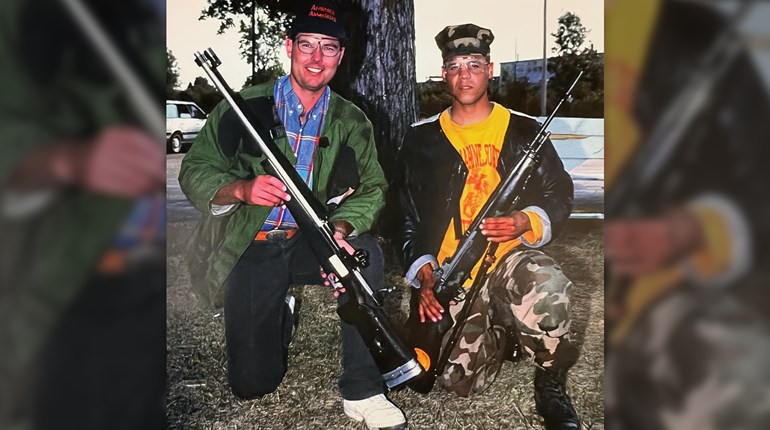

From the Shooting Sports USA archives: Former Managing Editor Chip Lohman’s interview with cowboy mounted shooting champion and multi-year Bianchi Cup celebrity competitor Kenda Lenseigne. As published in the July 2011 issue.
Kenda Lenseigne World Champion
By Chip Lohman
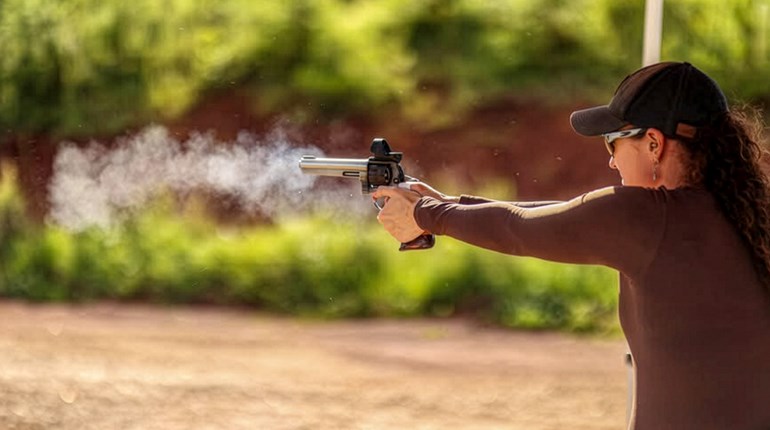
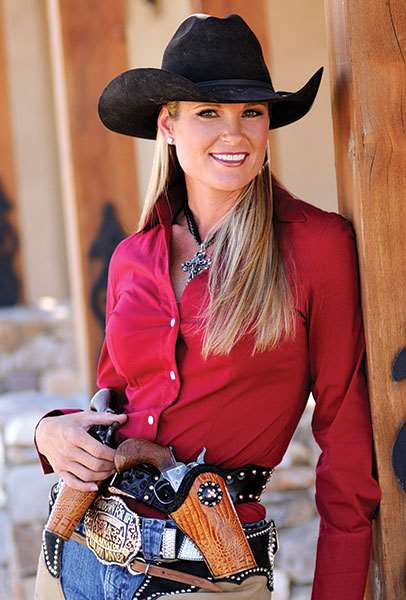
As you scan the tournament guide, you read that you’ll be firing a single-action revolver, requiring that you re-cock the gun after each timed shot. You’ll be required to change guns—from a holster, using only one hand. As you raise your eyebrows, you learn that you’ll also be firing at moving targets. And as laughter turns to tears, the instructions specify: “... all from horseback at 35 mph.” This is what Kenda Lenseigne does for a living, and she’s the best in the world.
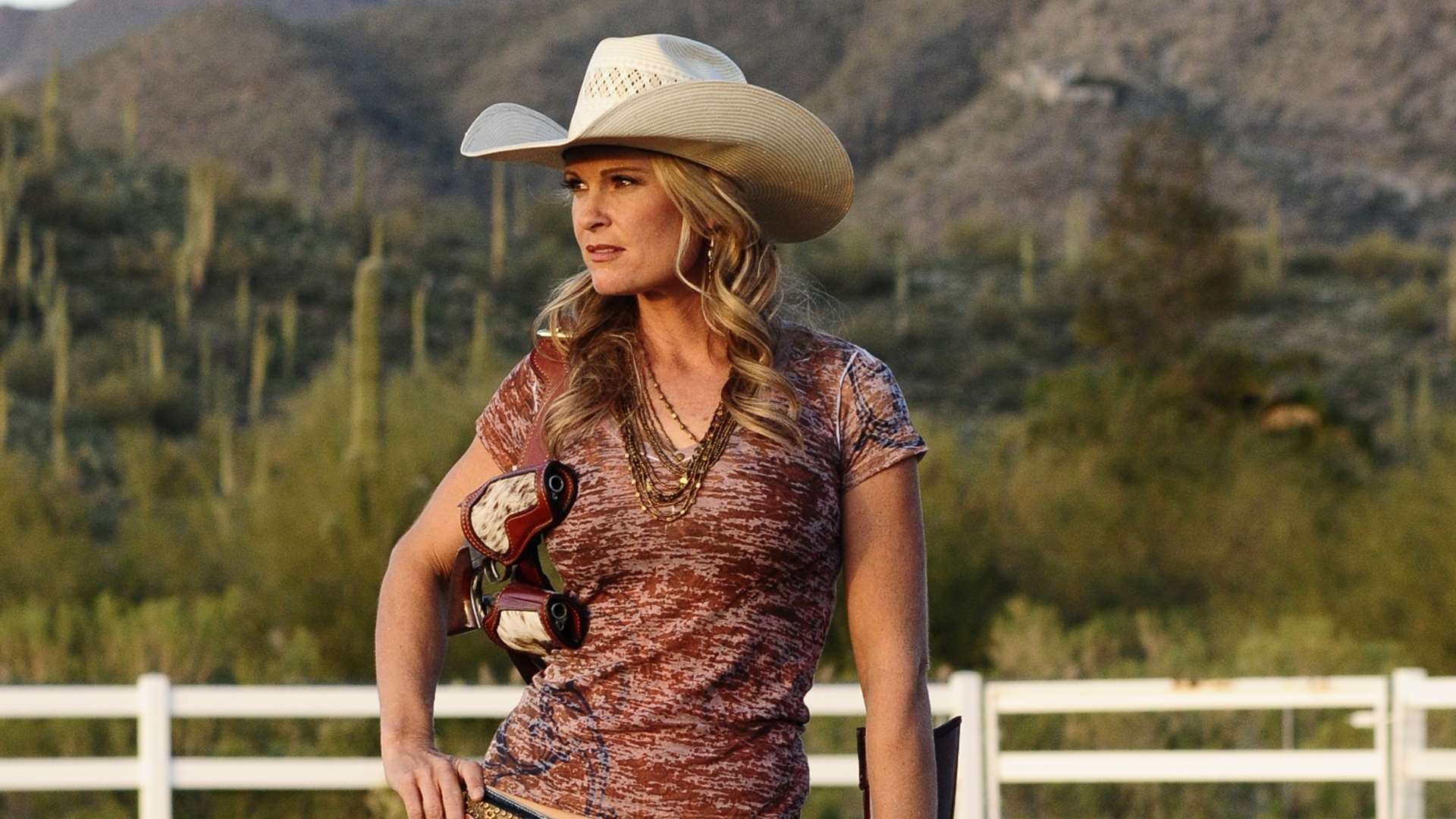
Two weeks prior to the 2011 Bianchi Cup Action Pistol Championship, Kenda Lenseigne granted Shooting Sports USA an interview from her ranch in Arizona. Her enthusiasm for her sport came through the phone as she explained the rules of Cowboy Mounted Shooting, her training and learning a new gun for the Bianchi Cup as a celebrity guest.
SSUSA: We adjusted the schedule for your flight this evening. Are you off to another shoot?
KL: I’m headed to Oregon for the Cabela’s grand opening in Springfield. I will be there representing one of my sponsors, Cimarron Firearms, promoting the new line of my signature mounted shooting guns. Cabela’s picked up the line to carry in their stores so this is a great way to help kick-off the partnership.
SSUSA: Your schedule is pretty full with daily training, national clinics and 30 competitions a year.
KL: I devote a lot of time coaching people for the sport, with private instruction and mounted shooting clinics all over the U.S. I also take in clients’ horses for training, plus I have four shooting horses of my own—my best horse Justin and three up-and-comers that hopefully will become a good back-up for Justin. All require a strict program that includes pattern work and acclimation to gunfire noise.
SSUSA: How did you begin your equestrian career?
KL: I started riding on my own when I was two years old in Washington. I credit my career path to my mom who rode horses while she was pregnant with me and tells me as soon as I could hold my own head up, I’d ride in the saddle with her. I had my first pony at age two and I began competing in junior rodeo at age four. After high school I moved to Texas and worked on a cutting horse ranch as an apprentice with some of the best trainers in the industry.
SSUSA: Is there a lot of similarity with that early work and what you do now in cowboy mounted shooting?
KL: Some. The timed aspect of rodeo events are similar, with pattern work against the clock, and the finesse of working cow horses is similar in the way a horse needs to be balanced and athletic. I am fortunate to have experience in both worlds to use that knowledge now in my training program.
SSUSA: Is the gunfire noise a wall that some horses just can’t get past?
KL: Sometimes. In my 13 years, I’ve had only a few horses that have had a hard time accepting the noise, at least to match the skill level of the rider. It’s one thing to let the horse run as fast as it wants because they are running scared, which usually means poor pattern performance as the horse is more than likely out of control. Some horses accept gunfire right away, while others take a little longer.
SSUSA: What are the events in your sport?
KL: The main event is a six-stage match with an accumulated time score over the six runs. The pattern changes for each run. There’s also a rifle competition, where the competitor will shoot the first five targets with their revolver and then pull a rifle for the second five.
SSUSA: Are you holding onto anything other than the reins while you’re shooting the rifle?
KL: No (laughs). After turning a barrel, we drop the reins and race toward the finish line while shooting our targets. Most horses that are rifle trained will run a straight line.
SSUSA: How fast are your patterns?
They vary with each set pattern, some are more technical or long and some are just fast. The “fast” patterns can be run in the 10-second range. To put it into perspective, a full size rodeo arena is usually about 200 x 300 feet, with 10 targets involving one or more turns and a gun change.
SSUSA: While cocking a single-action revolver! You’re shooting at balloons, but without a projectile, correct?
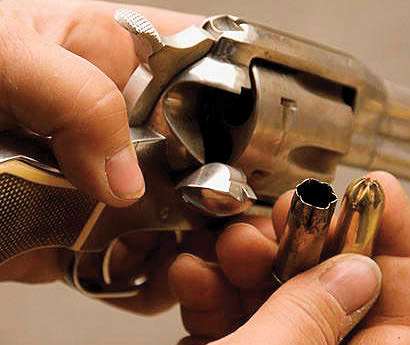
KL: That’s right. We shoot match-provided .45-caliber blanks filled with black powder. It’s the burning powder that breaks the balloon. The standardization of the blanks is good from a competitor standpoint because it levels the playing field across the country, so if I shoot in Washington or Florida, the ammo is the same. Our blanks are certified to travel no more than 20 feet, making it a safe spectator event in an arena setting. The optimum range for accuracy is to engage the targets from 6 to 10 feet.
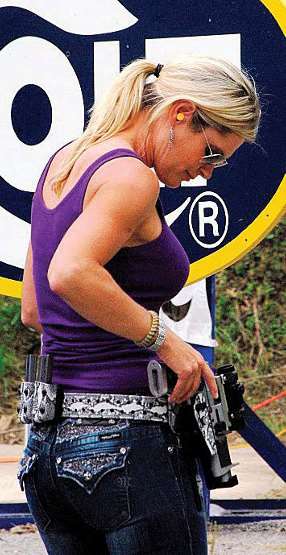
SSUSA: Similar to traditional shooting sports, you have studied Lanny Bassham’s book “With Winning in Mind” as part of your training to become a world champion. With all that is going on in your sport, you must have looked at Bianchi and thought: “Is that all there is? You just stand here and shoot?”
KL: No! (laughing) I wish it were that easy. I’ll admit I was a little intimidated because I had never shot that type of gun before, firing at a tiny little target. It’s completely different than what I am used to. On the day I arrived, I received a crash course from Don Golembieski, a High Master competing at the Bianchi Cup. From there it was time to compete. I felt the pressure of expectation as a world champion shooter, even though it was a completely different style of shooting, which is where Lanny Bassham’s mental management program came in handy. Just remembering the sequence of how to load a semi-automatic, take the safety off and shoot with a scope was challenging.
SSUSA: Have you done much live shooting since then?
KL: I haven’t picked up a live gun since then! I told Scott Carnahan of Safariland, one of my new sponsors and partner for a new mounted shooting line of equipment, that I only have a few good shots in me so I might as well not waste them on practice (laughs).
SSUSA: Well, I saw you shoot and you did very well. That’s a testament to your status as a world-class athlete with essentially one afternoon of training.
KL: Well, thank you. I credit most of that to the good coaching I received from Don. But Bianchi was a great experience and I’m really excited to be a part of it again.
SSUSA: Thank you very much for sharing your perspective on what may become a new sport for some of our readers.
Watch this June 2011 YouTube video where, after this interview, she set a new world record in Guthrie, Oklahoma.
For more information about Kenda’s many awards, national clinics and competition schedule, see kendalenseigne.com
Most Popular