
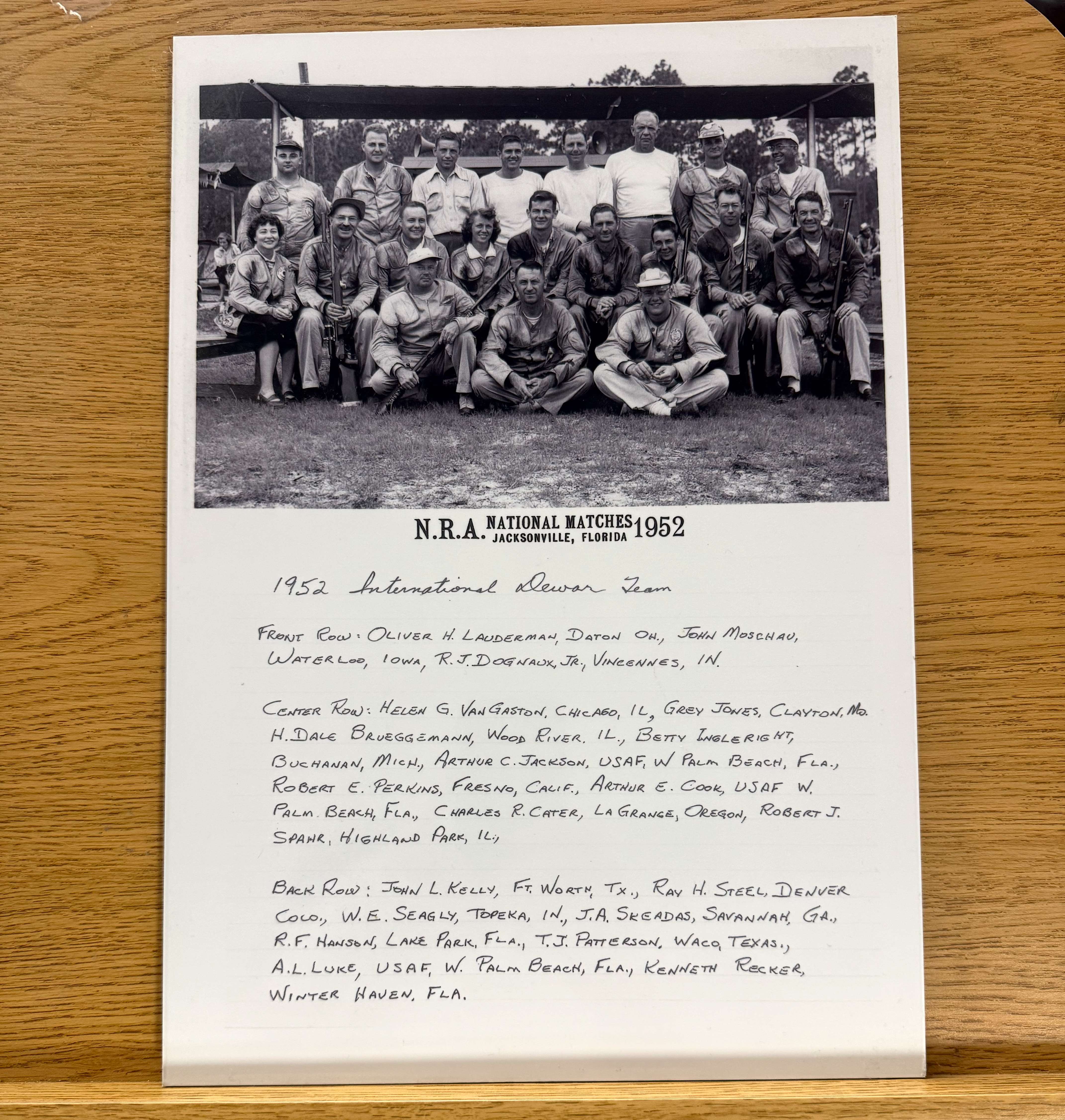
Study the faces for a moment. Twenty-odd competitors stand lined up on a scrap of Jacksonville, Florida, grass, squinting into the August glare of the 1952 National Matches, rifles slung or grounded at their feet. Someone has captioned the print, in a careful hand, “1952 International Dewar Team.” The image freezes them in place. What it cannot show is that the tradition they belonged to was already 43 years old when the shutter fell—and that, improbably, it’s still alive today.
To understand the photograph, you have to travel back to 1909, and to a Scotsman with a gift for whisky and self-promotion. Sir Thomas Dewar—of the distilling family, a Member of Parliament and later a baron—put up a towering silver loving cup for the Society of Miniature Rifle Clubs, the British body that would grow into today’s National Small-bore Rifle Association. The format attached to his gift was quietly radical. Rather than ship riflemen across the Atlantic at ruinous expense, each nation would shoot the same course on its own home range, then mail the scorecards to the host country to be tallied.
The invitation found a willing partner in America. When it reached the NRA, the association’s then-President Gen. James A. Drain accepted on the spot, haggling only over the particulars—trimming the course to 50 feet, a friendlier indoor distance stateside, and setting the first contest for the winter of 1909. Britain, the United States and Australia made up that inaugural field, the Australians drawn in because one of their riflemen, Arthur Hill, had been quietly running postal matches with an old English club. Each side fielded a small army. The original pitch had called for teams of 500, an impossibility nobody could stage, so the nations settled on 50 shooters apiece, 10 shots each. Britain won going away, 14,583 out of a possible 15,000. It would not be the last time the NRA’s marksmen chased a British number across the water.
It remains one of the odder propositions in all of competitive sport: a match in which you never once lay eyes on your opponent. For most of its life the Dewar has been a chiefly Anglo-American affair, two lines of prone shooters separated by an ocean, aiming at identical paper and learning who won only when the mail makes the return crossing.
The contest took its lasting shape after World War I. Beginning in 1919 it moved outdoors and slimmed down, each team now 20 strong, firing 20 shots at 50 yards and 20 more at 100—a sequence still known as the Dewar Course—with metallic sights, under British rules, on British targets. The first American squad of the modern match assembled during the inaugural NRA National Smallbore Championships at the Navy’s range in Caldwell, New Jersey, and one of its members made quiet history. Blanche Crossman, wife of match director Edward C. Crossman, became the first woman ever to shoot for a U.S. international team—a footnote in 1919, a landmark in hindsight. (Crossman was no slouch himself—the “Father of American Smallbore” was one of the most influential shooting sports writers of the early 20th century in the U.S.)
Which brings us back to the Florida grass. The 1952 team was no ordinary muster. Kneeling among them was Arthur Cook, who four years earlier in London had won Olympic gold in smallbore rifle prone. Robert Perkins of Fresno, California, had just taken the 1952 national smallbore title and Betty Ingleright of Buchanan, Michigan, had claimed the women’s crown while finishing inside the overall top 10. That same sweltering week, an Air Force shooter named Allan Luke, III—the roster’s “A.L. Luke”—collected the inaugural Vandenberg Trophy up on the high power line.
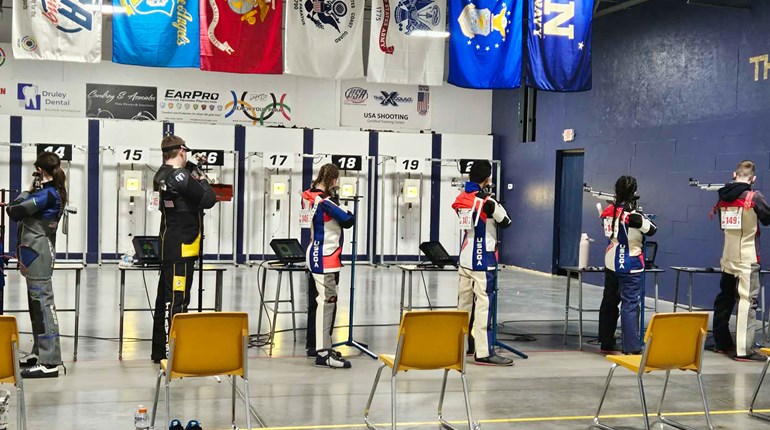
Look for the Dewar Team today and you will find it, essentially unchanged in spirit and very nearly so in its rules. The U.S. squad is still drawn from the top 22 shooters—20 firing members and two alternates—in the metallic-sight aggregate at the NRA National Smallbore Championships, now held at the Cardinal Shooting Center in Marengo, Ohio. Competitors still shoot 50 yards and 100 yards, on British targets, under British rules that reach right down to the gear: to make the team, an American must fire British-legal kit—a 40 mm sling and a magnifying lens allowed in the front or rear sight, but never both. Coaches still crouch at shooters’ shoulders, exactly as they did in 1919. And the top-scoring American each year still carries home a plaque named for Edward C. Crossman—the very match director whose wife had made history on that first 1919 team.
The rivalry has proved just as durable, and it’s still, overwhelmingly, the United States against Great Britain. So thoroughly did the NRA’s teams own the early decades that in 1931, flush with Dewar wins, the association challenged Britain to settle things face-to-face, put up a trophy donated by Gen. John J. Pershing—and promptly lost on British soil. The postal war carried on regardless. Australia broke through for a win in 1972 and South Africa in 1998, while Canada, New Zealand and others have taken their turns, but the plot rarely changes. In 2025, Great Britain took the cup once more, its 7836 to the United States with 7750—a decisive gap in a shooting discipline measured in fractions—while New Zealand, back in the Dewar for the first time since 1994, announced itself in third at 7671.
And the post office still plays its part, for richer and poorer. That same year, several British scorecards vanished or ran late in the mail—not in the Dewar, as it turned out, but in two of its sister postal matches—forcing the organizers to fall back on reserve scores by mutual agreement. It was a hazard Sir Thomas Dewar would have recognized in 1909, and proof that these contests can still turn on a postage stamp.
If the Dewar’s first century proves anything, it is that the tradition adapts rather than fades. The postal match rolls on—the 2026 U.S. team takes the line on Sunday, July 26—but more news waits at Bisley, where the NSRA is introducing its Dewar World Championship for the Bisley National Rifle Meeting this August: individual and club-team events built, in the association’s words, to celebrate the heritage of smallbore shooting while handing competitors a fresh challenge to chase. More than a century after a whisky baron mailed his idea across the Atlantic, the cup he gave is not just gathering dust in a glass case.
The rifle shooters in the 1952 NRA National Smallbore Championship photograph could not have known any of that, of course. They knew only the unforgiving Florida heat and the weight of the U.S. team’s history in their hands. They took their shots, signed their cards and sent them east—trusting, as Dewar shooters always have, that somewhere across the water, someone was doing precisely the same.
Most Popular