WARNING: All technical data in this publication, especially for handloading, reflect the limited experience of individuals using specific tools, products, equipment and components under specific conditions and circumstances not necessarily reported in the article and over which the National Rifle Association (NRA) has no control. The data has not otherwise been tested or verified by the NRA. The NRA, its agents, officers and employees accept no responsibility for the results obtained by persons using such data and disclaim all liability for any consequential injuries or damages.
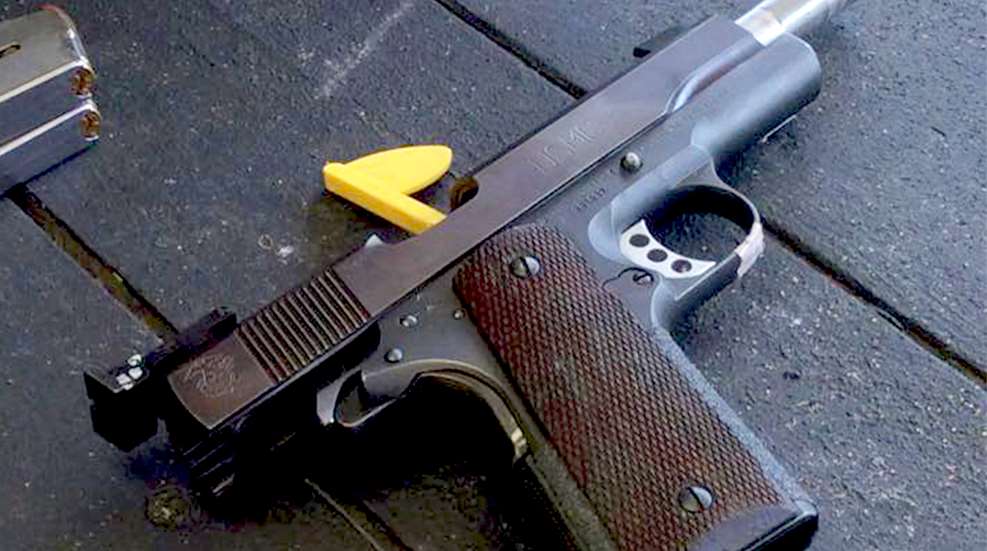
Pictured above: The venerable National Match 1911A1 still soldiers on.
One often-overlooked aspect of handloading highly-accurate pistol ammunition is the amount of crimp and its effect on accuracy. Please note this pertains to loading for semi-autos—revolver crimp techniques address some quite different issues.
Briefly, different amounts of taper crimp are used with various handloads to obtain best accuracy. The amount is based on bullet weight, powder burn rate and charge, plus other factors. It is not unusual for our Custom Firearms Shop to vary a load’s crimp in degrees of 0.001 inch and re-test for finest accuracy.
Brass is also important to pistol accuracy. While accurate ammunition can be loaded using brass of mixed parentage, that is not conducive to finest results, particularly at 50 yards. It is important for the serious handloader to use brass of the same headstamp, and ideally one lot number, to maximize uniformity.
Uniformity of the case overall length (OAL) as it comes from the factory is also important to achieving utmost accuracy. A uniform case length (best measured after sizing) will contribute to greater consistency of crimp, neck tension, ignition/burn of powder charge, etc. Cartridge case-length consistency varies from lot to lot, as well as by maker. Some manufacturers are more consistent in this dimension than others.
Given the volume of ammunition consumed by active pistol competitors, using inexpensive, mixed surplus brass for practice, particularly at the “short line” (25 yards), is understandable. However, for the “long line” (50 yards), purchasing and segregating a lot of high-quality brass to be used strictly for slow-fire is a wise idea. Similarly, pay attention to primer brands, powder types and charges, etc. Evaluating accuracy with a Ransom or other machine rest at 50 yards can quickly reveal the effect of changes made to handloading recipes.
Bullets are another vital issue. First, there is the question of FMJ vs. JHP. A friend of this writer spent decades making and accuracy-testing rifle and pistol bullets during quality control testing for a major bullet manufacturer. In his experience, making highly-accurate FMJ bullets is much more difficult than making highly-accurate JHP’s, in large part due to the way the jackets are formed. Small die changes could affect accuracy of FMJ lots dramatically.
The Civilian Marksmanship Program (CMP) now allows “safe, jacketed ammunition” in Excellence-in-Competition (EIC) Service Pistol matches, although wadcutter ammunition is prohibited. Thus, the option to use very accurate JHP designs simplifies the life of CMP SP shooters in pursuit of the prestigious Distinguished Pistol Shot badge.
During the days when FMJ bullets were required, accuracy-testing each lot and setting aside the best for 50-yard use was very important. This practice is still wise; however, finding very accurate lots of JHP’s should be much easier. Those who must use FMJ’s should buy the largest quantity bullets possible that are known to be accurate, to ensure adequate availability and quality.
Hopefully, these tips will be helpful to any pistol shooters interested in accurate handloads, not just precision shooters. Small tweaks to your normal routine can pay big dividends in improved accuracy and make practice and competition more rewarding. Stay safe, and good shooting!
Thanks to the U.S. Army Marksmanship Unit for allowing the reprint of their handloading series.