The below is an excerpt from the 1978 book, Olympic Shooting, written by Col. Jim Crossman and published by the NRA. Read Part 1.
1956—Melbourne: Caviar On Our Faces (Part 2)
By Colonel Jim Crossman
Pistol shooter John Beaumont had come over from Hawaii to shoot in the matches, and although with little international experience, he was a fine shot.
While nearly all outdoor smallbore rifle shooting in the United States at the time was in the prone position only, indoor shooting—especially collegiate—was in three or four positions. It was not surprising to find that the position shooters on the team had been hot shooters in school. Herb Voelcker had shot on a national champion team, had won All-American status and had won the National Individual Championship while in college. Jim Smith and Verle Wright also were experienced position shooters.
Surprising was the absence of Bill McMillan from the pistol team, especially as he had led in both preliminary stages. But he was eliminated by a gun malfunction in the last stage. The ground rules for selecting a team were later modified to permit a bit more flexibility in this matter, since the object of the exercise is to pick the best shot, not to pick the best-functioning gun.
Alternates were picked for each of the positions, in case one of the principals should drop out. Everyone practiced as best he could on his home range and sent scores in to the team officials. Some of the alternates turned in scores that were beating some of the principals, but despite this and the many midnight incantations by the alternates, hoping by black magic to give the principals some debilitating but not fatal disease, all the principals sailed and all the alternates stayed home.
The Australians constructed the ranges on their Army rifle range at Williamtown, seven miles from Melbourne and 15 miles from the Olympic village. For the 50-meter event, they fastened targets to existing target machines and built a firing line at 50 meters, with partitions every second firing point. Although the calendar said it was spring, the weather was not spring-like during practice. The temperature was about 50 degrees and a wind of 20 to 30 m.p.h. blew from the south. The ranges faced south, ideal for keeping the sun out of your eyes in that part of the world, but it meant the wind blew into the shooting stand from the front or right front. UIT officials finally decided that the shooters needed more protection, and erected a partition between adjacent firing points, closed in the back of each booth, and partially closed in the front with canvas. The partitions made things more pleasant and kept the shooters from being blown off the firing line.
But a break in the backstop let the wind through to swirl around the 50-meter booths on the right end of the firing line. Benner drew a booth on the right end in the 50-meter slow-fire event, and he stepped up there to meet a 35 m.p.h. wind. Although he spent an hour getting off his first 20 shots, he was not successful in getting away from the wind and he came in with a 537.
On the other end of the line things were a little better. Pinion, down on that end, let four shots get away from him for an 88 on the fourth string, with the rest of his scores 91 or better. This gave him a total of 551, next in line and five points behind Finland's Linnosvuo in first place and Soviet Oumaraov in second. Pinion's bronze medal was the sole burst of glory for the United States.
Part 3 of our look back at the Melbourne 1956 Olympics is coming soon. Be sure to subscribe to the free Insider newsletter for the latest updates.
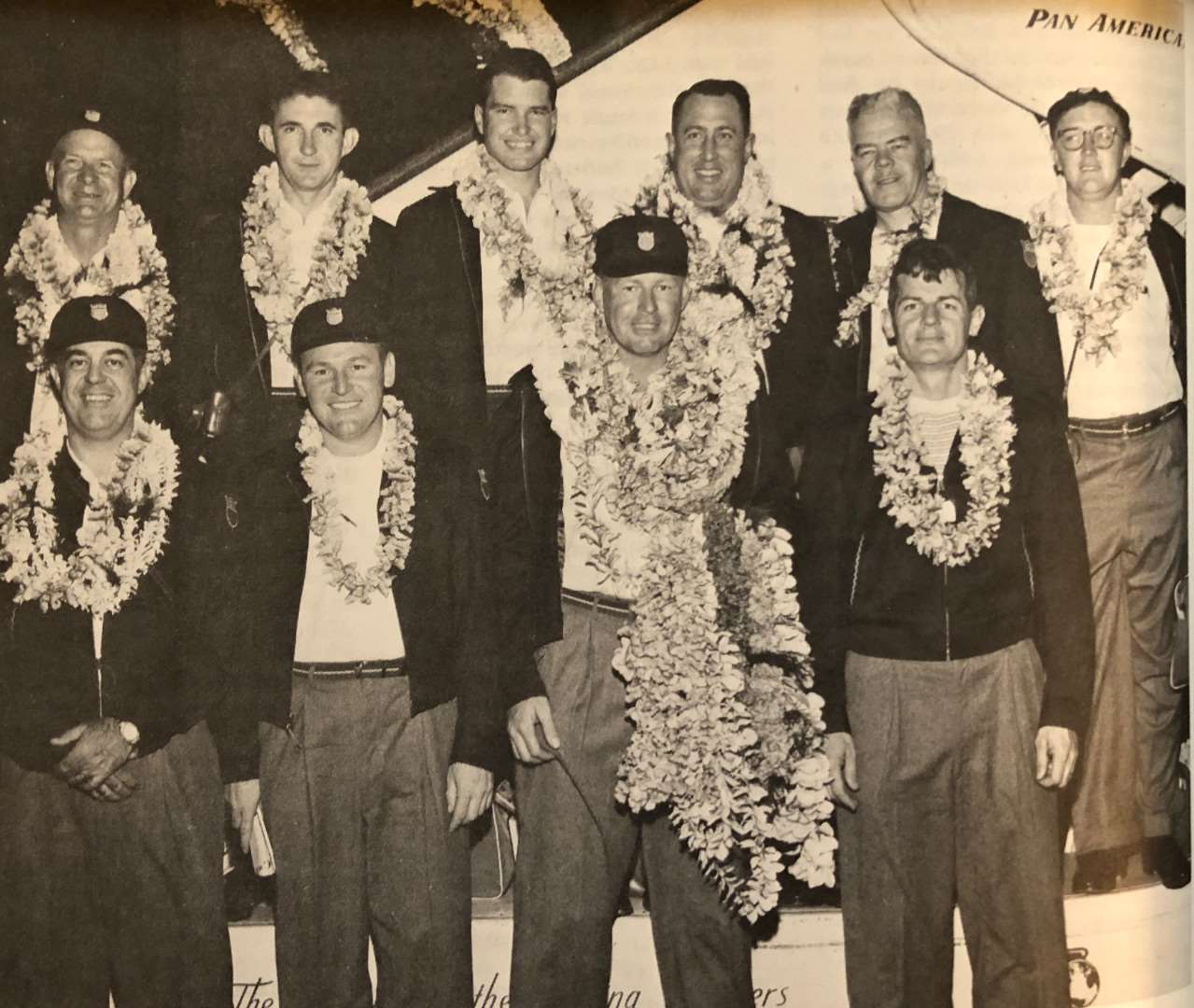
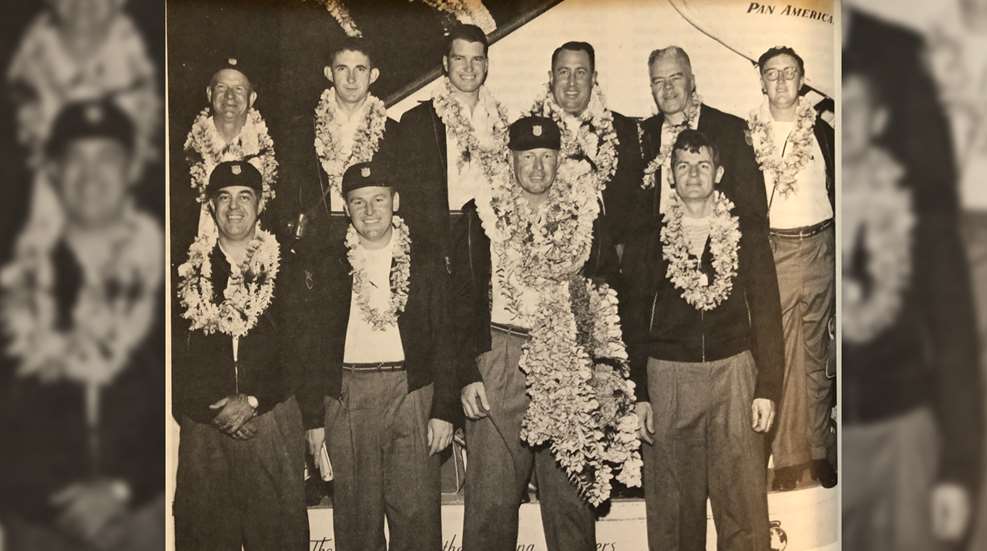
Photo: 1956 Olympic Shooting Team en route to Australia. From left to right: Pinion, Voelcker, Smith, Benner, Swanson, Wright, Lea, Forman, Beaumont and Jackson. Photo from NRA Archives.
Read more: Antwerp 1920 Olympics: Everything But The Kitchen Sink