
In biathlon, nothing happens slowly. Athletes arrive at the range with rifles in hand, lungs burning and heart rates climbing toward 180 beats per minute. Five targets. Fifty meters. Seconds that stretch impossibly long—especially for viewers learning just how quickly a race can pivot. At the Milan Cortina 2026 Winter Olympics, this is the environment in which Deedra Irwin will once again test the narrow line between control and chaos—and where the United States may finally find itself within a single shot of history.
Irwin enters her second Winter Olympic Games as the top-ranked American woman biathlete, currently placed 26th in the world. At the Beijing 2022 Winter Olympics, she delivered the best individual biathlon result ever for Team USA, finishing seventh in the women’s 15 km individual race. One missed shot separated her from the podium. In a sport governed by absolute penalties and unforgiving arithmetic, that margin still resonates.
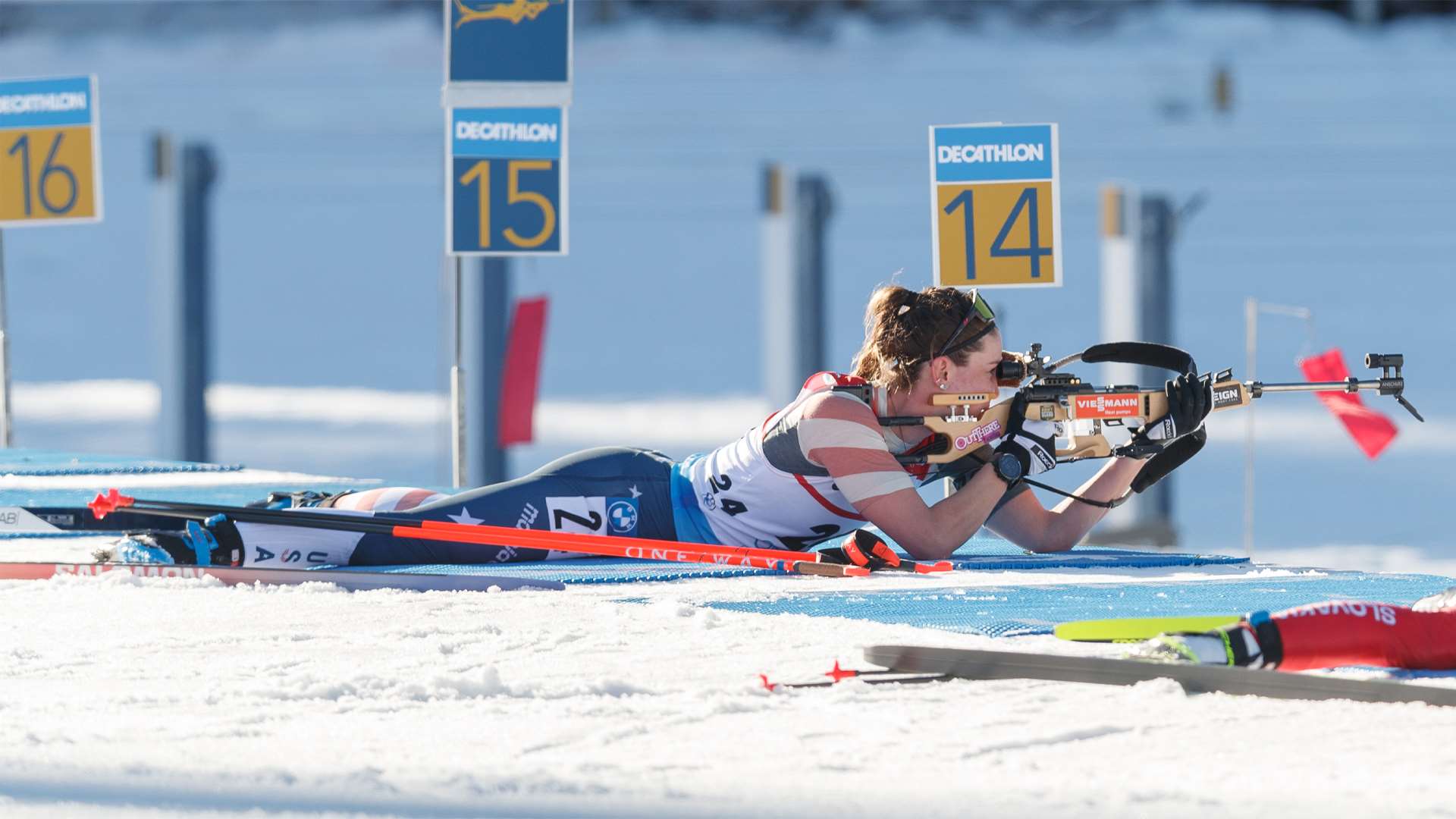
Biathlon has been in the Olympics since 1960, but the U.S. has never claimed a podium finish. The sport remains largely dominated by European nations—Norway, Germany, France—where biathlon is woven into sporting culture and national identity. Against that backdrop, Irwin’s ascent has been shaped by marksmanship and an unorthodox path that reflects the sport’s own contradictions.
Raised in Wisconsin and educated at Michigan Technological University, Irwin began her athletic career as a cross-country skier before discovering biathlon at a training camp in upstate New York. That introduction led not just to a new discipline, but to a new direction. Now 33, she lives in Vermont and serves as a staff sergeant in the Vermont Army National Guard. As a member of the Army World Class Athlete Program (WCAP), she balances military service with the demands of international competition.
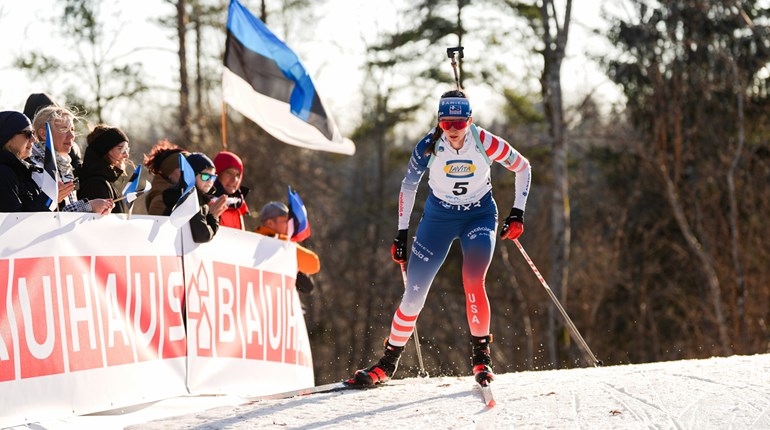
Modern Olympic biathlon is contested with .22 LR smallbore rifles at a fixed distance of 50 meters. Rifles must weigh no less than 3.5 kilograms (7.7 pounds). After each skiing lap, biathletes stop for shooting bouts consisting of five shots each in prone and standing positions. Targets are tiny: 45 mm in diameter for prone and 115 mm for standing. For every missed target, athletes either ski a 150-meter penalty loop or, in individual races, receive a one-minute time penalty. A single missed shot can erase minutes of skiing—and no lead is ever safe on the range.
Biathletes rely on highly specialized rifles, featuring straight-pull actions and folding stocks for rapid operation and efficient carry while skiing. Irwin shoots a modified Anschütz Fortner rifle—a gold standard in the sport—with an Anschütz barrel and a French-made Sanseigne stock.
Irwin’s shooting has increasingly become her signature. At the World Cup in Nove Mesto last month, she hit 19 of 20 targets in the women’s 12.5 km mass start, finishing 10th. It marked her second top-10 World Cup result of the season, earned under pressure and with penalty loops waiting for every mistake.
At Milan Cortina 2026, biathlon competition will take place in Anterselva/Antholz, one of the highest venues on the international circuit at more than 5,200 feet above sea level. Located roughly an hour north of Cortina d’Ampezzo, the range is carved into a landscape that rewards preparation and punishes impatience. To prepare, the U.S. Biathlon Team conducted elevation camps in northern Italy, layering altitude acclimation onto already demanding endurance and shooting training.
The Milan Cortina 2026 Winter Olympic program features 11 biathlon events:
- Mixed 4x6 km Relay
- Men’s 20 km Individual
- Women’s 15 km Individual
- Men’s 10 km Sprint
- Women’s 7.5 km Sprint
- Men’s 12.5 km Pursuit
- Women’s 10 km Pursuit
- Men’s 4x7.5 km Relay
- Women’s 4x6 km Relay
- Men’s 15 km Mass Start
- Women’s 12.5 km Mass Start
Each format favors different strengths, and knowing when athletes shoot, how penalties are applied and how starts are structured can change everything a viewer sees on the course.
Irwin is scheduled to open her Olympic campaign in the mixed 4x6 km relay, a format where shooting discipline carries the added weight of responsibility to teammates. Relays allow eight rounds for five targets, with the final three loaded one at a time. Miss after eight, and the penalty loop awaits—one lap for every target left standing. Here, under shared pressure and with limited ammunition, races are often won—or quietly lost.
Team USA arrives in Italy with growing momentum. Earlier this season, a mixed relay squad featuring Irwin, fellow Milan Cortina athletes Maxime Germain and Campbell Wright, and Chloe Levins finished sixth at the World Cup in Östersund—Team USA’s best result in the discipline since 2021. On the men’s side, Wright, just 23, has emerged as a breakout contender after winning silver medals in the sprint and pursuit at the 2025 World Championships.
Biathlon rewards neither bravado nor hesitation. It asks athletes to ski at full intensity, then execute with mechanical calm while millions watch targets flip—or refuse to. For a shooting audience, the appeal is unmistakable: this is marksmanship under the most hostile conditions imaginable, where breath control competes with oxygen debt and penalties are irreversible.
For Deedra Irwin, Milan Cortina 2026 offers another shot at the Olympic biathlon podium. In a sport measured in margins, she stands closer than any American ever has.
Watch Milan Cortina 2026 Winter Olympic biathlon events on NBC and Peacock.