** When you buy products through the links on our site, we may earn a commission that supports NRA's mission to protect, preserve and defend the Second Amendment. **
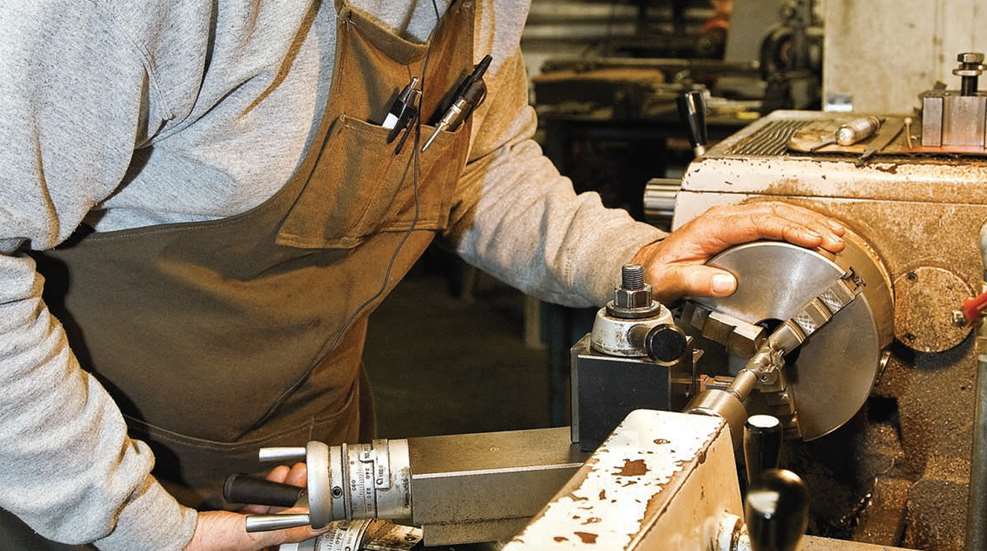
The popular subject of five- versus six-inch barrels for a competition semi-automatic pistol has been around for a long as I can remember. There are basically three viewpoints to investigate to determine the advantage of either setup:
Here’s a refresher on the cycling of a semi-automatic pistol.
Mechanical
The first aspect, mechanical performance, is fairly easy to evaluate. Using a five-inch barrel as a baseline, anytime more mass or weight is added (longer barrel) to the moving parts of a semi-auto pistol, it requires either increasing the internal cartridge pressure or reducing recoil spring resistance to maintain cycle timing. The factors involved in the rearward movement of the slide upon cartridge detonation are:
On a properly built precision pistol, there should be a “hard fit” between the barrel bushing inside diameter (ID) and barrel outside diameter (OD); slide stop pin and bottom barrel lug; and slide breech face and barrel hood. For ultimate precision, these three interfaces need to be fitted precisely with a “touch fit” (lapped) tolerance. Combined, these three areas result in friction. To make the point, I could remove the recoil spring from a precision-built pistol and actually measure the force necessary to unlock the gun from the in-battery portion of the cycle. With a properly built pistol, the force would be substantial. Now, to create the force necessary to unlock and cycle the slide rearward, it would require either an increase in chamber pressure or a reduction of recoil spring/ main spring weight. For argument’s sake, we could also decrease the tolerances between the previously described components, but this would decrease accuracy.
So far I’ve discussed rearward movement (recoil). Now for forward movement. Once the slide has reached maximum rearward movement, the return to battery (forward) is accomplished solely by the force generated by the compressed recoil spring. As the slide begins to move forward, the disconnector rail on the bottom of the slide picks-up the next cartridge from the magazine. The cartridge rim slides upward along the breech face and underneath the extractor claw. The bullet nose strikes and slides up the frame/barrel feed ramp and into the chamber. At this point, the bottom barrel lug, slide stop pin, upper barrel lugs and barrel/barrel bushing all mate together. Once again, it requires a recoil spring with sufficient power to accomplish this, and a change of barrel length alters the balance of weight. If we lighten the recoil spring, we will also need to loosen the fitting areas that make the pistol accurate. Some calibers work better than others because of the forces they generate. For example, .45s and .38 Supers are not as greatly affected as would be .38 Special or 9mm cartridges. Adding the weight of a scope, mount and rings to the slide or a heavy sight rail magnifies the problem severely.
Certain modifications can be done to counteract slide weight such as removing material, either internally or externally. A sight rib could also be machined to remove weight and a scope could be moved from a slide mount to a frame mount. You will also find that ammunition that cycles well in hotter temperatures will not cycle the same in colder temperatures. And while all this is going on, ejection reliability will change if not properly tuned to the final build.
So how is all this affected by changing the barrel length? To circumvent the weight problem of a longer, six-inch barrel and heavier slide, the longer barrel can be installed in a five-inch slide. However, testing has proved this to have negligible effect.
Target Feedback
Accuracy testing with a six-inch barrel resulted in an approximate 30 FPS drop in velocity when the same barrel was shortened to five inches. Surprising to some, accuracy actually improved by ⅜ inch (.375) with the shorter barrel. This was likely due to a balance of velocity and stabilization.
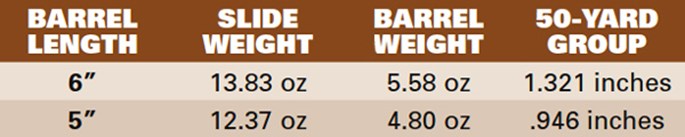
Testing was conducted with a Sams Custom Gunworks barrel test fixture. Ammunition used was Winchester Super Match .38 Special with 148-grain lead wadcutter in 10-shot groups.
Shootability
There are two advantages to shooting a six-inch barrel/slide pistol. If mechanical sights are used, the shooter has the advantage of a longer sigh radius, which amplifies changes in the sight picture for a more refined hold. Perhaps the biggest advantage to the shooter is a reduction of felt recoil. This is the same perception created with the added weight of a slide-mounted scope on a five-inch slide. The goal has always been to fire a .45 with the recoil of a .22 LR! Other devices such as compensators (not very effective with a .45 ACP due to low pressure) are used to control muzzle flip, but are not allowed in certain matches.
A six-inch slide makes the muzzle heavier, which is a personal choice of the shooter. The bottom line for me: I believe the mechanical disadvantages of the six-inch slide/barrel would cause me to prefer a five-inch setup. Of course, the ultimate decision will be made by the individual and his or her requirements.
- Mechanical function and reliability
- Accuracy—What does the target “say?”
- Shootability—How does each configuration perform in the hands of the shooter?
Here’s a refresher on the cycling of a semi-automatic pistol.
Mechanical
The first aspect, mechanical performance, is fairly easy to evaluate. Using a five-inch barrel as a baseline, anytime more mass or weight is added (longer barrel) to the moving parts of a semi-auto pistol, it requires either increasing the internal cartridge pressure or reducing recoil spring resistance to maintain cycle timing. The factors involved in the rearward movement of the slide upon cartridge detonation are:
- Rearward momentum of the slide and nearly simultaneous unlocking of the upper and lower barrel/slide lugs
- Extraction of cartridge case from the chamber
- Hammer cocked by slide against the pressure of the mainspring
- Ejection of the fired case
On a properly built precision pistol, there should be a “hard fit” between the barrel bushing inside diameter (ID) and barrel outside diameter (OD); slide stop pin and bottom barrel lug; and slide breech face and barrel hood. For ultimate precision, these three interfaces need to be fitted precisely with a “touch fit” (lapped) tolerance. Combined, these three areas result in friction. To make the point, I could remove the recoil spring from a precision-built pistol and actually measure the force necessary to unlock the gun from the in-battery portion of the cycle. With a properly built pistol, the force would be substantial. Now, to create the force necessary to unlock and cycle the slide rearward, it would require either an increase in chamber pressure or a reduction of recoil spring/ main spring weight. For argument’s sake, we could also decrease the tolerances between the previously described components, but this would decrease accuracy.
So far I’ve discussed rearward movement (recoil). Now for forward movement. Once the slide has reached maximum rearward movement, the return to battery (forward) is accomplished solely by the force generated by the compressed recoil spring. As the slide begins to move forward, the disconnector rail on the bottom of the slide picks-up the next cartridge from the magazine. The cartridge rim slides upward along the breech face and underneath the extractor claw. The bullet nose strikes and slides up the frame/barrel feed ramp and into the chamber. At this point, the bottom barrel lug, slide stop pin, upper barrel lugs and barrel/barrel bushing all mate together. Once again, it requires a recoil spring with sufficient power to accomplish this, and a change of barrel length alters the balance of weight. If we lighten the recoil spring, we will also need to loosen the fitting areas that make the pistol accurate. Some calibers work better than others because of the forces they generate. For example, .45s and .38 Supers are not as greatly affected as would be .38 Special or 9mm cartridges. Adding the weight of a scope, mount and rings to the slide or a heavy sight rail magnifies the problem severely.
Certain modifications can be done to counteract slide weight such as removing material, either internally or externally. A sight rib could also be machined to remove weight and a scope could be moved from a slide mount to a frame mount. You will also find that ammunition that cycles well in hotter temperatures will not cycle the same in colder temperatures. And while all this is going on, ejection reliability will change if not properly tuned to the final build.
So how is all this affected by changing the barrel length? To circumvent the weight problem of a longer, six-inch barrel and heavier slide, the longer barrel can be installed in a five-inch slide. However, testing has proved this to have negligible effect.
Target Feedback
Accuracy testing with a six-inch barrel resulted in an approximate 30 FPS drop in velocity when the same barrel was shortened to five inches. Surprising to some, accuracy actually improved by ⅜ inch (.375) with the shorter barrel. This was likely due to a balance of velocity and stabilization.
Testing was conducted with a Sams Custom Gunworks barrel test fixture. Ammunition used was Winchester Super Match .38 Special with 148-grain lead wadcutter in 10-shot groups.
Shootability
There are two advantages to shooting a six-inch barrel/slide pistol. If mechanical sights are used, the shooter has the advantage of a longer sigh radius, which amplifies changes in the sight picture for a more refined hold. Perhaps the biggest advantage to the shooter is a reduction of felt recoil. This is the same perception created with the added weight of a slide-mounted scope on a five-inch slide. The goal has always been to fire a .45 with the recoil of a .22 LR! Other devices such as compensators (not very effective with a .45 ACP due to low pressure) are used to control muzzle flip, but are not allowed in certain matches.
A six-inch slide makes the muzzle heavier, which is a personal choice of the shooter. The bottom line for me: I believe the mechanical disadvantages of the six-inch slide/barrel would cause me to prefer a five-inch setup. Of course, the ultimate decision will be made by the individual and his or her requirements.
Most Popular