WARNING: All technical data in this publication, especially for handloading, reflect the limited experience of individuals using specific tools, products, equipment and components under specific conditions and circumstances not necessarily reported in the article and over which the National Rifle Association (NRA) has no control. The data has not otherwise been tested or verified by the NRA. The NRA, its agents, officers and employees accept no responsibility for the results obtained by persons using such data and disclaim all liability for any consequential injuries or damages.
Previously, we reviewed how to obtain match Winning accuracy from combat-grade brass. Read part one, part two and part three if you missed them.
Sorting of bullets for extreme long-range accuracy is not difficult to do, but some background in theory is needed. In this article, we will begin with the basics and end with “extreme bullet sorting,” which we've long found beneficial to our long-range rifle accuracy. Using this technique, a capable competitor can shoot a 1.319-inch five-shot group at 1000 yards.
First, the vast majority of the centerfire rifle ammo our teams use does NOT employ sorted bullets. We do test samples of each new bullet lot at full distance before it is fielded to the teams, to ensure a high level of accuracy. Excellent rifle accuracy can easily be obtained using standard, high-quality match bullets without sorting. So, unless you have a specific NEED to sort bullets, feel free to add points to your score through practice, rather than obsessively fretting about your bullets!
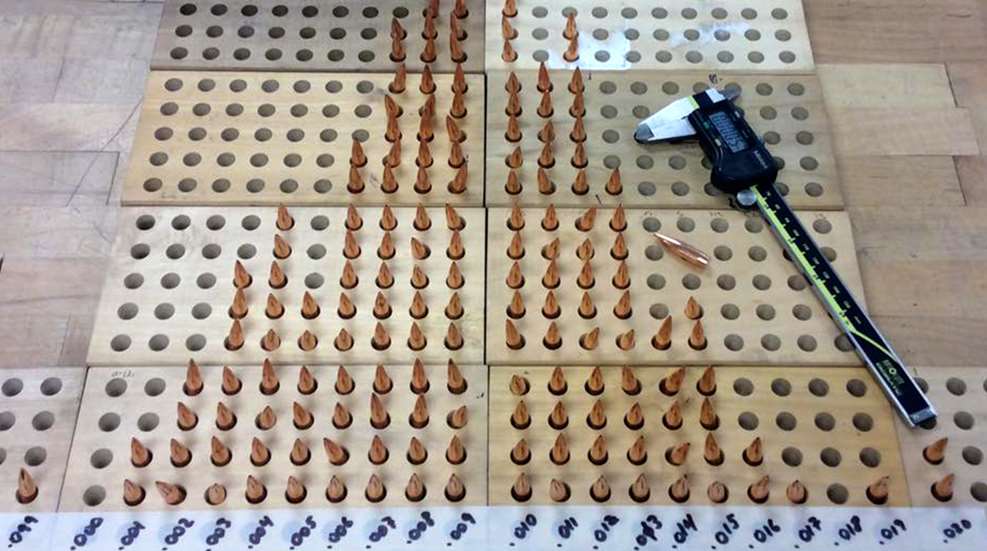
Here at the U.S. Army Marksmanship Unit’s (AMU) handloading shop, we only sort individual bullets for the most demanding long-range applications and competitions. Only the most accurate rifles and shooters can fully exploit the benefits of this technique. The basic sorting process involves measuring the Overall Length (OAL) of the bullets, and grouping them in 0.001 inch increments. It's not unusual to find lots of match bullets that vary as much as 0.015-0.020 inch length throughout the lot, although lots with much less variation are seen as well. Even in bullet lots with 0.015 inch OAL variation, the bullet base-to-ogive length will show much less variation. Hence, our basic sort is by bullet OAL. One obvious benefit of sorting is easily seen in the below photo. The few bullets that are VERY different from the average are culled out, reducing probable fliers.
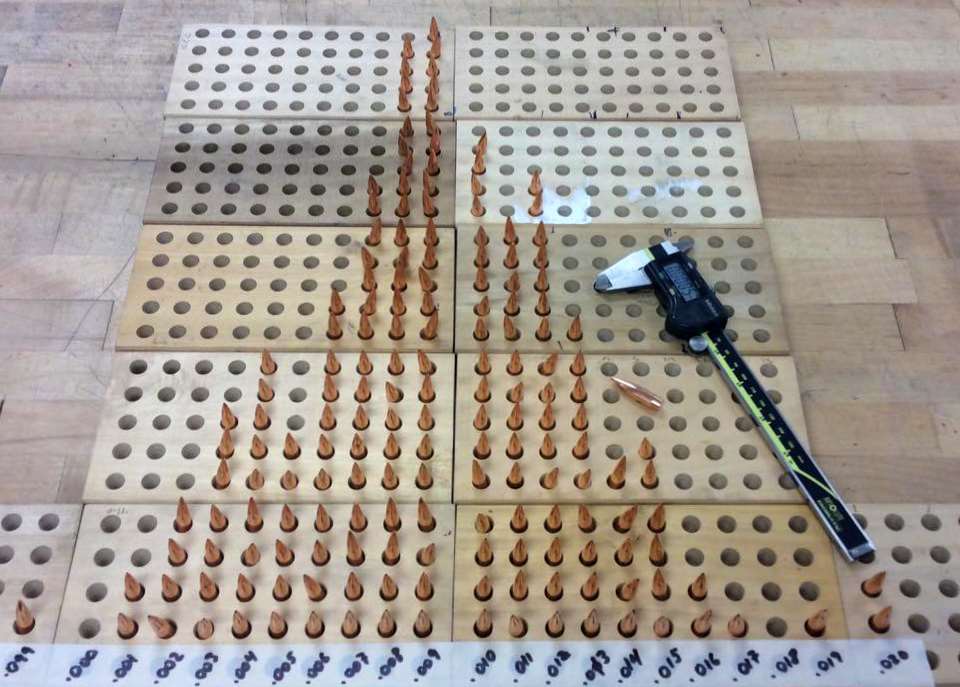
So, where to begin? How does one know what OAL increments to use when sorting? The answer is simple. As each lot of bullets is unique in its' OAL distribution, it's best to sample your bullet lot and see how they are distributed. In the above photo, you will see a set of loading trays with a strip of masking tape running along the bottom. Each vertical row of holes is numbered in 0.001 inch increments corresponding to the bullets' OAL. A digital caliper makes this task much easier. As each bullet is measured, it is placed in the line of holes for its’ OAL, and gradually, a roughly bell-shaped curve begins to form. The photo posted here is of a bullet sample set (“histogram”) in the early stages.
Note that near the center, bullets are much more plentiful than near the edges. At the extreme edges, there are a few that differ markedly from the average, and these make great chronograph or sighting-in fodder. We recommend using a sample of 200 bullets from your lot, and 300 is even better. Some bullet lots are very consistent, with a tall, narrow band of highly-uniform bullets clustered together over just a few thousandths spread. Other lots will show a long, relatively flat curve (less uniform), and you may also see curves with 2 or more “spikes” separated by several 0.001 inch OAL increments.
Now we can see what percentages of bullets will fall into very uniform groups. How do we know what size OAL groups for sorting? The answer is, it depends on your application.
We'll close for now, but tune in for our next article discussing this topic, where we will decide how best to group your sorted bullets. Until next time, good luck to all of you, and “favor center!”
SSUSA thanks the U.S. Army Marksmanship Unit for allowing the reprint of this article.
Most Popular