Wildcatting—making cartridges not produced by any major ammunition manufacturer—used to be staggeringly popular, especially among rifle enthusiasts seeking precision for competition. While resulting in successful cartridges that remain with us today, some attempts at logically predicting cartridge performance didn’t pan out. One you may never have heard about was Speer’s “Index Number” system that attempted to correlate cartridge specifics of bullet and case volume to assign the cartridge a smokeless powder with the “most efficient” burning.
Necking up and down
Quite a few of today’s popular cartridges didn’t come from the factory, rather they went to the factory as wildcats and came out with new names. One of the oldest is the .30-06 necked down to .25 caliber by several independent inventors and variously labelled the 25 High Power, 25 Neidner, 25 Whelen and today, simply the .25-06. In the early 1920s, wildcatters necked up the same case to take a .35 caliber bullet. James Howe of Griffin & Howe fame got Col. Whelen’s name to stick to that one as the 35 Whelen. Doubtless, you could name several cartridges based on just the .308 Win. case (itself derived by shortening the .30-06 case) that wildcatters also necked up and down to see what it would do.
Wildcatters contributed much to the understanding of ballistics, as well as accomplishing a lot of the grunt work for cartridge manufacturers, both in cartridge development and in finding out what shooters really want. Intelligent wildcatting is not haphazard. Since the invention of the self-contained metallic cartridge men have been trying to understand and correlate all the complex physics involved in launching bullets with speed and precision, because once we understand the rules, then development can proceed logically with predictable results. To this end we’ve seen the development of useful mathematical predictors like the Greenhill formula for rifling twist rates, sectional density for bullet penetration and ballistic coefficients for bullet aerodynamics.
The “Index Number”
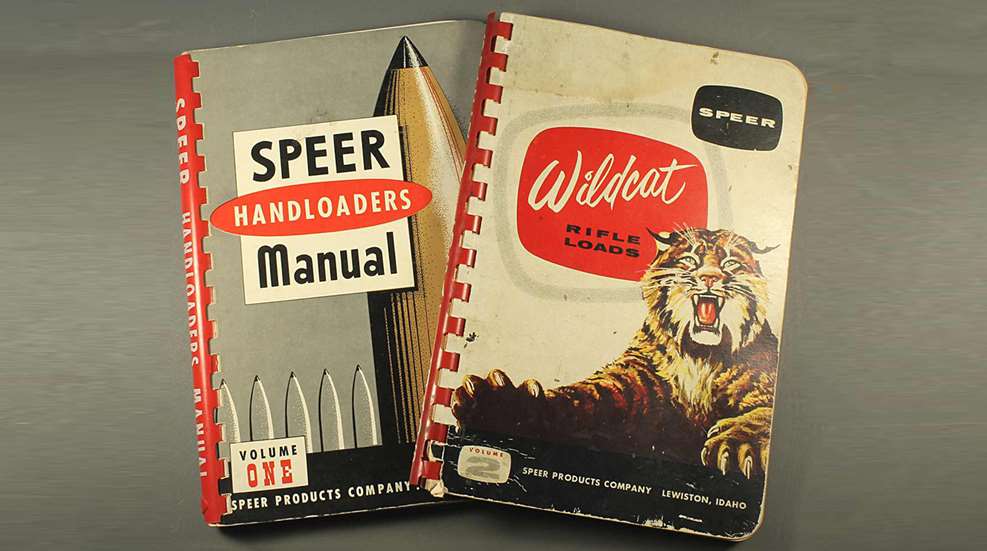
When creating wildcats was still widely popular, Speer’s Wildcat Rifle Loads (1956) offered handloaders the “Index Number” concept for predetermining the “most efficient” smokeless powder to use, given case volume, bullet diameter and bullet sectional density (SD). Speer’s formula to determine their Index Number is:
(V ÷ G3) x (W ÷ d2)
There’s no need for eyes to glaze over like that first day in Mrs. Whatsername’s seventh grade algebra class—all the variables in this formula are familiar to us as knowledgeable shooters, and we can punch the numbers into any cellphone or hand calculator to get an answer.
V = case volume in cubic inches
G3= bullet diameter, cubed
W = weight of the bullet in grains, divided by 7000 (the number of grains in a pound)
d2 = diameter of the bullet, squared
Note (W ÷ d2) determines bullet SD, but most modern bullet manufacturer reloading manuals list SD outright. To find case volume, weigh an empty case, then fill it with water to the neck/shoulder junction and weigh it again; subtract the empty weight from the full weight to find the difference, then divide the difference by 252 (the weight of one cubic inch of water, in grains). Voilà—case volume in cubic inches.
We then apply the resulting Index Number to a chart listing a baker’s dozen of smokeless powders in the Speer Wildcat Rifle Loads manual (see photo). Powders appear on the vertical axis on the left, Index Number on the horizontal axis. Those powders that fall within the crosshatched area of the chart where the Index Number intersects it have burn rates most efficient for that case/bullet combination, according to the theory. Wildcat Rifle Loads explains, “The most efficient powder is the one that will show maximum allowable pressures along with maximum velocity without filling the case to a level beyond the shoulder.” Such powder is also completely consumed before the bullet exits the muzzle.
Theory vs. data
How does the theory compare to load data? It seems most logical and consistent in this exercise to compare the indicated powders on the Speer Wildcat Rifle Loads chart with loads in Speer’s contemporary 1954 Handloaders Manual Volume One reloading manual. Using the familiar-to-us but then-new .308 Win. as an example, the first part of the formula results in 6.33, and utilizing Speer’s own 150-grain bullet provides an SD of .225. Multiplying those two numbers in accordance with the formula gives an Index Number of 1.42.
The powders that appear in both Speer’s Handloaders Manual Volume One and in the cross-hatched area of Index Number 1.42 in the Wildcat Rifle Loads chart are IMR 4064 and the long-discontinued Hi Vel 2 and Ball-C. Speer’s Handloaders Manual Volume One lists those powders, plus IMRs 4320, 4895, 3031 and 4198 for this bullet/load combination, all of which fall outside the chart’s “most efficient” crosshatched parameters (IMR 3031 by a hair).
Again, according to Wildcat Rifle Reloads, the most efficient powder for any case/bullet combination will consume the entire charge before the bullet exits the muzzle while also imparting the highest possible velocity with safe pressure. While IMR 4064 may accomplish much of that under a 150-grain bullet when filled to the shoulder of a .308 Win. case, note in the data table that IMR 4064 does not produce the highest velocity. And the load data utilizing powders other than IMR 4064 obviously indicate that the Index Number does not predict an unwavering correlation between “most efficient” powder and cartridge precision (accuracy), either. That is, other powders and loads may outperform the “most efficient” powder in velocity or precision.
It appears then, that the Index Number pursuit proves that there is no direct, immutable correlation between “most efficient” powder and best cartridge performance—at least, not expressed in seventh grade algebra. But then why did Speer publish the Index Number theory—as a velocity touchstone, a simple guide for wildcatters entering unknown territory? Was it a grasp at the handloader’s chimera that “most efficient” powders somehow should equate to highest performance? Did Speer pursue the Index Number any further? And who can we credit with creating the concept?
Alas, those answers may already be lost to history as the sole mention of the Index Number I could find is the source, my throwback copy of Speer’s Wildcat Rifle Loads. I recently posed the question to Speer in a couple of e-mails, but received only an e-shrug in reply. Vernon and Raymond Speer’s original Lewiston, ID, company is now absorbed into a chain of subsidiaries and apparently there’s no one left there who knows anything about the Index Number—you and I now know as much about it as does Speer. We can surmise that the concept isn’t really viable after all. Still, that the Index Number existed at all for the handloader illustrates the one-time immense popularity of wildcatting, and Speer’s part in it.