** When you buy products through the links on our site, we may earn a commission that supports NRA's mission to protect, preserve and defend the Second Amendment. **
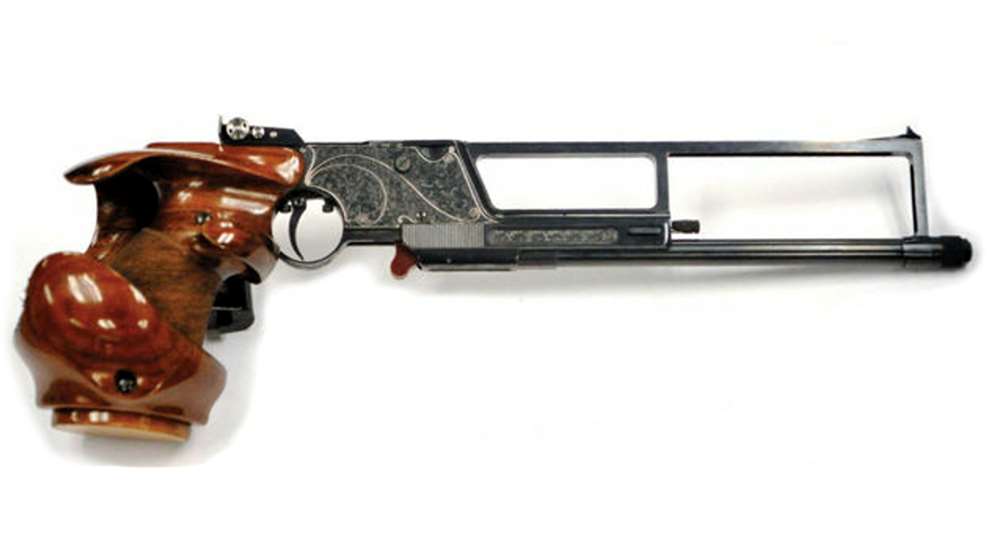
Even after being banned from international competition in 1956, production continued on this revolutionary gun. Below is Pat Cherry’s interesting story about how he became an owner of one of the 125 guns produced.
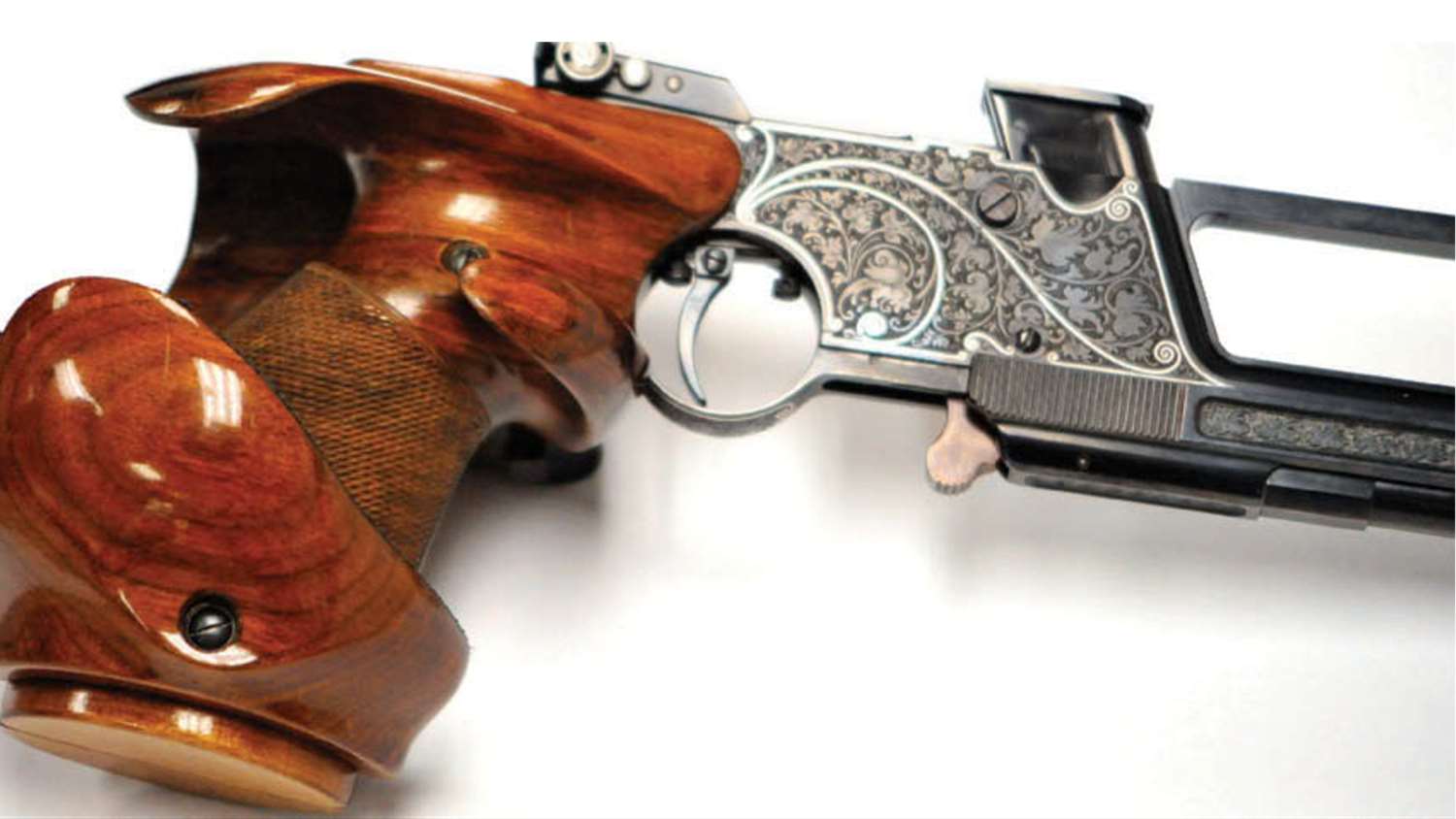 While on his way to Camp Perry in the summer of 2009, OSU Pistol Coach Jim Sweeney happened onto this pistol on consignment and called me. After talking with the store to verify what they had, Gary Conway and I drove up see the gun for ourselves. The shop owner stated that he had had it for several months and I was only the third person to show any interest in it. Feeling such a gun was worth more than the asking price, I bit the bullet and purchased it. I wrote to the Tula Arms Museum in Russia and found some information on it but they had no idea who the original owner was.
The engraved MC-3 models were made for the Soviet Government and given to dignitaries. I had known about the pistol since its use in the 1956 Olympics but had never seen one. Although I have been to several Russian gun museums, I had never seen an MC-3 or the earlier prototype MC-1 or MC-2. Tula is the only museum I know to have one on display, although there may be others I have missed.
What follows are excerpts from my research and some translated extracts from an article by Victor Ron (Tula Museum) and Alexei Aleskovskii.
Even though only 125 copies of the MC-3 sports model were produced in the USSR, this pistol was far ahead of its time and nearly revolutionized competitive shooting. In the years that followed World War II, Soviet shooting enthusiasts had no choice but to learn gunsmithing, as no pistol suitable for high-precision target shooting was produced domestically. This, indirectly, was aided by law enforcement officers, almost all of whom were recent war veterans who did not consider a sports pistol a danger to the public. This tolerance facilitated the development of the USSR sports gun industry. In the early 1950’s, Efim Leont’evich Khaidurov began production of his remarkable pistols. Sportsmen often modified their pistol by adding weights beneath the barrel and altering the frame silhouette by sawing off pieces to raise the hand closer to the barrel axis. Quoting E. L. Khaidurov, “there had not been a part of the pistol that escaped the hands of a shooter on the mission to improve his firearm.”
In 1954 Soviet shooter P. K. Sheptarsky proposed the design for use in MP-8 matches (speed shooting five silhouette targets from 25 meters). Development of the new MC-3 free-style model using 5.6mm (.22 RF) caliber cartridges began at the “Tula Central Constructor Bureau of the Sports and Hunting Weaponry” and was replicated by leading builders of the time.
For reduced recoil, the barrel and slide are located in the lower part of the frame, below the trigger pin level. The action uses the energy of free recoil. Cocking the hammer, locking and unlocking the barrel channel, feeding, chambering and extraction are all done automatically. The trigger weight and length are adjustable. The 5-round magazine is located above the barrel. The orthopedic hand stocks have an adjustable hand support and were made of a high quality walnut.
The MC-3 Record weighs 3.13 pounds with an overall length of 19.29 inches. Barrel length is 8.66 inches for a sight radius of 13.77 inches. The only information I have on accuracy are reported group sizes using the two popular 6mm cartridges. Accuracy at 25 meters was “no more than .98 inches for the silhouette cartridge and .82 inches for the ‘Silhouette-M.’”
 The MC-3 Record pistol was primarily used by Soviet athletes in International shooting matches called MP-8. In 1956 in Budapest (Hungary), V. Nasonov fired a 592/600, beating the previous record by five points. Soon afterwards, E. Khaidurov raised the DOSAAF [Paramilitary society in the Soviet Union that promoted marksmanship through competitive shooting] record of 293 to 299. Later that year, V. Sorokin set a world record with an MC-3 Record, after which the International Shooting Union (ISU) forbade the use of the MC-3 in international competitions. It did so by adding this language to its rulebook: “The axis of a gun barrel shall not be lower than the upper part of the shooter’s wrist.”
With that, the future of the MC-3 Record came to an end. The Record was produced in the custom shop at Tula in small numbers: 14 in 1951-1955, 111 in 1956-1960, and a single pistol in 1961-1965. (Although Tula states that 125 such pistols were made, their records indicate 126.) As is evident from these production numbers, despite the 1956 ban, shooters held on to the hope that the gun would be allowed to return to competitive shooting. Unfortunately, they hoped in vain. [Editor’s note: Other than one or two vintage Derringers, we believe this was the first production gun of its kind—the first upside down gun.]
Close-up of the presentation model MC-3. Note the magazine that loaded from the top, as well as the fine engraving, silver inlay and polished walnut hand stocks.
The engraved MC-3 models were made for the Soviet Government and given to dignitaries. I had known about the pistol since its use in the 1956 Olympics but had never seen one. Although I have been to several Russian gun museums, I had never seen an MC-3 or the earlier prototype MC-1 or MC-2. Tula is the only museum I know to have one on display, although there may be others I have missed.
What follows are excerpts from my research and some translated extracts from an article by Victor Ron (Tula Museum) and Alexei Aleskovskii.
Even though only 125 copies of the MC-3 sports model were produced in the USSR, this pistol was far ahead of its time and nearly revolutionized competitive shooting. In the years that followed World War II, Soviet shooting enthusiasts had no choice but to learn gunsmithing, as no pistol suitable for high-precision target shooting was produced domestically. This, indirectly, was aided by law enforcement officers, almost all of whom were recent war veterans who did not consider a sports pistol a danger to the public. This tolerance facilitated the development of the USSR sports gun industry. In the early 1950’s, Efim Leont’evich Khaidurov began production of his remarkable pistols. Sportsmen often modified their pistol by adding weights beneath the barrel and altering the frame silhouette by sawing off pieces to raise the hand closer to the barrel axis. Quoting E. L. Khaidurov, “there had not been a part of the pistol that escaped the hands of a shooter on the mission to improve his firearm.”
In 1954 Soviet shooter P. K. Sheptarsky proposed the design for use in MP-8 matches (speed shooting five silhouette targets from 25 meters). Development of the new MC-3 free-style model using 5.6mm (.22 RF) caliber cartridges began at the “Tula Central Constructor Bureau of the Sports and Hunting Weaponry” and was replicated by leading builders of the time.
For reduced recoil, the barrel and slide are located in the lower part of the frame, below the trigger pin level. The action uses the energy of free recoil. Cocking the hammer, locking and unlocking the barrel channel, feeding, chambering and extraction are all done automatically. The trigger weight and length are adjustable. The 5-round magazine is located above the barrel. The orthopedic hand stocks have an adjustable hand support and were made of a high quality walnut.
The MC-3 Record weighs 3.13 pounds with an overall length of 19.29 inches. Barrel length is 8.66 inches for a sight radius of 13.77 inches. The only information I have on accuracy are reported group sizes using the two popular 6mm cartridges. Accuracy at 25 meters was “no more than .98 inches for the silhouette cartridge and .82 inches for the ‘Silhouette-M.’”
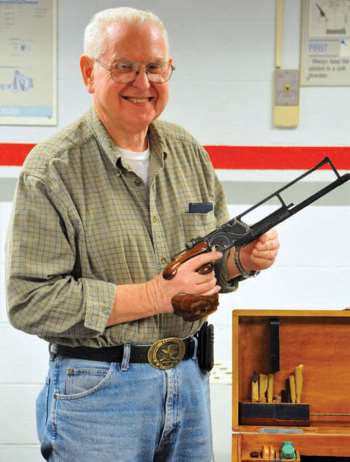
Author with one of only 125 Russian MC-3 Record pistols produced before being banned from International competition.
With that, the future of the MC-3 Record came to an end. The Record was produced in the custom shop at Tula in small numbers: 14 in 1951-1955, 111 in 1956-1960, and a single pistol in 1961-1965. (Although Tula states that 125 such pistols were made, their records indicate 126.) As is evident from these production numbers, despite the 1956 ban, shooters held on to the hope that the gun would be allowed to return to competitive shooting. Unfortunately, they hoped in vain. [Editor’s note: Other than one or two vintage Derringers, we believe this was the first production gun of its kind—the first upside down gun.]
Most Popular