
“Tangent,” “secant” and “ogive” are terms of calculus, trigonometry and geometry, and most shooters and handloaders are less interested in advanced mathematics than we are in maximizing enjoyment in our sport. But bullet ballistics is science, not magic or luck, and understanding the principles behind our practices can help aid our success, so let’s take a quick look at these terms—without the complex formulae.
These terms describing the shape of a bullet’s forward section have been the purview of the precision rifle shooter, though they are today being added to the lexicon of hunters extending their effective range for bagging game animals. But what’s the difference between bullets of tangent and secant ogive, really? How does one measure the shape of a bullet’s ogive? For that matter, what’s a bullet ogive?
Ogives and Circles
A rifle bullet’s ogive is not a single point on the bullet, rather it is the entire forward portion of the bullet that tapers from the bullet’s forward-most point of fullest diameter (bearing surface) all the way out to the bullet’s meplat (tip). A tangent ogive is shorter in length than a secant ogive, making for a bullet with a lower ballistic coefficient and more drag. A longer secant ogive offers improved aerodynamic properties of higher BC and less drag over a shorter tangent ogive, but is not always a better choice for other reasons explained here.
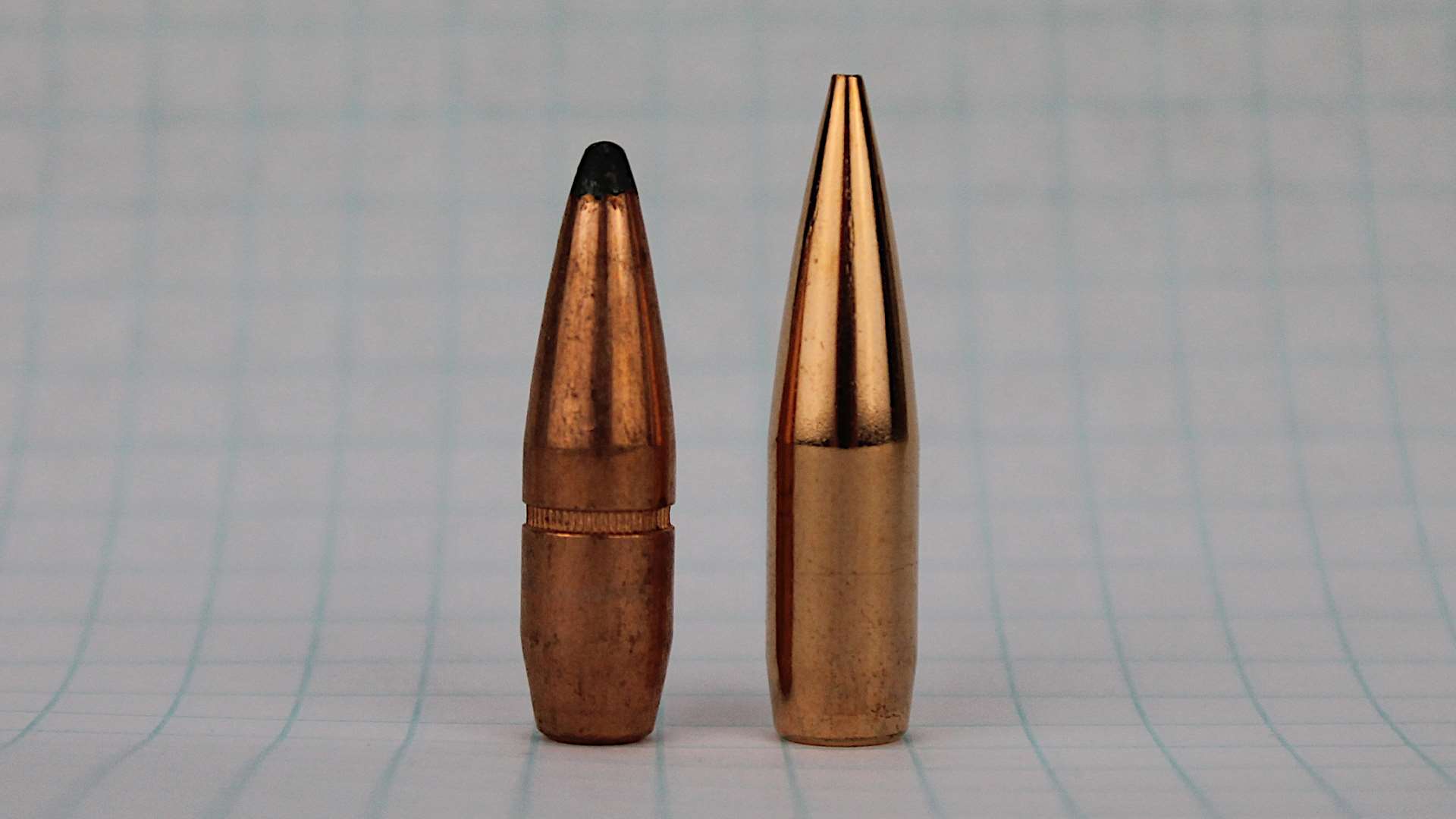
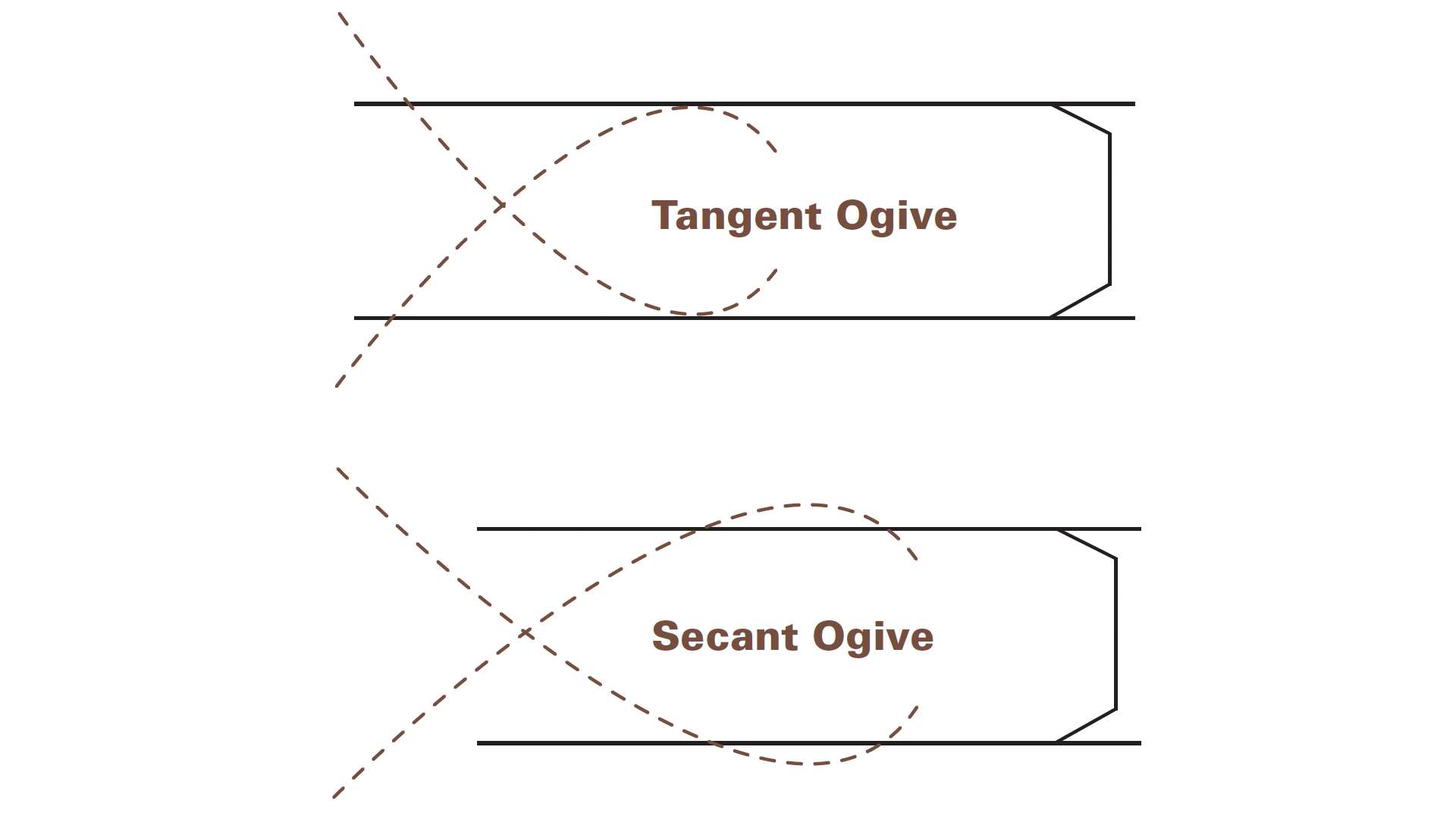
Characterizing the ogive shape is derived mathematically from the arcs of two circles, the radius of the bullet at the meplat, and the radius of the ogive where it meets the bearing surface (the length and curve of the ogive are also in the calculation). This is where the terms “tangent” and “secant” come in. Each refers to how a straight line intersects an arc at one (tangent) point or two or more (secant) points. A straight line crosses the tangent ogive’s arc once, and crosses the secant ogive’s arc twice. That’s it. Math aside, what’s important to shooters is that we understand the pros and cons of tangent and secant ogive bullets so that we employ them properly.
Tradeoffs
Life decisions and physics are both full of tradeoffs, and while much improved aerodynamically, the downside to the secant ogive bullet is that it is very sensitive to seating depth—that is, to how far away from the rifling lands it starts its trip downrange. Starting several thousandths of an inch closer or farther from the rifling than optimum results in an increase in bullet dispersion (group size) at the target. Rifle chamber throats typically aren’t configured for secant ogive bullets, which may account for some of this bullet’s fussiness.
The tangent ogive bullet is less sensitive and more forgiving in this regard, which is why some rifles shoot tangent ogive bullets with greater precision than the “better” secant ogive bullet. For the non-handloader who cannot adjust bullet seating depth, shooting factory ammo loaded with tangent ogive bullets may be the best choice—this is something that must be determined for each individual rifle.
Note that secant ogive bullets are necessarily longer by design than tangent ogive bullets, so for optimum stabilization secant ogive bullets usually require a faster rifling twist rate than do tangent ogive bullets. Something to keep in mind when re-barreling or selecting a new competition rifle is whether or not you wish to shoot secant ogive bullets.
Hybrid Compromise
As it turns out, a compromise between the tangent and secant ogive seems to offer the best features of both while minimizing the drawbacks of each. This is the “hybrid” ogive, which starts off as a tangent ogive just in front of the bullet’s bearing surface, then quickly transitions to a secant ogive the rest of the way to the bullet meplat. The hybrid ogive provides the excellent aerodynamics of the secant ogive along with the tangent ogive’s lesser sensitivity to seating depth. Still, hybrid ogive bullets will shoot best with a bit of fine-tuning of seating depth, and may benefit from a faster twist rate for stabilization.
Among major manufacturers, Berger Bullets, Hornady and Nosler all offer hybrid ogive bullets (and some loaded ammunition) for competition shooting, and Berger’s Classic Hunter, Hornady’s ELD-X and Nosler’s AccuBond Long Range are hybrid expanding bullets intended for hunting. For more specific information and caliber availability, visit their websites.